Monday, September 06, 2010

At the Chawk Iftar Market

Chawk Bazar in old Dhaka is the largest wholesale market in Bangladesh. On a normal weekday it sees frenetic activity as trucks, pushcarts and people push, pull, pedal, and carry large quantities of merchandise ranging from shoes to candy to clothing to pots and pans against a backdrop of wheeling and dealing by the canny Dhakaiya businessmen.

During Ramzan, however, the commercial activity grinds to a halt each afternoon as Chawk hosts the largest Iftar market in Dhaka.

Having been here before, I know to get an early start. It is impossible to get all the way to Chawk by car (unless one wants to single-handedly cause a traffic jam) so I leave mine two kilometers away and walk. Passing the far corner of the Central Jail’s wall I turn right into Chawk square. The market is still a hundred feet away, but I can already smell the fusion of flavors – spicy, grilled, fried, pungent. I encounter the dates – a dozen sellers offering them in different states of congealment, from the deep-brown gooey Khejur oozing syrup to bone-dry Khormas and orange-yellow unripe dates. As I pass them, I feel something on the backside of my arm and discover a large bee making himself comfortable. The dates have attracted hundreds of bees who feast on the sticky syrup. This does not deter the shoppers, though, and one laughs when I manically shake my arm to dislodge the bee. I ask a seller where the bees come from. “They come from all over, the dates are like a gift of Allah to them,” he says.

Puzzling over where bees get their pollen in urban, almost treeless old Dhaka, I reach the police point of Chawk proper. The Iftar market stretches left from here, taking up the street’s breadth. The rows of tables on either side of the street holding the food run for three blocks.

The fresh fruits and vegetables come first as several types of melons, papayas, cucumbers, oranges, apples, and tomatoes all sell briskly. Next up are the meat items: there are whole roast chicken and quails, roast legs of lamb, giant cauldrons of Haleem, a beef stew made with seven types of lentils, and various kababs. Among the specialties of old Dhaka is the Shutli Kabab (Shutli means “in a thread.”) It is a large cylindrical patty of meat tied together by a thread running through its middle. It is cooked over coal, then sold in slices.

I overhear one Shutli vendor grumbling after an unfruitful haggling session with a customer. “Where do these cheap people come from? He wants to eat old Dhaka Shutli Kabab but pay only Tk 300 for a kg. Well, if he wants to eat my Shutli Kabab, it is going to cost him Tk 500. That’s because it is the best,” he snorts.

At 4pm Iftar is still two hours away but the crowd is thick. When not stopping to buy, people walk on their left, but there is no way to avoid the pushing and shoving, and every time I stop to take a picture I am acutely aware that a dozen people walking in file behind me have also stopped mid-stride. Crowd, heat, flavors, and humidity push me into sensory overload. Sweat drenches my shirt and my head feels light. Once in a while a harried looking woman comes by braving the crowds of mostly men. I spy a little girl, perhaps 7 or 8, who has come here wearing a Burkha. She waits patiently, eyeing the goodies, as her father buys some Peyajus.

A little further up are three or four tables selling a concoction called “Boro Baper Polai Khai.” (Roughly translated, “Older father’s son eats” and I suspect the strange name contributes to its popularity.) This is a mixture of several items including puffed rice (muri), chick peas (chhola), pieces of boneless chicken roast, boiled eggs, spices (particularly cumin), curried liver, chunks of Shutli kabab. The master mixer stands at the middle of the table as his assistants debone whole roast chickens and cut the other meats into bite size pieces. When everything is ready, the master makes the final mix into yet another batch that will satisfy the customers waiting eagerly in line. At least three different vendors offer this dish, each claiming to be the original inventor.

Large deep-fryers have been set up sporadically on the road and are frying Jilapis, Peyajus, Pakoras, while Sheek and Boti Kababs grill away at open barbecues, cooks patiently fanning the coals with a hand-fan. A Chawk specialty is the giant Jilapi weighing one whole kilogram. As I watch a cook squeeze the Jilapi dough into a fryer, I hear voices from below: under a nearby table three men with rolling pins are rolling out tiny round breads to be fried and eaten with Ghughni, a salad of chick peas. As I watch, one of them pops a chunk of fried bread into his mouth. I blink in disbelief. Is he secretly munching away during his fast? But he repeats, quite openly, and with it goes another of my stereotypes. In conservative old Dhaka, I thought, openly eating during Ramzan would be a big no-no.

I run into a man sitting next to an empty basket, watching the hustle and bustle. "Did you sell everything?" I ask. "Yes, sold all my Bangi's," he said, beaming contentedly, "started at noon today." A Bangi is a type of melon with a coarse sandy texture.

After some more wandering among the market and its devotees I decide I have had enough. The Chawk market is a memorable if intense experience, but like enjoying other good things in life, I decide moderation is key and leave with the million flavors tickling my nostrils.

[Note: The photos below -and the story - are from multiple visits to the Market.}

Old Dhaka Style Jilapi


Endless Row of Tables


Checking Out Them Papayas


Frying Some Goodies


Shutli Kabab Salesman (not the unhappy one)


Rolling the Small Breads


Mixing up Boro Baper Polai Khai


A Small Argument


A Shared Joke


Camaraderie


Little Burkha Girl


View From Overhead


Delivering the Goods While Helper Boy Looks On


Happy Seller Who Sold All His Melons

Saturday, August 14, 2010

Distinctive Istanbul

Photos of Istanbul from a recent trip.

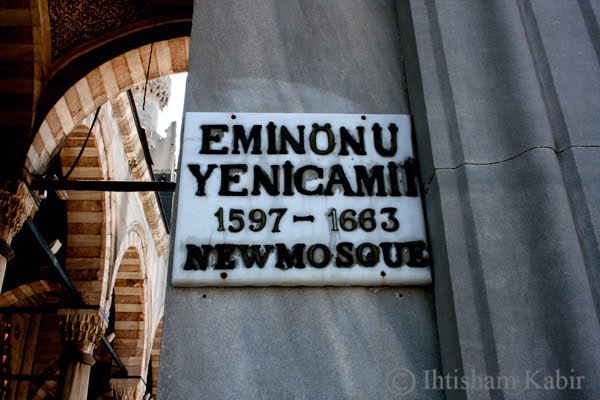
Where else would a 400-year mosque be considered "new?"


The same mosque from a distance. All the mosques follow basically the same beautiful pattern (invented by architect Mimar Sinan who got his first big break when he built a bridge in record time so the impatient Sultan could go conquer a neighboring nation quickly). Number of minars and domes vary from mosque to mosque.


Inside the Aya Sofia, which started as a Church (2000 years ago), becoming a Mosque after the Ottomans conquered Constantinople, and then became a Museum during Ataturk. I found the face (lower left) most curious - was it there during the time it was a Mosque? Only this face remains, but the other three in each corner of the dome have been erased. Hmmm.


Istanbul Cemeteries have lots of roses.


Istanbul skyline from Galata Bridge (on the Bosphorus.)


Inside an off-campus building of Istanbul University in Beyoglu.


Clothing is big business in Istanbul. They use lots of mannequins, sultry...


...mysterious...


...and you could easily lose your head over them!


Oh, here is how the Turks do World Cup flags...


... and other things.


Inside the Topkapi Palace, this was essentially the Sultan's bedroom...


...and the toilet.


Many cafes in Istanbul offer board games to entice customers.


I was expecting Turkish coffee, but found the Turks like to drink tea, like our "Rong Cha".


What can I say, one of the great cities of the world. Hope I can go again someday.

Sunday, July 11, 2010

Silence of the Fans

The World Cup has been in full swing for a few days. Looking for related street art I find myself in Sutrapur in old Dhaka. I have entered a serious football fan zone with flags waving overhead and walls covered with street art. I take my time photographing the flags fluttering in the wind, trying to capture them at the right position. A few people stand around watching me. One of them comes up and says, “The best World Cup art is still ahead.” How far? I ask. Right there, just follow me, he beckons. As I follow him, he says, “I am a lowly government servant, but I love football. So I had to have my say.” He introduces himself as Satu.

We walk a few blocks, then into a narrow lane across from Dalpottir More. I have been on this lane before – it splits like the bars of a Y. The light here is difficult so I never got a good picture here. We take the right bar of the Y. Soon Satu is pointing out his three-story house, the last one in the alley.

Satu proudly shows off the Argentine décor on the wall of his house. He says he paid the local street painter Tk. 1700 to paint it. But then I look up and see a Brazil flag on his rooftop. What gives? Is the devoted Mr. Satu really two-faced about his fanhood?

“Oh, that’s nothing. It’s just that one of my renters likes Brazil. So I allowed him a small flag.”

Mr. Satu then offers me a cold drink. However I have many roads to cover, so I thank him for his offer and move on.

At an intersection deep inside Narinda, I find a gorgeous Argentina painting in front of a car-part machine shop. I look at it for a while from across the street and decide to photograph it. I bend down to make sure the photo is not crooked and snap the shutter during a gap between rickshaws and pedestrians.

I am walking away when a voice cuts across sharply from within the shop. It's one of the workers and he steps out to point. “Aren’t you going to take a picture of the other one there?"

Ooops. That was a nice Brazil painting diagonally across the street. I had missed it completely. And this man was a diehard Brazil fan. Of course I had to photograph it. What was I thinking? “Thank you, Bhaiya, for pointing it out. I suppose you are a Brazil fan?” The guy nods. “Then how come there is this big Argentina painting in front of your shop?” “That’s the owner’s,” he replies sullenly, and pops back into the shop.

A few days later I am in the same neighborhood. Only a few days, but it seems like the world has turned upside down for football fans. That’s because Brazil and Argentina have both lost ignominiously.

I search for the Brazil and Argentina fans. “Where have they gone? Are they still watching the games?” I ask a man at a tea stall adda. “They have all gone home,” he says, snickering in a most disrespectful way. At this another man pipes in indignantly: “No, no, it is like this. The Brazil fans became German fans because Germany defeated Argentina, and the Argentina fans became Holland fans because Holland defeated Brazil. And some from each side became Spain fans because Spain defeated neither.” Ummm, I see. But what about the final? Are you supporting Spain or Holland. They look at each other, a little lost, like ships on a stormy night trying to find anchor. I suppose the Final will be an anticlimax for Old Dhaka football fans.

Argentina flag in Narinda...


...and a few days later.


Mr Satu in front of his painting.

Monday, June 14, 2010

Nimtoli

To get to Nimtoli you start out at the Chankharpul intersection and head towards the Central Jail on Nazimuddin road. About fifty feet down, there is a road on the left, lined with paper recycling stores. Follow this road for a quarter mile, and you will see a smaller alley to the right. You cannot miss it because of all the black banners hanging from everywhere. This is Nimtoli.

The fire in Nimtoli burned on the night of June 1, two weeks ago, at the T intersection at the end of this alley. It took 142 lives. Many others are still in the hospital.

In the past, I have visited this area, so full of life with a warm neighborhood atmosphere, and taken pictures. Look here, here and here.

However, today it was quiet. People tried to go about their business - kids walked to school, store owners opened up shop, small factories hummed - but the laughter and carefree life that once characterized this area was missing.

I tried to piece together what had happened.

On the third floor of a multi-story apartment building, a dinner party was celebrating the engagement of Runa to Jamil, a ceremony called "Panchini" in Bangla. For the Panchini feast, a chef was cooking old Dhaka style food in large cauldrons outside the entrance of the building. This was around 9pm on June 1st.

Just inside the building (on the ground floor, which is a large garage) was a cache of highly flammable chemicals, used by a nearby factory. Between the cooking and the chemicals was the wall of the building.

As the food cooked - one cauldron on a large gas stove, the other on a large wood-fired stove, both open-air - the walls of the garage heated. Eventually the chemicals caught fire. As fire flared out, two motorcycles parked in front of the building quickly caught fire, as did the large electric transformers overhead.

The fire spread very quickly because the chemicals exploded and flew all over. The house across the street on the south was engulfed. The streets were on fire, preventing people from escaping.

As I looked inside a burned barber shop, I was introduced to Mr. Syed Maqbul Ali, whose wife Fauzia Begum perished in the fire. His flat on top of the barber's is across the street of the six-story apartment on the west.

Mr. Ali showed me inside his flat. He was watching TV when he heard the transformers outside the multi-story building explode. First he ran into his son's room which faced this building. By this time, flying chunks of chemicals, on fire, had entered this room through the window and the room was on fire. He shut the room door and was able to run down the stairs and escape in the nick of time.

His wife, who had gone to attend the party, was not so lucky. She asphyxiated with many others. His two children - a son and a daughter - survived because they were not in the neighborhood.

As I talked to people there, I heard similar stories over and over. A woman, whose brother owned a grocery store, told me that he was found dead - from asphyxiation - over the narrow drain between his store and the street. The owners of a Bakorkhani store had shuttered themselves in when the fire started thinking they would be safe. Instead they perished. Six people from a tin shed house died on a narrow path from their door to the main road, because the road was on fire and there was no escape route. However, the tin shed next to them had an escape route into another alley and those inhabitants all survived. And so on. It is absolutely, totally, heartbreaking.

A lot of things are being written about this fire. The blame game goes on - the narrow streets, perhaps blocking the fire trucks, the person who had stored the chemicals, all the small factories in the area - all the experts are going at it full swing.

Clearly there are no easy answers. You cannot simply shut down all factories in old Dhaka. You cannot make narrow streets wider.

Yet it seems to me that some simple knowledge of the flammability of the material, and transmitting this knowledge to the chefs, could have prevented this disaster. Often these chemicals are imported from China with signs written in Chinglish. If there were large warning signs on the containers in Bangla, could this disaster have been prevented?

And surely new buildings need better to live up to better safety standards.

An ounce of prevention - educating people about disaster risks, and being alert about dangerous situations - could probably go a long way towards preventing the next disaster.

In the meantime the people of Nimtoli try to piece their lives back together. Mr Moqbul's daughter is engaged. But now is not the time to think about his daughter's marriage, he says. He mentioned something about how his wife ran the household, and then seemed at a loss, perhaps trying to sort out how he would cope. And he spoke proudly of his son who has just passed his SSC and started Intermediate classes.

[Update 15 June 2010: About the wedding: days after the fire, the Prime Minister of Bangladesh announced that since Runa's mother had died in the fire and she was left without any guardian, the PM was going to essentially act like guardian and host the wedding at her official residence. As a result, Runa and her beau, her sister Ratna and her fiance, and one other affected couple were married in the Prime Minister's residence at the same time.]

The multi-story building where it all started on the third floor.


View from the top looking east. Multi-story is at the edge of the bottom-left of this photo. No one survived in the house across the street (on right of photo, with the corrugated tin sheets on top.)


Entrance to the multi-story where the cooking was taking place. The sign forbids entrance without permission from authorities.


Burned motorcycles...


...and a rickshaw van's saddle.


The Bakorkhani shop. They shuttered themselves in thinking they could escape, but perished instead.


The tin sheds. Inhabitants of the one on the left (now collapsed) escaped. Ones from the right (with window) were stuck in the narrow path leading out of their house into the road. The brick wall around the left house was of course standing.


The grocery store. Woman said she is the sister of the owner, who was found dead at the drain in front of the store.


Remains of curry and dal at the restaurant next door.


Remains of ceiling fan in the restaurant.


Barber shop downstairs from Syed Moqbul Ali's flat.


Onlookers looking into the barber shop.


Moqbul's son's room.


Mr. Syed Moqbul Ali. The third floor of the six-story is across the street and to his left on the photo. His wife perished at the corner next to that window.

Sunday, May 23, 2010

The Stories of "Killing the Water"

Killing the Water is a collection of twelve short stories by Mahmud Rahman published by Penguin Books. The author is a native of Bangladesh who has lived in the United States since the early 1970s. He has the rare quality of being versatile in both English and Bangla literature, having translated the stories of the late Mahmudul Huq into English and written a pioneering analysis of the transplant fiction of Kazi Anwar Hossein (of Masud Rana fame.)

The stories cover a lot of ground. They deal with themes ranging from the 1971 War of Liberation to racial violence experienced by a fresh immigrant in the United States. In between, we sample generous helpings of relationships and symbolism, unexpected multi-racial bondings, intimate details of Bangladeshi culture and affectionate remembrances of the way things were in that land in mid-20th century. And as you might expect, lots of water - ponds, rivers, rain, storms and cyclones.

Two things stand out about the collection. First is the depiction of details of rural Bangladesh in the mid-20th century. An example is the Tabij that Altaf, the protagonist of City Shoes in the Village, receives from his mother, and how he reacts to it. Some descriptions are almost photographic: eg, the way Moni scoops up the coconut flesh after drinking his Daab (Before the Monsoons Come), and the subtly class-conscious interaction between Reza the insurgent and the mango-seller (The Interrogation.)

The second is treatment of the migrant's experience of not quite belonging. In your heart of hearts, you don't really belong there because you are the perpetual newcomer. And since you have left home, you don't quite belong here, either. So you take refuge with other migrants of similar experiences (Yuralda, Neela) or people at the fringe (Carlotta.) This neurosis travels backward in time to afflict Moni (who should be a freedom fighter but cannot), and Altaf (who by throwing away the Tabij makes a valiant attempt to cut all ties to his own roots.)

Going back and forth through time is a common occurrence in these stories, as memories of the motherland dominate the psyche of many characters.

The writing style is varied and rich. There is epistolary narration, surreal rationalization of evil, bluesy loneliness and longing, and good old fast-moving storytelling.

The stories have momentum and keep the reader going. They are worth reading for their humane and insightful portrayal of people caught between worlds. The book was recently long-listed for the Frank O'Connor Prize. So go get yourself a copy and give it a whirl!

Friday, May 07, 2010

Mother's Day Tribute

Today is Mother's Day: a day to celebrate and honor all mothers, often the unsung heroes of the day.

Here are some photos of mothers in Bangladesh.

I remember my mother on this day. She left us way too soon.

Conversation before school.


Spiffying up the school uniform.


At the bus stand before Eid.


A helping hand or two.


At the Boi Mela (book fair.)


An unexpected storm.


The favorite bottle.


Quick snack before hitting the Boi Mela (book fair).


Helping down the stairs in Lalbagh.


Serving up the drinking water in small gulps.


Why doesn't this train move?


We are off!

Thursday, May 06, 2010

Bicycling in Cambodia

In March I went on a trip I had wanted to do for a long time - a 7-day, 360km, bicycle ride from Bangkok to Angkor Wat in Cambodia. Here are my impressions of Cambodia published in the Daily Star.

Monday, March 22, 2010

Kella's Kids

Today The Daily Star is running my photo essay on kids at Lalbagh Kella.