Showing posts with label food. Show all posts

Friday, June 19, 2009

Unusual Fruits and Drinks

Recently I came across unusual fruits and drinks in Bangladesh.

Here is a Cham Kathal, looking exactly like a jackfruit, but only about six inches long.


Inside, a Cham Kathal has pods similar to a Jackfruit. However, they have a slightly sour taste. I understand the seeds inside the pods are also eaten, fried.


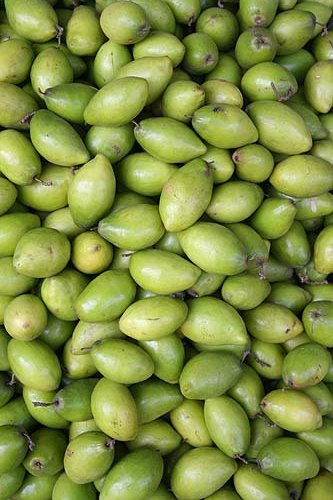
This fruit is called Deua. Inside it vaguely resembles Ata (custard apple), but again, quite sour.


Here are some other fruits, clockwise from bottom: Kath Lichu, Deshi Gab, Bel and Nuinya Fol.


Of these, the most intriguing is Kath Lichu. I just tried it yesterday. It tastes identical to Longan grown in Thailand and Malaysia, but it is much smaller (and the seed is bigger.)

I call these Galapagos potatoes, because of their resemblance to Galapagos turtles :-) Seriously, I have been unable to find out much about these potato-like roots. Someone told me about "Maitya Aloo" which may be this.


On the medicinal front, dried roots, barks and fruits abound. This man sells Arjun tree bark (useful for heart disease), as well as Trifola (combination of dried Amloki, Hortoki and Bohera - three fruits that, coincidentally, deer love to eat.)


Among drinks, Aloe Vera juice is very popular. Aloe plants are a cash crop in many places in Bangladesh.


Bangladeshis like their Shorbot - sweetened and flavored cold drinks. For example, one made from the fruit Bel is supposedly good for cooling during the heat (and for digestion.)


Then there is one made from Tok Doi (sour yogurt):


... and from Gur (molasses) with a sprinkle of Ishobguler Bhushi (flax seed?)


Here is some pre-made honey syrup for making more Shorbot!


I also love the Cashew apple but I don't have a good photo. I have not seen it sold in stores. You have to pluck it from the tree. It is filled with sweet juice inside, which bursts with flavor inside your mouth when you bite it. This year I tried refrigerating it - colder, it tastes much better. I understand people in CHittagong Hill Tracts make Toddy from it :-)

Conspicuously absent from the street is Beter Guta (the fruit of the cane tree) from my childhood. I understand cane is almost wiped out from Bangladesh :-(

A word to the wise: if you are bacterially challenged (ie, the bacteria in your stomach are used to western food, ie, you have lived in western countries for a while) then I urge caution when partaking.

Finally, I am gateful to Rais for indentifying Aloe, Stefan for teaching me about Cashew Apples and Gofur for showing me the Cham Kathal.

Bon appetit!

Monday, July 23, 2007

Rich and Poor

Rich man's fruits - apples, oranges, other imported stuff...


Poor man's fruits - gaab, bhubi (lotkon), guavas


One thing is for sure: nothing comes close to the flavor of a tree-ripened Bhubi (Lotkon)! Here are some growing in a tree:

Saturday, June 16, 2007

Food Adulteration

Food adulteration, whether intentional or not, has been my biggest concern since I returned here. My strategy has been: a) don't eat too much of the same thing; b) avoid large fish and c) eat fresh fruits/veggies and avoid processed food as much as possible. One particular nasty news was when Rokon Ud Dowla got a formaldehyde detection kit and discovered a large amount of tainted fish in the fishmarkets. A few days ago, I read about mangoes being ripened using Carbide. (But then, don't they ripen bananas using sulfur dioxide while transporting them North to the US?)

Imagine my surprise, then, at reading this article, complaining about food adulteration and contamination all over Asia. So we are not alone (but does my kidney care?)

Although the article implies a certain purity in food in Western countries, I don't think things are all that different. I am reading Michael Pollan's The Omnivore's Dilemma which discusses American food habits, and raises some serious concerns. An example: Chicken McNugget is made from 38 ingredients, many of which are completely synthetic chemicals.

Pollan also discusses how the discussion went from "What foods are good for me?" to "What nutrients are good for me?" The two are quite different.

His advice: don't eat anything that your grandmother would not recognize as food!

So next time you open a wrapper and start munching, think whether it passes the grandmother test.

(btw, my grandmothers would recognize chocolate, so I am safe heh heh )

Sunday, May 20, 2007

To Share or Not To Share...


... that is the question :-)

Friday, May 18, 2007

Lychees (photos)

Lychees have ripened. They are selling for between Tk 160 and Tk 200 per hundred (1 USD = Tk 70 approx.) Here are some pictures.

Yummy baby!


They are all over the place. Above you...


and behind you...


... there are doubledecker lychees...


...and lonely lychees.


Adults love them...


... and so do kids!


"You toucha my lychees I puncha your nose!"


Lychee leaves and anchor.


The sellers were out in force. "They are Kora (extreme) sweet!"


"Here, try a sample if you don't believe me."


"Heck, they'll even grow hair on your chest!"

Saturday, April 21, 2007

Tormooj (Watermelons)

The heat is on. Watermelons are in season.

It's a sweet antidote to the heat.


Boats coming into Dhaka are loaded with melons.


Unloading from the lower deck...


...and loading into a boat...


Boys who helped unload show their reward.


This boy had to swim ashore with his one.


Man taking melons home to village.


Melons on display after rain.


A more attractive display.


Another way to show off.

Thursday, January 25, 2007

Boroi Season

Boroi season is in full swing here in Dhaka. Kids are having a blast, with the vendors posted strategically outside school gates. I have tried at least four varieties, though I am sure there are many more. Prices are high. If you buy from the posh side of town, you can pay a ridiculous Tk 100/kg for the premium Oval and Aapel Borois. In other places, the minimum is still a high Tk 60/kg.

That said, the Borois I tried were absolutely delicious. The Aapel (Apple) Boroi was the sweetest, but the oval one was the best overall because of its extra crunchy texture. And the round deshi boroi had great flavor with just a little tartness.

Here are some pictures.

Aapel Borois


Oval Borois


Deshi Borois


Incidentally, I tried a Boroi off of a tree in Ayutthaya, Thailand, recently and it tasted just like our Deshi Borois.

Friday, September 29, 2006

Long Live Siddiqua Kabir

Siddiqua Kabir's (no relation) "Ranna Khadyo Pushti" is a famous Bangladeshi cookbook. When we were living in the US, it provided us recipes for many standard Bangla dishes.

Funny - after we returned to Bangladesh, the book has enabled us to recreate many "foreign" dishes. This is a great help, particularly for our kids, who grew up with Western food.

For example. our children like pancakes for breakfast. Back in the US I used to make them buttermilk pancakes from a mix. But how to find the mix here in Bangladesh? No problem! Mrs. Kabir's book has a recipe for pancake using locally available ingredients. All you need are flour, egg, baking powder, salt, sugar, milk and oil. In 30 minutes or less you will have pancakes that taste as good or better than the ones in the States.

Her Chinese recipes have also turned out to be accessible and tasty.

So... if you are contemplating returning home from the West, and are worried about what your kids will eat, worry no more because Mrs. Kabir's book covers a lot of territory.

Tuesday, August 01, 2006

Local Delights

One of the most delightful things about coming back to Bangladesh is the access to second-tier local fruits. The top-tier ones, such as mangoes and lichis, were available in the US. But the smaller ones (such as "Lotkon" (Bhubi in Sylheti), Orboroi (Leboir in Sylhet), Guavas (specially the small ones with red inside, called "Syedi Shofri" in - guess where? - Sylhet), Kamrangas, Jamruls, Amlokis, Koromcha, Panifol, Makhna, etc etc - parade through here during the year, one after another.

These fruits played a bigger role in my childhood than the top-tier ones because they were more easily accessible.

They are not just eaten fresh, but some in Bharta, others as "Tok", some in Jelly, and yet others in Aachar (eg, Leboir makes an excellent sweet achar.)

I tasted a Bhubi after 30 years. The taste and flavor were as exquisite to me as they had been years ago.

Thursday, June 01, 2006

The Sweet Month

It is the middle of the Bengali month JoisTha, also known as the "modhu" month. "Modhu" means honey in Bengali.

So why is JoisTha the sweet month? Because our favorite fruits have ripened.

Sweet, fragrant lychees are in full swing. Of the many varieties floating around, I have tried three. The "deshi" ones have slightly fatter seeds and thinner layer of flesh around it. The "bombay" ones have thinner seeds but just as juicy - the preferred way to get these is to "book" a tree in Rajshahi and then share it amongst a group. Someone from work had done this and so I got a few hundred. The third variety I tried was much bigger than the other two with larger grains on them. This one was also delicious.

Another fruit that I did not taste in many years has also ripened - Jaam. These black ovals have an intense sweet-tangy taste and are extremely refreshing. The best way to eat them is to smash them up with some salt which softens the tang. Black outside and purple inside, Jaams tasted just as good as they had years ago.

KaThaals - Jackfruits - have also started arriving in the markets. Two main kinds - the soft, chewy kernels and the crunchy kernels (Khaja KaThaal) - have their own fanatical followings.

And the king of them all, mangoes - the early varieties from Rajshahi are available, including Gopalbhog, but the sublime Lengra is not here yet. Maybe in a couple of weeks...

(I do miss the California summer fruits, specially the incredibly sweet white nectarines and babcock peaches bought from farmer's markets - the grocery store ones were no good.)