I just re-read a speech on the long-form narrative that I find fascinating, because every time I read it I glean something new from it. Good stuff from the editor of the New York Times Magazine.
For example, having recently acquired a Kindle and an iPad, I read his observations about reading substantive things on electronic devices with renewed appreciation.
Incidentally, it is the New Yorker which excels (or maybe excelled) in this kind of journalism: in-depth and broad coverage of a particular issue by a journalist who spent several months digging in and writing about it. In the 90s, some of their reports of events in Africa, Balkans and parts of Asia, as well as those on health/medicine, innovation and technology, etc were astonishing.
I am thinking, in particular, of the non-fiction of Malcolm Gladwell (Outliers), Richard Preston (The Hot Zone), Atul Gawande (from the frontlines of medicine and surgery) and others. Just amazing stuff.
Speaking of which, there is plenty of raw material right here in Bangladesh for this kind of in-depth reporting (and it does not all have to be negative - there are many positive stories, too...) And while the NY Times Magazine spends over $40,000 for one of these stories, ours can be done on a much smaller budget.
Would the reading public pay for anything like this? Or, perhaps more relevant, would the advertisers see value in it?
(Thanks to Mahmud Rahman for pointing me to this article.)
Showing posts with label talk. Show all posts
Showing posts with label talk. Show all posts
Thursday, December 01, 2011

Wednesday, April 01, 2009
Telling Off The Photographer
I was photographing in a lower-middle-class area of Dhaka where the roads are empty of traffic, children play on their way to school, and grandpas sit on their doorsteps with grandkids on their lap, watching the world go by.
Suddenly I was accosted verbally from behind. "You, sir, why are you taking pictures?" she asked. I ignored her and kept walking. "It won't bring in any money, will it?" she persisted, following me. I still did not turn around, but visually retraced my steps to picture her - probably the matronly mama in her fifties who was chatting with her neighbor a few doors back.
"No, no money," I said, shaking my head.
"I knew it!" she said. "What good are you, taking pictures of the kids going to school and families and people working hard?" She paused, waiting for my reaction. None came but I kept walking.
"See, what you gotta do is find the beggars and lulas (handicapped people) and the sick and take their picture. Then we will be able to get some money. Understand?"
"Oh, I see," I said.
"But, since you insist on taking pictures of the normal around here, why not take the picture of this chatpati wallah woman to your right? And watch for that kid playing up on your left - he is really cute."
Suddenly I was accosted verbally from behind. "You, sir, why are you taking pictures?" she asked. I ignored her and kept walking. "It won't bring in any money, will it?" she persisted, following me. I still did not turn around, but visually retraced my steps to picture her - probably the matronly mama in her fifties who was chatting with her neighbor a few doors back.
"No, no money," I said, shaking my head.
"I knew it!" she said. "What good are you, taking pictures of the kids going to school and families and people working hard?" She paused, waiting for my reaction. None came but I kept walking.
"See, what you gotta do is find the beggars and lulas (handicapped people) and the sick and take their picture. Then we will be able to get some money. Understand?"
"Oh, I see," I said.
"But, since you insist on taking pictures of the normal around here, why not take the picture of this chatpati wallah woman to your right? And watch for that kid playing up on your left - he is really cute."
Friday, February 06, 2009
The Six Hundred Thousand Dollar Man
The talk of the town: Bangladeshi cricketer Mashrafee who was "sold" to an Indian outfit for $600,000 in an auction. As a friend pointed out, we are now a cricketer-exporting nation :-). AFAIK, the deal means that he will have to play between 15 and 30 days of cricket for this team. In exchange he gets to keep a cool $600k (sans taxes.)
The amount may not be much compared to what Western sports stars make, but here it is staggering. "What will you do with all that money?" appears to be the most common question the cricketer is facing.
Heartiest congratulations to Mr. Mashrafee.
Wish: maybe now Bd national cricket team can stop being surprised by minnow teams?
I am also thinking what this money deal will mean to the younger generations. The good thing is that many more from all strata will feel inspired to play cricket. OTOH, I sure hope that Bd kids don't end up with a bad case of the "inner-city kids NBA dreams syndrome." In the US, lured by dreams of multi-million dollar NBA contracts, many poorer kids give up on their studies, then also fail to make it as basketball stars. The reason is simple: the odds against are astronomical, no matter how good one is.
Nevertheless, this is a Good Thing. It boosts self-confidence on all levels and shows we-can-do-it-too. In a nation so short of visible heroes, one hopes Mr. Mashrafee will end up being one and inspire many others. (Eg, he could publicly encourage kids to stay in school and finish their studies while working on the sports.)
The amount may not be much compared to what Western sports stars make, but here it is staggering. "What will you do with all that money?" appears to be the most common question the cricketer is facing.
Heartiest congratulations to Mr. Mashrafee.
Wish: maybe now Bd national cricket team can stop being surprised by minnow teams?
I am also thinking what this money deal will mean to the younger generations. The good thing is that many more from all strata will feel inspired to play cricket. OTOH, I sure hope that Bd kids don't end up with a bad case of the "inner-city kids NBA dreams syndrome." In the US, lured by dreams of multi-million dollar NBA contracts, many poorer kids give up on their studies, then also fail to make it as basketball stars. The reason is simple: the odds against are astronomical, no matter how good one is.
Nevertheless, this is a Good Thing. It boosts self-confidence on all levels and shows we-can-do-it-too. In a nation so short of visible heroes, one hopes Mr. Mashrafee will end up being one and inspire many others. (Eg, he could publicly encourage kids to stay in school and finish their studies while working on the sports.)
Sunday, June 08, 2008
Ekkerey Dekhaya Disey (They've Shown Us)
Strange coincidence. In the last two weeks, I ran into two completely unrelated people - both highly qualified, PhD economist types working at responsible jobs - who told me the same thing.
The essence of what they said: Look at our farmers and what happened in the last few months. It only goes to show that if they get enough support, our farmers can really perform beyond expectations. The government assured them enough fertilizer and electricity for irrigation (I know, because even in the nicest neighborhoods of Dhaka loadshedding was brutal this summer). And they showed what they can do. Ekkerey dekhaya disey.
True, the Boro harvest was amazing. But the potato harvest before that was pretty large too. Knock on wood - let's hope it keeps going this way.
In my mind, more than anyone else, one person is responsible for the reinvigorated Bangladeshi farmer: Shykh Shiraj.
How about a ticket next election of Shykh Shiraj and Magistrate Rokon-ud-Dowla, huh?
That would be interesting...
The essence of what they said: Look at our farmers and what happened in the last few months. It only goes to show that if they get enough support, our farmers can really perform beyond expectations. The government assured them enough fertilizer and electricity for irrigation (I know, because even in the nicest neighborhoods of Dhaka loadshedding was brutal this summer). And they showed what they can do. Ekkerey dekhaya disey.
True, the Boro harvest was amazing. But the potato harvest before that was pretty large too. Knock on wood - let's hope it keeps going this way.
In my mind, more than anyone else, one person is responsible for the reinvigorated Bangladeshi farmer: Shykh Shiraj.
How about a ticket next election of Shykh Shiraj and Magistrate Rokon-ud-Dowla, huh?
That would be interesting...
Thursday, October 25, 2007
Conversations in the Bus
Me: Does this bus go to Sadarghat?
Conductor: Get in, get in, sir! And you over there sir, get in! And you back there, too. Emptybus, emptybus! Everyone can have a seat. Get in get in!
---------------
Conductor to old woman: Can I have your fare?
Old woman offers 2 Taka.
Conductor: Where are you going?
Woman: Gulistan
Conductor: That's 4 taka from here.
Woman: No, it is 2 Taka. You did not even stop at the right place. I
had to run to catch the bus.
Conductor: 4 Taka please.
Woman, after a pause: I don't have it.
Conductor, incredulous: You don't have it?
Woman: No, I don't.
Conductor: Oh, why didn't you say so in the first place instead of all your big talk. You could have just said you don't have any more money.
Leaves the woman alone after the insult.
----------------
Conductor: Your fare!
Man reading newspaper: Why are you yelling?
Conductor: I have been asking - where is the fare?
Man: Hey, don't you know how to behave? Why can't you ask politely?
Conductor: I have asked many times - your fare.
Man: Here! And don't bother me again.
-----------------
A man gets in, but all the seats are taken. A nine-year-old boy is
sitting next to his Dad.
Man: Hey, you told me there were seats when I got on!
Conductor (looking around): Hey you, Uncle, your boy is on a child ticket. Pick him up on your lap, he can't take up a full seat.
Dad picks up boy and puts him on lap, somehow. New man takes boy's seat. Life goes on.
------------------
A woman and a man are sharing a double seat. Man gets up to exit. Another man tries to take the seat. But woman keeps the empty and yells, "Chachi! (Auntie!)" She saves the seat while her Auntie comes from the front of the bus.
Man looking to sit down considers wringing her neck but thinks the better of it, mutters and looks out the window.
------------------
Man: You know, I love to come on this bus.
Me, surprised: Why?
Man: Because I used to live here (near Malibagh-Bonosri) when it just started developing - lots of memories.
Me: Oh. So you are on the bus on a pleasure trip of sorts...
Man: No, I have to go to the bank. I kept an account open in this branch near my old house, so that every once in a while I am forced to come here to the bank. I love this place so much, but if there were no business I would never come here all the way from Tongi!
------------------------
Passenger gets a call on the mobile: Hello
Passenger (energized): Slamalaikum sir, yes, I am on my way, you did ask me to come at 9am right? (it is 9:15).
Passenger: I am just crossing Gulistan on the bus - will be in Sadarghat in just a few more minutes. Yes, yes, no problem sir. You don't worry about it at all.
(Bus was nowhere near Gulistan - quite a bit behind).
Passenger hangs up, having contained that fire.
------------------------
Bus stops at Bahadur Shah Park. Still a kilometer away from Sadarghat.
I suddenly notice everyone has de-bussed except me, and the conductor is beckoning to me.
Me: You said this bus goes to Sadarghat.
Conductor: Yes, sir, and we are here.
Me: This is quite a distance from Sadarghat.
Conductor: Sir, all the buses to Sadarghat actually stop here. See, all those buses turning aroung the Park?
I see that indeed, there are two Sadarghats in Dhaka: the bus Sadarghat which is a kilometer away from the Launch Sadarghat. Argh!
Conductor: Get in, get in, sir! And you over there sir, get in! And you back there, too. Emptybus, emptybus! Everyone can have a seat. Get in get in!
---------------
Conductor to old woman: Can I have your fare?
Old woman offers 2 Taka.
Conductor: Where are you going?
Woman: Gulistan
Conductor: That's 4 taka from here.
Woman: No, it is 2 Taka. You did not even stop at the right place. I
had to run to catch the bus.
Conductor: 4 Taka please.
Woman, after a pause: I don't have it.
Conductor, incredulous: You don't have it?
Woman: No, I don't.
Conductor: Oh, why didn't you say so in the first place instead of all your big talk. You could have just said you don't have any more money.
Leaves the woman alone after the insult.
----------------
Conductor: Your fare!
Man reading newspaper: Why are you yelling?
Conductor: I have been asking - where is the fare?
Man: Hey, don't you know how to behave? Why can't you ask politely?
Conductor: I have asked many times - your fare.
Man: Here! And don't bother me again.
-----------------
A man gets in, but all the seats are taken. A nine-year-old boy is
sitting next to his Dad.
Man: Hey, you told me there were seats when I got on!
Conductor (looking around): Hey you, Uncle, your boy is on a child ticket. Pick him up on your lap, he can't take up a full seat.
Dad picks up boy and puts him on lap, somehow. New man takes boy's seat. Life goes on.
------------------
A woman and a man are sharing a double seat. Man gets up to exit. Another man tries to take the seat. But woman keeps the empty and yells, "Chachi! (Auntie!)" She saves the seat while her Auntie comes from the front of the bus.
Man looking to sit down considers wringing her neck but thinks the better of it, mutters and looks out the window.
------------------
Man: You know, I love to come on this bus.
Me, surprised: Why?
Man: Because I used to live here (near Malibagh-Bonosri) when it just started developing - lots of memories.
Me: Oh. So you are on the bus on a pleasure trip of sorts...
Man: No, I have to go to the bank. I kept an account open in this branch near my old house, so that every once in a while I am forced to come here to the bank. I love this place so much, but if there were no business I would never come here all the way from Tongi!
------------------------
Passenger gets a call on the mobile: Hello
Passenger (energized): Slamalaikum sir, yes, I am on my way, you did ask me to come at 9am right? (it is 9:15).
Passenger: I am just crossing Gulistan on the bus - will be in Sadarghat in just a few more minutes. Yes, yes, no problem sir. You don't worry about it at all.
(Bus was nowhere near Gulistan - quite a bit behind).
Passenger hangs up, having contained that fire.
------------------------
Bus stops at Bahadur Shah Park. Still a kilometer away from Sadarghat.
I suddenly notice everyone has de-bussed except me, and the conductor is beckoning to me.
Me: You said this bus goes to Sadarghat.
Conductor: Yes, sir, and we are here.
Me: This is quite a distance from Sadarghat.
Conductor: Sir, all the buses to Sadarghat actually stop here. See, all those buses turning aroung the Park?
I see that indeed, there are two Sadarghats in Dhaka: the bus Sadarghat which is a kilometer away from the Launch Sadarghat. Argh!
Monday, August 06, 2007
"Oh Yeah, I Read That Book!"
I was talking about flooding with my friend M when he mentioned that the Jamuna had gotten a lot bigger after the big earthquake of 1871(?). "Huh?" I said, puzzled. "Yes, a novel I am reading is partly set around the Jamuna and it mentions this. It's called ChilekoThar Shepai."
"Oh yeah, I read that book!" I recognized it instantly. "But wait a second, isn't it set in old Dhaka during the Shongram?"
"It is set in both old Dhaka and the Chars."
Whoops. I had read it twelve years ago. It was a hard read. I remember that it portrayed the life of the Dhaka subaltern very well. But I had completely forgotten about the char part of the book.
So, while I keep racking up the "Books I Have Read" list, the "Books My Memory Has Undone" also keeps growing, ready to embarrass me at the right moment :-)
BTW, looking through ChilekoThar Shepai, I find it a lot easier to follow the dialog now than I did 12 years ago living in the US.
"Oh yeah, I read that book!" I recognized it instantly. "But wait a second, isn't it set in old Dhaka during the Shongram?"
"It is set in both old Dhaka and the Chars."
Whoops. I had read it twelve years ago. It was a hard read. I remember that it portrayed the life of the Dhaka subaltern very well. But I had completely forgotten about the char part of the book.
So, while I keep racking up the "Books I Have Read" list, the "Books My Memory Has Undone" also keeps growing, ready to embarrass me at the right moment :-)
BTW, looking through ChilekoThar Shepai, I find it a lot easier to follow the dialog now than I did 12 years ago living in the US.
Wednesday, August 01, 2007
The Conversation
I am standing at one of my favorite streets in the city, in front of a tailor shop. Although the shop is open, there are no customers this early. Instead, a friend of the tailor visits, and they both stand at the shop entrance drinking tea. The tailor talks with his better-dressed, well-heeled friend - both in their 20s. Suddenly the conversation gains ten decibels becoming an argument.
I don't move away - instead, stand at the foot of the stairs, ostensibly watching the morning crowd go about its business, but really eavesdropping. What are these guys saying?
"How can you say the (caretaker) gubmint is doing any good?" the tailor is complaining, "everything is so expensive here! Look at this cloth for a 3-piece suit. Costs Rs 200-300 in India and here it's Tk 800."
"But the gubmint needs some time to straighten things out - everything is such a mess. The country was crawling with crooks." his friend clearly liked the gubmint.
"Oh, but look at all the poor people - they can barely buy enough to eat. Have you seen how much the prices have gone up?" - Tailor
"Of course, prices are going up all over the world! Where have you been? Didn't you hear that even a country as big as China now has to export food? And now with all this rain we will have flood-schmlood (bonna-Tonna) - and prices will of course go up more." - Friend
"What will happen then? People will suffer even more. We just need enough to eat, and can't even get that." - Tailor
"And no one here pays taxes either. Look at Partex and [couldn't catch other company names], holding back millions in taxes, and threatening to shut down factories and firing thousands if anyone says anything. How can a gubmint do anything if citizens don't pay taxes." - Friend
The tailor is momentarily taken aback by this turn, but regains his stride swiftly. "Koitasi to, there is no future for this country. All full of corruption and poor people. And a good-for-nothing gubmint."
Friend is optimistic:"We have come a long way. Just look at all the cars and buildings and clothes that people wear. And everyone is well-fed. Just take a look and remember how poor we were. We will go a long way."
Both have noticed me standing around, and I can't help suspepcting the conversation has taken a pedagogic tone for my benefit. I decide I have heard enough and move on while my glass is half-full (or was it half-empty?)
I don't move away - instead, stand at the foot of the stairs, ostensibly watching the morning crowd go about its business, but really eavesdropping. What are these guys saying?
"How can you say the (caretaker) gubmint is doing any good?" the tailor is complaining, "everything is so expensive here! Look at this cloth for a 3-piece suit. Costs Rs 200-300 in India and here it's Tk 800."
"But the gubmint needs some time to straighten things out - everything is such a mess. The country was crawling with crooks." his friend clearly liked the gubmint.
"Oh, but look at all the poor people - they can barely buy enough to eat. Have you seen how much the prices have gone up?" - Tailor
"Of course, prices are going up all over the world! Where have you been? Didn't you hear that even a country as big as China now has to export food? And now with all this rain we will have flood-schmlood (bonna-Tonna) - and prices will of course go up more." - Friend
"What will happen then? People will suffer even more. We just need enough to eat, and can't even get that." - Tailor
"And no one here pays taxes either. Look at Partex and [couldn't catch other company names], holding back millions in taxes, and threatening to shut down factories and firing thousands if anyone says anything. How can a gubmint do anything if citizens don't pay taxes." - Friend
The tailor is momentarily taken aback by this turn, but regains his stride swiftly. "Koitasi to, there is no future for this country. All full of corruption and poor people. And a good-for-nothing gubmint."
Friend is optimistic:"We have come a long way. Just look at all the cars and buildings and clothes that people wear. And everyone is well-fed. Just take a look and remember how poor we were. We will go a long way."
Both have noticed me standing around, and I can't help suspepcting the conversation has taken a pedagogic tone for my benefit. I decide I have heard enough and move on while my glass is half-full (or was it half-empty?)
Monday, July 30, 2007
Riad
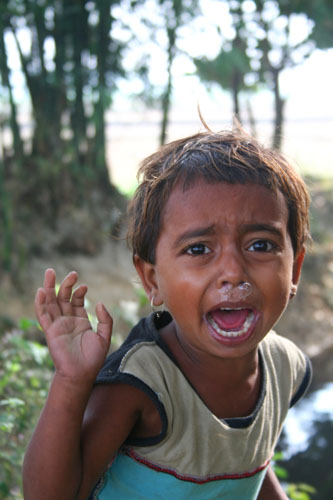
This is Riad.

He was selling umbrellas on Farm Gate's pedestrian overpass. He studies in Class Five.
A customer wearing turqoise asked the price of a matching turqoise umbrella. 110 Taka, said Riad. The customer checked it out, then offered 90. "Sir, I have one price, it is 110 Taka," Riad insisted. The customer walked off. Riad did not capitulate. After a few minutes, customer reappeared and bought the umbrella for 110.

I asked Riad if he knew the customer would return and pay the asking price. Yes, I was sure, he said. But how did he know? "If they are a Hi-Fi customer, they will huff and puff, but then they will go to the other side of the overpass, price the umbrellas there, and find my price was the best. So they come back." So where do the umbrellas come from? "From Saudi, sir". But it says made in China. "Our people get it from Saudi." Oh well.
Riad has been doing this for thirteen months. It's really his Dad's business, and he helps out whenever he has time off from school. Although he seemed to be proud of helping out his Dad, I also sensed some embarrassment at being caught outside school like this.
Riad (under the umbrella) and friends.


He was selling umbrellas on Farm Gate's pedestrian overpass. He studies in Class Five.
A customer wearing turqoise asked the price of a matching turqoise umbrella. 110 Taka, said Riad. The customer checked it out, then offered 90. "Sir, I have one price, it is 110 Taka," Riad insisted. The customer walked off. Riad did not capitulate. After a few minutes, customer reappeared and bought the umbrella for 110.

I asked Riad if he knew the customer would return and pay the asking price. Yes, I was sure, he said. But how did he know? "If they are a Hi-Fi customer, they will huff and puff, but then they will go to the other side of the overpass, price the umbrellas there, and find my price was the best. So they come back." So where do the umbrellas come from? "From Saudi, sir". But it says made in China. "Our people get it from Saudi." Oh well.
Riad has been doing this for thirteen months. It's really his Dad's business, and he helps out whenever he has time off from school. Although he seemed to be proud of helping out his Dad, I also sensed some embarrassment at being caught outside school like this.
Riad (under the umbrella) and friends.

Thursday, July 26, 2007
Will There be a Flood?
With so much rain the last few days, flood is on my mind. At a dinner last night I talked with a Water Engineer (someone who works at the Water Modelling Institute in Dhaka.) Here are some things he said:
1. It is too early to say if there will be flooding this year. Apparently the rainfall-to-date is about average.
2. A main reason for flooding is the simultaneous cresting of the Padma, Jamuna and Meghna rivers (or sometimes Jamuna and Meghna.) If this happens (mid-August, my friend thought) we will get Flooded.
3. The roads and alleys in Dhaka which go underwater during heavy rain are not "Flooded" per se - the water experts consider them drainage-congestion-induced waterlogging.
4. When Dhaka gets flooded water enters from the rivers through the drainage system.
5. Waterlogged places often get sewage mixed into the water because the sewage system is not isolated but rather designed so that normal rainwater enters and pushes the sewage out. So too much water allows the sewage into the streets. Ugh. Isn't it possible to build a one-way valve?
6. Dhaka once had a wonderful canal system that did not requires drains. Much has been written on this lately. I guess waterlogged streets remind people of the good old days.
1. It is too early to say if there will be flooding this year. Apparently the rainfall-to-date is about average.
2. A main reason for flooding is the simultaneous cresting of the Padma, Jamuna and Meghna rivers (or sometimes Jamuna and Meghna.) If this happens (mid-August, my friend thought) we will get Flooded.
3. The roads and alleys in Dhaka which go underwater during heavy rain are not "Flooded" per se - the water experts consider them drainage-congestion-induced waterlogging.
4. When Dhaka gets flooded water enters from the rivers through the drainage system.
5. Waterlogged places often get sewage mixed into the water because the sewage system is not isolated but rather designed so that normal rainwater enters and pushes the sewage out. So too much water allows the sewage into the streets. Ugh. Isn't it possible to build a one-way valve?
6. Dhaka once had a wonderful canal system that did not requires drains. Much has been written on this lately. I guess waterlogged streets remind people of the good old days.
Wednesday, July 18, 2007
Imex Revisited
Upon my return home I found my laptop battery was dead. So I called Asif at Imex. He had a replacement battery of the same size. So I went there yesterday evening to pick it up.
Imex has done well since my last post. They have a second "office" on the same floor - really like a showroom - about 6'x15', air-conditioned. There is a grid of slots on one wall holding about 50 laptops - some for repair, others for sale. The older office is now a Karkhana where Asif's techies busily fix computers.
I joined the 3 or 4 customers seated around the table. Asif+workers were time-sharing between them. Asif also answered questions for techies who walked in from his Karkhana with questions or problems.
We tried out the new battery but it too was not holding a charge. Then we realized that something was broken in the power port, because the "Charging" light turned off a minute after being powered up. A new battery was not the solution - something had come loose at the back and needed to be repaired.
Various people walked in as I waited for the diagnosis. One techie was looking for a "Dell"-labelled frame - the black thing that goes around the LCD on your laptop. Asif pulled out various frames until he found the matching one. For another person a fat cable came out of a jam-packed Hush Puppies shoebox. Several customers went away contented, their work completed.
At 8 a guy brought two dinner plates full of chhola-muri. Wordlessly, Asif, his co-workers and the customers started chomping on fistfuls of snack without stopping what they were doing. In the middle of the feast power went out. The IPS instantly came on sans AC. The munching continued.
Two religious-types wearing alkhallas, flowing beards and earnest expressions, marched in looking to buy a used laptop. Asif asked their budget. "20 to 25 thousand Taka." He offered a Dell with Pentium 3 for 26000, and a Toshiba Dynabook for 20. One of them called the boss (the Imam?) and explained the laptop configuration and price. "What about service?" he then asked Asif. "There will be service", Asif said with a mischievous smile, "service is always there." The R-T's started looking puzzled. "Free service always?" Asif sustained his cat-ate-the-canary smile. My patience ran out. "Parts!" I said to the R-Ts, "Parts!" In Bangladesh, service, meaning labor, is usually free or cheap, but parts are the killer.
A guy sitting next to Asif chimed in: "Whoever bought a laptop from here never ever came back unhappy. Get the Dell - parts are all available." (I have noticed this in many shops - a second person sitting next to the Mahajan, looking wise, and dispensing objective-sounding advice to customers.) The R-T's talked amongst themselves and decided to go off and mull it over.
Asif said he can fix the loose connection, but it will take two days. I came home with my laptop. I need to schedule two laptop-free days so it can be repaired. (Incidentally we did get a new laptop during the recent US visit but my better half needed it more than me so she has it :-))
Imex has done well since my last post. They have a second "office" on the same floor - really like a showroom - about 6'x15', air-conditioned. There is a grid of slots on one wall holding about 50 laptops - some for repair, others for sale. The older office is now a Karkhana where Asif's techies busily fix computers.
I joined the 3 or 4 customers seated around the table. Asif+workers were time-sharing between them. Asif also answered questions for techies who walked in from his Karkhana with questions or problems.
We tried out the new battery but it too was not holding a charge. Then we realized that something was broken in the power port, because the "Charging" light turned off a minute after being powered up. A new battery was not the solution - something had come loose at the back and needed to be repaired.
Various people walked in as I waited for the diagnosis. One techie was looking for a "Dell"-labelled frame - the black thing that goes around the LCD on your laptop. Asif pulled out various frames until he found the matching one. For another person a fat cable came out of a jam-packed Hush Puppies shoebox. Several customers went away contented, their work completed.
At 8 a guy brought two dinner plates full of chhola-muri. Wordlessly, Asif, his co-workers and the customers started chomping on fistfuls of snack without stopping what they were doing. In the middle of the feast power went out. The IPS instantly came on sans AC. The munching continued.
Two religious-types wearing alkhallas, flowing beards and earnest expressions, marched in looking to buy a used laptop. Asif asked their budget. "20 to 25 thousand Taka." He offered a Dell with Pentium 3 for 26000, and a Toshiba Dynabook for 20. One of them called the boss (the Imam?) and explained the laptop configuration and price. "What about service?" he then asked Asif. "There will be service", Asif said with a mischievous smile, "service is always there." The R-T's started looking puzzled. "Free service always?" Asif sustained his cat-ate-the-canary smile. My patience ran out. "Parts!" I said to the R-Ts, "Parts!" In Bangladesh, service, meaning labor, is usually free or cheap, but parts are the killer.
A guy sitting next to Asif chimed in: "Whoever bought a laptop from here never ever came back unhappy. Get the Dell - parts are all available." (I have noticed this in many shops - a second person sitting next to the Mahajan, looking wise, and dispensing objective-sounding advice to customers.) The R-T's talked amongst themselves and decided to go off and mull it over.
Asif said he can fix the loose connection, but it will take two days. I came home with my laptop. I need to schedule two laptop-free days so it can be repaired. (Incidentally we did get a new laptop during the recent US visit but my better half needed it more than me so she has it :-))
Friday, July 13, 2007
My Meeting With Mr. B.
During my recent visit to Silicon Valley I had coffee with Mr. B, an old friend with a colorful past that included, among other things, captaincy of a merchant ship, changing his course for computer science, and being one of the first employees of a successful Valley startup. A life characterized by larger-than-life episodes: facing a near-mutiny when he had to change ship's direction right in the middle of Asr prayers, or taking walk-in SATs on a whim while on shore leave in Bangkok and scoring perfect.
Like myself, B is a voracious reader, although perhaps I do not share the depth of his immersion in classical western culture. For example, we were discussing our children's education. "And what foreign languages should my children learn at school, do you think?" he asked me. "Spanish?" I offered from a pragmatic point of view.
"Actually, I was thinking more of Latin", he said. When I looked puzzled, he explained. "Look at Sanskrit. During my seafaring days I saw the overarching influence it had on the South East Asian countries. It molded their thinking and helped them build civilizations." I was still trying to connect the dots. "So learning Latin will help your son to think like that, in an overarching sort of way?" "Yes, much more so than Sanskrit."
B's fondness for Latin may have its roots in his favorite author, Nirad Chaudhuri. B said that one of Chaudhuri's books had large chunks of Latin without any translation. Apparently, when the publisher wanted to add translations, Chaudhuri had simply said "If a reader is not erudite enough to know this much Latin I don't want him as a reader". That settled that one.
And on we rambled about other things - where does Jhumpa Lahiri get her life-ideas from (hint: not from real life), where is Web 2.0 headed (need for editing), the market for a radically different kind of school in Bangladesh (teach more global skills), and the absolutely crucial need for English-medium instruction in Bangladesh. "Even if they want to be writers in Bangla, having learned English will discipline and focus their mind".
As our coffee cups emptied, I realized that an hour with B may excite, puzzle and occasionally infuriate the mind, but it is never boring!
Like myself, B is a voracious reader, although perhaps I do not share the depth of his immersion in classical western culture. For example, we were discussing our children's education. "And what foreign languages should my children learn at school, do you think?" he asked me. "Spanish?" I offered from a pragmatic point of view.
"Actually, I was thinking more of Latin", he said. When I looked puzzled, he explained. "Look at Sanskrit. During my seafaring days I saw the overarching influence it had on the South East Asian countries. It molded their thinking and helped them build civilizations." I was still trying to connect the dots. "So learning Latin will help your son to think like that, in an overarching sort of way?" "Yes, much more so than Sanskrit."
B's fondness for Latin may have its roots in his favorite author, Nirad Chaudhuri. B said that one of Chaudhuri's books had large chunks of Latin without any translation. Apparently, when the publisher wanted to add translations, Chaudhuri had simply said "If a reader is not erudite enough to know this much Latin I don't want him as a reader". That settled that one.
And on we rambled about other things - where does Jhumpa Lahiri get her life-ideas from (hint: not from real life), where is Web 2.0 headed (need for editing), the market for a radically different kind of school in Bangladesh (teach more global skills), and the absolutely crucial need for English-medium instruction in Bangladesh. "Even if they want to be writers in Bangla, having learned English will discipline and focus their mind".
As our coffee cups emptied, I realized that an hour with B may excite, puzzle and occasionally infuriate the mind, but it is never boring!
Wednesday, June 13, 2007
Do IT People Make Lousy Poets?
A few days ago, I met someone, a poet, who writes a poetry blog. While chatting with him, I told him that I am not into contemporary poetry - particularly if it is English. I love Tagore, Nazrul, Sukanta and particularly Jibananda (and maybe some Neruda and Langston Hughes in small doses) but that's about it.
He listened attentively and smiled. Then he gently asked me if I was an IT guy. When I confirmed, he said that he found IT people to be less interested in poetry.
The next few days I mulled over his words. I realized I did not like them. But although I knew IT people who have gone on to be novelists, directors, farmers, photographers, musicians, and other kinds of artists, I did not know one who had become a poet.
Was he right?
Poets come out of other professions all the time. William Carlos Williams, for example, was a doctor who kept index cards in his shirt pocket and wrote poems on them whenever he got a break.
(Incidentally, I first read Williams in an IT book - the front of Linear Systems, by Stanford's Thomas Kailath.)
Noodling around the Web, I found a computer scientist who is also a serious poet. One Richard Gabriel, once a Distinguished Engineer at Sun, now at IBM. (And now the programmer in me says, hey, if he is a poet, maybe he is not that good a programmer - did he write any interesting programs? Ha ha.)
Programming is very much a creative process, as is poetry. I can't think of a reason that programmers cannot be poets. Maybe there is something deeper going on? Or have I simply missed a lot of IT poets? Comments?
He listened attentively and smiled. Then he gently asked me if I was an IT guy. When I confirmed, he said that he found IT people to be less interested in poetry.
The next few days I mulled over his words. I realized I did not like them. But although I knew IT people who have gone on to be novelists, directors, farmers, photographers, musicians, and other kinds of artists, I did not know one who had become a poet.
Was he right?
Poets come out of other professions all the time. William Carlos Williams, for example, was a doctor who kept index cards in his shirt pocket and wrote poems on them whenever he got a break.
(Incidentally, I first read Williams in an IT book - the front of Linear Systems, by Stanford's Thomas Kailath.)
Noodling around the Web, I found a computer scientist who is also a serious poet. One Richard Gabriel, once a Distinguished Engineer at Sun, now at IBM. (And now the programmer in me says, hey, if he is a poet, maybe he is not that good a programmer - did he write any interesting programs? Ha ha.)
Programming is very much a creative process, as is poetry. I can't think of a reason that programmers cannot be poets. Maybe there is something deeper going on? Or have I simply missed a lot of IT poets? Comments?
Saturday, May 12, 2007
Such a Small Country
Yeterday at a function I met a well-educated gentleman. Turned out that he worked close to a cousin (someone whose intellect I respect immensely.) I asked my new acquaintance if he knew my cousin. Of course, he said, he has been there for many years. Suddenly he asked, "So are you from Sylhet too?" When I nodded, his eyes narrowed for a fraction of a second- I could almost see some thoughts go across his mind - and the conversation somehow ended quickly.
Now, perhaps he had other people to talk to, and my Sylhetiness had nothing to do with it, but I find that for a country so small, Bangladeshis are ridiculously provincial. "Desh", the Bangla word for country, also means "village home." Often people will ask me "Where is your Desh?" when they mean "Which region of Bangladesh are you from?" "Oh yeah, my Desh is Sylhet, only 35 miles from your Desh of Brahman Baria!" Right.
Then there are the inevitable stereotypes. Tangail, Barisal, Chittagong, Noakhali, Sylhet - we all love to wrap them in unsavory flavors. One day I was going somewhere with a friend who did not know my driver was from Mymensingh. He went on for a few minutes about how stupid, idiotic, moronic Mymensinghis are (I think he was trying to contrast them to the people of the district we were visiting, who he thought were very smart.) To his credit my driver kept quiet. About ten minutes later, when I asked my driver a question, he answered with an ultra-thick Mymesinghi accent - so thick that my friend understood and went red.
All this geographical stereotyping reminds me of my good friend Sanjiv who years ago worked at Siemens. After a reorganization, Sanjiv inherited a new boss. The first question the boss asked Sanjiv was "Are you from India?" Sanjiv's "Yes" caused a flicker of unhappiness to pass through the boss's face. Thus began a very difficult relationship, with boss making Sanjiv's life hell. Eventually Sanjiv moved to another group.
Some time later, Sanjiv found the real story. Years ago, the boss's wife had run off with an Indian man!
Now, perhaps he had other people to talk to, and my Sylhetiness had nothing to do with it, but I find that for a country so small, Bangladeshis are ridiculously provincial. "Desh", the Bangla word for country, also means "village home." Often people will ask me "Where is your Desh?" when they mean "Which region of Bangladesh are you from?" "Oh yeah, my Desh is Sylhet, only 35 miles from your Desh of Brahman Baria!" Right.
Then there are the inevitable stereotypes. Tangail, Barisal, Chittagong, Noakhali, Sylhet - we all love to wrap them in unsavory flavors. One day I was going somewhere with a friend who did not know my driver was from Mymensingh. He went on for a few minutes about how stupid, idiotic, moronic Mymensinghis are (I think he was trying to contrast them to the people of the district we were visiting, who he thought were very smart.) To his credit my driver kept quiet. About ten minutes later, when I asked my driver a question, he answered with an ultra-thick Mymesinghi accent - so thick that my friend understood and went red.
All this geographical stereotyping reminds me of my good friend Sanjiv who years ago worked at Siemens. After a reorganization, Sanjiv inherited a new boss. The first question the boss asked Sanjiv was "Are you from India?" Sanjiv's "Yes" caused a flicker of unhappiness to pass through the boss's face. Thus began a very difficult relationship, with boss making Sanjiv's life hell. Eventually Sanjiv moved to another group.
Some time later, Sanjiv found the real story. Years ago, the boss's wife had run off with an Indian man!
Wednesday, March 14, 2007
Extra! Extra! Goodbye Bangladesh!
Words on the street:
---------
Hawker selling newspapers: "[In English] Goodbye Bangladesh. Goodbye Bangladesh. Sheikh Hasina going to the America. In Bangla] Case being prepared against Khaleda Zia. [Back to English] Goodbye Bangladesh. Goodbye Bangladesh."
---------
Boy to me: "Uncle why are you taking pictures?" "Just for me." "What will you do with them?" "Maybe make a book" "Who will be the author of the book."
This gives me pause. "Hmmm. Not sure. Let me think. Which authors do you like?"
"Not sure. Let me think."
----------
Shopkeeper: [In English]"Uncle do you have one minute. We wanted to talk with you."
Me: [In Bangla] "Arekdin aashbo - I'll come another day."
Shopkeeper: [crestfallen]"Oh, you are a Bangla! Ok, never mind."
----------
Child: "Uncle can you take my picture?" Okay. "Can you take a picture of my little brother here?" Okay. "How about one of me sitting?" Okay. "Wow, you can see the pictures? Looks fine. Hey guys, come take a look." Okay. "Uncle how about a picture of that dog? Do you see the dog over there?" No, I have to go now.
----------
Boy: "Uncle how about a picture? Take one. Please?" Me: "What class do you go to? What is 5 times 12? Do you do your homework or cheat? Have you listened to everything your parents said today?" Boy: "Uh, I have to go now."
----------
---------
Hawker selling newspapers: "[In English] Goodbye Bangladesh. Goodbye Bangladesh. Sheikh Hasina going to the America. In Bangla] Case being prepared against Khaleda Zia. [Back to English] Goodbye Bangladesh. Goodbye Bangladesh."
---------
Boy to me: "Uncle why are you taking pictures?" "Just for me." "What will you do with them?" "Maybe make a book" "Who will be the author of the book."
This gives me pause. "Hmmm. Not sure. Let me think. Which authors do you like?"
"Not sure. Let me think."
----------
Shopkeeper: [In English]"Uncle do you have one minute. We wanted to talk with you."
Me: [In Bangla] "Arekdin aashbo - I'll come another day."
Shopkeeper: [crestfallen]"Oh, you are a Bangla! Ok, never mind."
----------
Child: "Uncle can you take my picture?" Okay. "Can you take a picture of my little brother here?" Okay. "How about one of me sitting?" Okay. "Wow, you can see the pictures? Looks fine. Hey guys, come take a look." Okay. "Uncle how about a picture of that dog? Do you see the dog over there?" No, I have to go now.
----------
Boy: "Uncle how about a picture? Take one. Please?" Me: "What class do you go to? What is 5 times 12? Do you do your homework or cheat? Have you listened to everything your parents said today?" Boy: "Uh, I have to go now."
----------
Tuesday, February 27, 2007
The Garrulous Taxi Driver
I had to take a CNG across town the other day. Turned out the driver was talkative with a lot of opinions. (A CNG is a small three-wheeled taxi, running on Compressed Natural Gas, popular in Dhaka.)
Of Bangladeshis he said, "We are the most luxury-loving people in the world." Why, I asked. "Because for only 12 Taka you can get a half-hour ride on a super-luxurious Volvo bus from Mirpur to Farm Gate. A bus that costs 1.5 Crore (about $210,000)! People seem to love it, too" he complained.
His other complaint was about the rich people. There are many families who have 4 or 5 cars now. Not only that, they change models every couple of months. "What do they need so many cars for? No wonder the roads are all clogged up."
We got on the rich people track after he complained how hard it was to make money. "We have to pay Tk 600 every day as rental for this CNG. We have to sweat so much just to earn Tk 200 daily income." He said he was hoping that the rental would drop to 500 soon.
We passed by a strip mall in Gulshan-1 where, among a row of about 10 almost identical storefronts, one had been demolished (because of unpermitted construction.) "Don't you think it is unfair to pick out only one while the others are intact?" I asked. "Not at all, that is a warning sign to the others. If they don't fix their storefronts, they will go, too," he said sternly.
He was optimistic about the country's economy, as I found out in a roundabout way, when he said that the Rangs Building was coming down for sure (this is a controversial Dhaka landmark, reputed to have been built unpermitted.) "But think about it," I said, "there are at least 1000 people who work in that building. Each one supports at least 4 or 5 others. That's a lot of people who will be out of a job." "No problem," he said, "they can get other jobs. They have to just look - there are plenty of jobs."
While he was talking he forgot to tell me that he was almost out of CNG. So we made an unplanned stop in Tejgaon Industrial Area for 15 minutes while he waited in the CNG fillup line, while I took a quick stroll in the underbelly of industrial Dhaka.
Back on the road, he ranted about the CNG business. "These CNGs should have cost only 1-1.5 lac Taka ($1500-2000) but because of the corruption and everyone taking their cuts, the owner had to pay 3-4 lac. That's why poor people like me have to pay Tk 600 a day for renting it," he complained.
Well at least he is not burning petrol. The bill for filling up with CNG (to last him 1.5 days of schlepping people around town) came to Tk 45, about seventy cents.
We reached our destination. The meter read Tk 80 ($1.10) for about 8 miles. I paid him an extra Tk 10 bakhseesh, and with freshly filled CNG tanks our garrulous driver went off to find his next passenger (and captive audience.)
Of Bangladeshis he said, "We are the most luxury-loving people in the world." Why, I asked. "Because for only 12 Taka you can get a half-hour ride on a super-luxurious Volvo bus from Mirpur to Farm Gate. A bus that costs 1.5 Crore (about $210,000)! People seem to love it, too" he complained.
His other complaint was about the rich people. There are many families who have 4 or 5 cars now. Not only that, they change models every couple of months. "What do they need so many cars for? No wonder the roads are all clogged up."
We got on the rich people track after he complained how hard it was to make money. "We have to pay Tk 600 every day as rental for this CNG. We have to sweat so much just to earn Tk 200 daily income." He said he was hoping that the rental would drop to 500 soon.
We passed by a strip mall in Gulshan-1 where, among a row of about 10 almost identical storefronts, one had been demolished (because of unpermitted construction.) "Don't you think it is unfair to pick out only one while the others are intact?" I asked. "Not at all, that is a warning sign to the others. If they don't fix their storefronts, they will go, too," he said sternly.
He was optimistic about the country's economy, as I found out in a roundabout way, when he said that the Rangs Building was coming down for sure (this is a controversial Dhaka landmark, reputed to have been built unpermitted.) "But think about it," I said, "there are at least 1000 people who work in that building. Each one supports at least 4 or 5 others. That's a lot of people who will be out of a job." "No problem," he said, "they can get other jobs. They have to just look - there are plenty of jobs."
While he was talking he forgot to tell me that he was almost out of CNG. So we made an unplanned stop in Tejgaon Industrial Area for 15 minutes while he waited in the CNG fillup line, while I took a quick stroll in the underbelly of industrial Dhaka.
Back on the road, he ranted about the CNG business. "These CNGs should have cost only 1-1.5 lac Taka ($1500-2000) but because of the corruption and everyone taking their cuts, the owner had to pay 3-4 lac. That's why poor people like me have to pay Tk 600 a day for renting it," he complained.
Well at least he is not burning petrol. The bill for filling up with CNG (to last him 1.5 days of schlepping people around town) came to Tk 45, about seventy cents.
We reached our destination. The meter read Tk 80 ($1.10) for about 8 miles. I paid him an extra Tk 10 bakhseesh, and with freshly filled CNG tanks our garrulous driver went off to find his next passenger (and captive audience.)
Sunday, February 11, 2007
Two Points of View
Little Girl: Man, what a horrible morning! There I was, up bright and early, but Abbu and Ammu wanted to sleep in. I heard Bhaiya and Apu playing by the pond, so I came to join them. Bummer, they would't take me in their game. What could I do? No one would even get me a hanky to clean my nose. So I decided to sit by the pond, stare at the water, and think. Then I hear a noise, turn around, and - YIKES! - this big man had snuck up behind me with a black shiny thing in his hand, pointing it at me. I screamed. I am sure he had a sack in which he wanted to carry me off. And he kept on saying "foto foto." What the heck is a foto? I screamed and screamed and ran for my life, even though Bhaiya and Apu tried to stop me and look at that horrible man. No way. I want Ammu. Ammu! AMMU!
Me: I am bicycling through this village early in the morning, enjoying the scenery and taking pictures. I see two kids playing on the yard by a pond, and another little girl sitting by the pond, staring into the water, lost in thought. It was a perfect moment. Not wanting to disturb her, I parked my bicycle a few feet away and approached the child from behind, very quietly. Just as I composed the photo through the viewfinder and touched the shutter, she heard me and turned around. She froze for a split second, eyes widening in fear, then found her voice, started screaming and ran away. I said "it's just a photo, don't worry, I won't hurt you" and her brother and sister tried to calm her down but to no avail. So I went back to my bicycle and waited for a few minutes. Then I checked back - her screaming had stopped and she had calmed down. But the poor thing was traumatized enough for one day, so I left.
The photo:
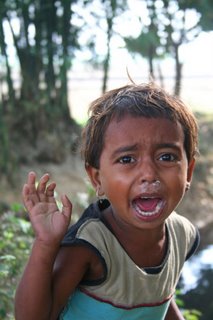
Me: I am bicycling through this village early in the morning, enjoying the scenery and taking pictures. I see two kids playing on the yard by a pond, and another little girl sitting by the pond, staring into the water, lost in thought. It was a perfect moment. Not wanting to disturb her, I parked my bicycle a few feet away and approached the child from behind, very quietly. Just as I composed the photo through the viewfinder and touched the shutter, she heard me and turned around. She froze for a split second, eyes widening in fear, then found her voice, started screaming and ran away. I said "it's just a photo, don't worry, I won't hurt you" and her brother and sister tried to calm her down but to no avail. So I went back to my bicycle and waited for a few minutes. Then I checked back - her screaming had stopped and she had calmed down. But the poor thing was traumatized enough for one day, so I left.
The photo:
Sunday, November 05, 2006
Cow Talk in Old Dhaka
I went to old Dhaka to pick up hard-to-get bicycle parts, then chatted with some locals. Now that we are past Ramzan people's thoughts are on Korbani Eid (when an animal is sacrificed) coming up in two months. The Korbani markets (for buying the sacrificial animals) will begin in earnest in another month, but cow talk has already started in old Dhaka.
So what are popular animals, I asked. "Cows and Khasis, of course", was the answer, "and the rare BhuTTi cow occasionally." BhuTTI cow? (Is this guy pulling my leg?) "It is a small cow, looks very nice, only so high (his hand is at the knees). They fetch a premium price because they are so rare."
Inevitably, talk of prices. "Last year a cow sold for Tk 220,000." Wow, I said, that's pretty high. "It was a big cow," he said, "and beautiful. Very meaty. You could not feel one bone on any part of its body from the outside." How much meat would it yield? "250-300kg, easily." What was it fed? "Better food than humans! Sacks of corn and other good stuff." Who bought it? "Some local commissioner (politician). Used to be only Chittagong merchants could afford these expensive cows, but now there are rich politicians and merchants everywhere."
This Sumo cow had led quite the pampered life. "It had a room of its own. One person was there just to clean up after it all day." And the Dhakaiya finale: "The owner of this cow did not want it to be bitten by mosquitoes, so it slept under a mosquito net every night."
So what are popular animals, I asked. "Cows and Khasis, of course", was the answer, "and the rare BhuTTi cow occasionally." BhuTTI cow? (Is this guy pulling my leg?) "It is a small cow, looks very nice, only so high (his hand is at the knees). They fetch a premium price because they are so rare."
Inevitably, talk of prices. "Last year a cow sold for Tk 220,000." Wow, I said, that's pretty high. "It was a big cow," he said, "and beautiful. Very meaty. You could not feel one bone on any part of its body from the outside." How much meat would it yield? "250-300kg, easily." What was it fed? "Better food than humans! Sacks of corn and other good stuff." Who bought it? "Some local commissioner (politician). Used to be only Chittagong merchants could afford these expensive cows, but now there are rich politicians and merchants everywhere."
This Sumo cow had led quite the pampered life. "It had a room of its own. One person was there just to clean up after it all day." And the Dhakaiya finale: "The owner of this cow did not want it to be bitten by mosquitoes, so it slept under a mosquito net every night."
Wednesday, September 06, 2006
Taxi Driver
Sometimes I commute in a taxi or CNG and get into conversations with the drivers regarding their occupation. They rent the taxis from the owner on a daily basis and pay for all expenses of running the vehicle for the day.
Daily rental: CNG: Tk 600; small blue/black taxi: 800; yellow cab: 900-1050;
Gas (CNG) expenses: Tk 120-150
Daily take-home: Tk 200-500 (after paying daily rental, gas, food)
Biggest pain: 2-3 hour wait at CNG station to fill up
Biggest joy: a long "khep" - to Norsingdi, Bhulta, Tongi, Savar, etc (assuming they don't get caught by a cop for breaking the routing rules)
Busiest day: Friday, when a lot of people go "home" for weekend; others just go out
Slowest day: Saturday - no one wants to go anywhere
Rainy days: can't handle all the people who want a ride
Working hours: 7am to 10 or 11pm.
Working days: alternate days since they need rest after 16 hours of driving
Kms covered in average day: around 300
The masses prefer CNGs over the taxis because of ventilation and mobility/navigability. But on winter days taxis are more in demand, since the open sides of a CNG cannot protect the passengers from cold.
Why do so many drivers say "No" to passengers when their vehicle is empty? Most drivers claim it has to do with the destination. If the passenger wants to go to a location from where it is hard for the driver to find another fare, then they say No. (Hmm, next time I hear a No I might try offering twice the metered fare - that should work, right? The trouble is as soon as I hear that No I am so irritated that there is no way I want to talk to the guy or see his face again!)
Daily rental: CNG: Tk 600; small blue/black taxi: 800; yellow cab: 900-1050;
Gas (CNG) expenses: Tk 120-150
Daily take-home: Tk 200-500 (after paying daily rental, gas, food)
Biggest pain: 2-3 hour wait at CNG station to fill up
Biggest joy: a long "khep" - to Norsingdi, Bhulta, Tongi, Savar, etc (assuming they don't get caught by a cop for breaking the routing rules)
Busiest day: Friday, when a lot of people go "home" for weekend; others just go out
Slowest day: Saturday - no one wants to go anywhere
Rainy days: can't handle all the people who want a ride
Working hours: 7am to 10 or 11pm.
Working days: alternate days since they need rest after 16 hours of driving
Kms covered in average day: around 300
The masses prefer CNGs over the taxis because of ventilation and mobility/navigability. But on winter days taxis are more in demand, since the open sides of a CNG cannot protect the passengers from cold.
Why do so many drivers say "No" to passengers when their vehicle is empty? Most drivers claim it has to do with the destination. If the passenger wants to go to a location from where it is hard for the driver to find another fare, then they say No. (Hmm, next time I hear a No I might try offering twice the metered fare - that should work, right? The trouble is as soon as I hear that No I am so irritated that there is no way I want to talk to the guy or see his face again!)
Subscribe to:
Posts (Atom)