Friday, July 21, 2006

Friday Morning in Old Dhaka (Photos)

Feeling inspired by the adventures of Mr Islam and Ms Mustoe, I took advantage of Friday morning's light traffic to bike to old Dhaka and check out Bara Katra/Chhota Katra.

On the way I ran into this life-size sculpture on Shaheed Tajuddin Rd, made entirely from rickshaw/bicycle chains:


When I reached old Dhaka, the stores were all closed, including the famous Haji's Biriyani House on Alauddin Road. It has no signs, but twice a day people line up to buy the delicious biriyani cooked in mustard oil:


Life, however, went on. Friday luxuries included a visit to the barbershop...


...and getting the ears cleaned.


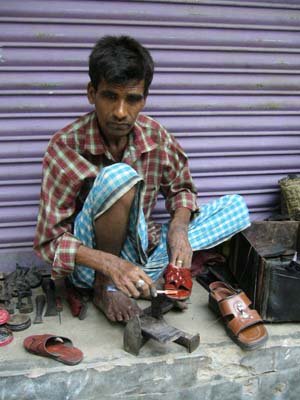
And don't forget shoes need polishing too:


A man in front of a closed store sold colorful children's clothes...


...And a girl was out wearing her "Friday best"


I had to share the road with all manners of vehicles!


The sky grew dark and in minutes there was a torrential downpour. I got shelter, but this rickshawallah did not get a break.


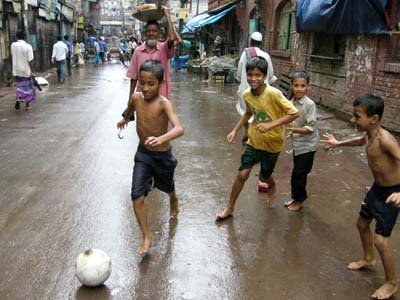
After the rain cleared, kids came out to play soccer on the wet street.


The fresh mud was no deterrant for a good tumble!


I went on to my destination. Details and photos in the next posting.

Wednesday, July 19, 2006

Math Olympiad

Starting in 2001, the nationwide Math Olympiad has increased young Bangladeshis' interest in mathematics and from a national craze we have gone international. Today the 47th International Math Olympiad ended in Slovenia. Bangladesh placed 80 out of 102 countries. So Bangladeshis are competing with the brightest from all over the world - thus learning to be globally competitive.

Team site is http://www.matholympiad.org.bd where you can see the contestants and sign a guest book if you choose.

Congratulations to the competitors for their effort, and to the organizers and sponsors for their dedication.

Bangladeshi and Other Bicyclists

Last weekend's ChhuTir Diney magazine (Prothom Alo) had a cover story on one Shahidul Islam, who bicycled from Tokyo to Dhaka. He started in Tokyo, crossed by sea to Korea, and after biking across, took a ship to China. From there he biked all the way to Vietnam, then Laos and Thailand. The Burmese stopped him from entering Myanmar, so he had to go back to Bangkok and fly to Dhaka. Quite an adventure! He covered 4000km from 26 March to 7 June. That averages to ~50km/day, but I'd bet his average on "biking days" was much higher, because it appears he took quite a few off days. Kudos to Mr. Islam on his accomplishment. He is quite an inspiration for us.

On a related note, I just finished reading "A Bike Ride" by Anne Mustoe, a 54-year-old British woman who bicycled around the world in 1988. The understatement of the title is reminiscent of another British traveller Eric Newby who called his hair raising adventure in Afghanistan "A Short Walk in the Hindu Kush." Ms. Mustoe's book is engaging and inspiring - the charm lies in her plain and straightforward storytelling. She started Eastward from the UK, through France, Switzerland, Italy, Greece, Turkey, Pakistan, India, Thailand, Malaysia and Singapore. Then she took a plane to California and biked across the US.

Her bicycle enabled Ms. Mustoe to mix with the locals - and indigenous ones at that - at a level that we in today's world of Hiltons and Sheratons are completely shut out of. There are stories of kindness and generosity from every country she visited. However, whenever there was a side-by-side comparison (eg, Turkey/Greece, Pakistan/India, Thailand/Malaysia), it appeared that people from Muslim countries charmed her more.

Too bad she jumped from Kolkata to Bangkok without bothering in Bangladesh, but back in 1988 she would have found it extremely difficult to find hotel-lodging in remote places in the country.

She has a great sense of humor, describing a harmonium as a "small keyboard with bellows" and baseball as "grown men in Victorian underwear playing rounders."

Oh, here is the amazing thing: even after 20000+km of cycling she still did not know how to fix a puncture. Go figure.

Wednesday, July 12, 2006

Gopal Bhaar and the Mobile Toilets

This article caught my attention today. It should be a big help for long-suffering denizens of Dhaka, although the number of toilets, 50, seems miniscule for 10 million people. Kudos to those who will make it happen.

http://www.thedailystar.net/2006/07/12/d607122503137.htm

But Tk.5 for defecating and Tk 2 for urinating? Reminds me of the old Gopal Bhaar story. Is someone going to be standing with a big stick to beat them up if they try to cheat?

Given our penchant for creating distinctions between people based on class, is there going to be a VVIP model, a VIP model and a Business and Economy model? The mind boggles at the possibilities.

And you know those signs on the back of cars here, things like, "Engaged in Important Export Duty", "Under Land Ministry", "Belongs to the Legal Counsel for the XX Minister", and the ubiquitous "Press"? Are we going to have similar signs for the potties? What will they say?

What would one advertise? Let's see... perfumes? lungis? Pepto-bismol? Or Ishobguler Bhushi?

Is there an exhaust-free CNG model in the works?

(Gopal Bhaar - the court jester for King Krishnachandra - story goes like this: one day a sentry arrived at Gopal's house and sat down to defecate on his lawn. Gopal ran out of the house and asked him to stop. The sentry said, "The King has ordered that I s**t on your lawn - so what can I do? Neither you nor I can disobey a king's direct order." Gopal asked him to wait a second, went inside the house and returned with a big stick. Then he positioned it like a baseball bat over the sentry. The sentry said "What are you doing?" Gopal said "The Kind only ordered you to s**t and said nothing about urinating. So if you urinate on my lawn while carrying out your assignment, I will kill you. Mutechho ki morechho." And so the sentry gave up and left. )

Saturday, July 08, 2006

Bangladeshis in Italy

Last month, a 20-year dream came true: we visited Italy. While it was an amazing lesson in history, I was also taken by surprise at the Bangladeshis in Italy.

I heard estimates of between 200,000 and 600,000 Bangladeshis in Italy.

I saw them in Rome, Florence and Venice (but not in Siena.) The ones I saw all had small to medium-size businesses. In Rome, they were selling handbags, sunglasses and tourist material on the streets. In Florence, we walked into a store selling "Indian-looking" things - "monohori dokan" - only to find the owner was a Bangladeshi who had a chain of these stores in the city.

In Venice, they were selling trinkets - like little puppets made from balloons - on the Accademia bridge and in San Marco Square. The seller told me these would not sell in Rome, but in Venice the tourists buy them.

They were incredibly kind and polite to us. The person in Florence - much to our protestations - fed us Cokes and ice cream, and sold things to us at large discounts. When it came to prices, they said "Pay us what you want - we are so happy to see a Bangladeshi tourist here." It was a kind of haggling in reverse. One street vendor in Rome, after selling a sunglass at 18 Euro to an European person, turned around and sold me a similar sunglass at 4.5 Euro. I wanted to pay him more, but, incredible as it seems, he would not take it. I think this covered his cost, barely.

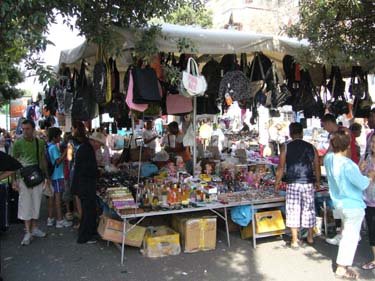
At a mini-flea-market of Bangladeshi stalls at the Tiburtina station in Rome, I fell into a discussion of the business. It costs them 1000-2000 Euros a month to rent each stall. The work is very hard, and they live frugally. So they are able to save some money which they send home. One seller in Venice said he can save up to Euro 1000 a month, but only if a lot of conditions are met (eg, he has to sell an average of 50 euros' worth daily; his food expenses cannot exceed Euro 80/month, etc etc.)

I was inspired by their entrepreneurship and touched by their generosity and hope their dreams come true soon.

Here is a stall at the mini-flea-market outside Tiburtina:

Tuesday, July 04, 2006

Happy Birthday America

It's 4th of July, hope you are enjoying a sunny day outside, perhaps a picnic or a barbecue, finishing up with sweet watermelon and fireworks!

Monday, July 03, 2006

Anwar Choudhury on Mirror Talk Show Tomorrow

Just a quick note, my better half Sonia will interview the British High Commissioner Anwar Choudhury on the Mirror Talk Show on Bangladeshi TV Channel I. At 6:20pm BDT, 1:20PM UK, and 5:20 am California.

Wednesday, June 21, 2006

Web 2.0 article

On the emergence of Web 2.0 and how Bd can play in this:

http://www.thedailystar.net/2006/06/19/d606190901122.htm

Tuesday, June 20, 2006

Queue Manners

I am out of the country at the moment, so please accept my apologies for the infrequent blog postings.

At ZIA, as I was standing in (a long) line at the gate for the final security check, for a split second there was a 2-feet gap between me and my family, and mysteriously this man had sneaked into the gap. When I asked him how he had gotten into the line between me and my family, without saying a word he looked down, turned around and quickly walked to the back of the line. I was thinking this is Bangladesh.

Well guess what, I was at the MacDonald's in Dubai airport, in line to buy breakfast, when - again, my attention had travelled for a couple of seconds - these two Arabic looking guys popped into the line ahead of me. When I asked them how did you guys get here they started saying loudly their flight leaves soon, what was the problem, where was I from, etc, in Arabic accents. I calmly but firmly told them there was a line here, they need to go to the back of the line and it was none of their business where I was from. They backed off. Shokter Bhokto Noromer Jom.

Final incident: near Mont Blanc, France, waiting at a train station to visit Glacier caves, we thought we were in line when a huge mass of europeans enter the same area, and get in front of us, bypassing us on the right. They were East Europeans, I think. Well, I was thinking, I am from Bangladesh and I know how to play this game! So I led my companions to bypass them on the left and were some of the first to get on the train!

It was a good lesson. I will still get irritated whenever I see Bangladeshis jump queue, but at least I will remember they are not the only ones.

oh, btw, the guys in Dubai? When we left McD's after eating a leisurely breakfast, they were still chomping away. So much for the late for the flight excuse.

Friday, June 09, 2006

Unusual Agro Products

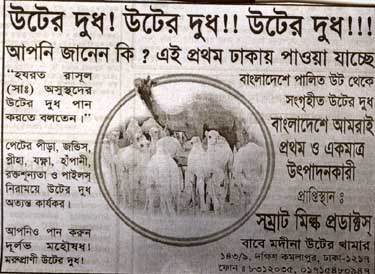
Agriculture is a thriving sector in Bangladesh. I have heard of some unusual agricultural products, including jackfruit seeds exported to Japan, and a syrup made from "Khejurer Rosh" - the sweet fluid extracted from Date trees.

Here is another one that was advertised in the paper yesterday - locally produced camel milk! (or is it !!!)

Wednesday, June 07, 2006

Personal Space

Because of a sudden downpour at the usual time - 7am - I was late going for my morning run today. When I reached the park at 8:10, I found it empty. Instead of sharing this park with dozens of others - mostly walkers - I had the whole place to myself.

I found myself wondering why this was so. Had the numerous people who walked here every morning, as early as 6am, been scared off by the rain? Were they all busily getting ready for another day at the battlefields of work? Did they decide to forego the Park authority's stern advice, spelled out in bold letters at vantage points throughout the park: the crisp "Health is Wealth", the common-sensical "Of all exercises, Walking is best" and the logic-defying "All the wealth you accumulate has to be shared with others, but your health is for your own enjoyment only."

But here is the weird part. Instead of being pleased that I had this small but open place to myself, I was actually missing those people! I realized that I was learning to become a Bangladeshi again, and that my notion of personal space - once so important to me when I was in the US - was slowly eroding.

Whether or not you agree with Sartre that existence precedes essence, you have to agree that an important essence of being Bangladeshi is making do with tiny amounts of space: an inevitable side-effect of 130 million people sharing a land smaller than Wisconsin. From the moment a person is born, to their deathbed, they must cope and thrive while surrounded by people.

You can call it "making do" with small space - or you can say that they are violating my personal space. It really does not matter. The point is that Bangladeshis deal with this issue heroically every day. But this same heroics can drive foreigners to distraction. Some days I marvel at the heroics, other days I want to pull my hair out.

I marvel at the way a romantic couple makes the long walk up to one of the large flyovers in the city, because there are no pedestrians on top, and they think they are alone on top of the world. I marvel at gaggles of schoolchildren, or the streams of garment workers who flutter out like so many butterflies from their institutions. I marvel at the way shopkeepers at the Bazaar who manage to keep track of the orders of all the customers who are never in line and always crowding them. I marvel at the way that drivers, rickshaw pullers and bicyclists all share the road, sometimes getting in each others' way, always navigating through whatever tiny space they can find, but never losing their cool. And I marvel at the traffic policemen who, despite all the crazy traffic, keep on directing traffic to reduce jams and get people to where they are going. (Well, most of the time. Sometimes the traffic cops seem asleep or just stand there without doing anything.)

I pull my hair out when the Bangladeshi passenger contingent on a flight to Middle East, upon hearing the announcement, rushes to the gate as one monolithic mass, almost trampling each other and small children in their hurry to board the plane. Is the plane going to take off without them? Once inside the plane, when I am standing on the aisle placing the bags on the overhead, why must they push and shove past me instead of giving me 5 seconds to sit down and get out of their way? When I am at a crowded place, such as a Bazaar, I pull my hair out when I am pushed, shoved, stepped upon and sometimes even poked by umbrellas. But no one else seems to mind this kind of behavior - whether on sending or receiving end - it seems they grew up with it and know no better.

Encroachment on personal space goes beyond the physical. What about the intense stares one receives on the road or public space, specially if one is foreign or female (or both?) And at the workspace, instead of delegating work and letting employees complete it in their own intellectual space, we Bangladeshis love to butt in and micromanage. When someone falls sick, every well-wisher has a recommendation for this medicine and that doctor.

So there you have it. For better or worse, to be a Bangladeshi means learning to make do with very little personal space. And it looks like I am getting used to it, even as I enjoy a morning run.

Another Dream Project

I was brainstorming with some brilliant ex-BUET engineers in Dallas and this idea came to us:

1. Pick 10 enterprising and resourceful kids from final year CSE (the self-starter types rather than good-in-the-exam types). This is the critical step. They must be willing and able to read reams of code and figure out how a software is working.

2. Give each a cubicle and a Internet-connected computer.

3. Point them to sourceforge and other open source repositories.

4. Tell them they have 12 months, during which they will get paid, to build whatever they want using open source code. Of course they must show up every day and work on their project.

Who knows, something interesting may come out of this. Cost? Maybe 25-35 lac?

Submarine Cable

Apparently 23 ISPs are now connected to the submarine cable. My ISP, Grameen Cybernet, claims to be connected. However, I am seeing virtually no difference in my browser and download performance. I measured 27kbps download and 55 kbps upload speeds today. According to my service level I should be getting (pre-submarine) 32 down and 16 up (which, to be fair, I almost never got in reality, so things have gotten ever so slightly better.)

Grameen Cybernet also told me about issues related to how BTTB is allocating bandwidth to ISPs.

Be still my beating heart.

:-(

Sunday, June 04, 2006

Bangladesh: The Sleeping Beauty

Nice article in The Independent of UK:

http://travel.independent.co.uk/asia/article355274.ece

"... We reflected on why so little had been done to preserve the country's heritage."

Yes indeed.

Thursday, June 01, 2006

The Sweet Month

It is the middle of the Bengali month JoisTha, also known as the "modhu" month. "Modhu" means honey in Bengali.

So why is JoisTha the sweet month? Because our favorite fruits have ripened.

Sweet, fragrant lychees are in full swing. Of the many varieties floating around, I have tried three. The "deshi" ones have slightly fatter seeds and thinner layer of flesh around it. The "bombay" ones have thinner seeds but just as juicy - the preferred way to get these is to "book" a tree in Rajshahi and then share it amongst a group. Someone from work had done this and so I got a few hundred. The third variety I tried was much bigger than the other two with larger grains on them. This one was also delicious.

Another fruit that I did not taste in many years has also ripened - Jaam. These black ovals have an intense sweet-tangy taste and are extremely refreshing. The best way to eat them is to smash them up with some salt which softens the tang. Black outside and purple inside, Jaams tasted just as good as they had years ago.

KaThaals - Jackfruits - have also started arriving in the markets. Two main kinds - the soft, chewy kernels and the crunchy kernels (Khaja KaThaal) - have their own fanatical followings.

And the king of them all, mangoes - the early varieties from Rajshahi are available, including Gopalbhog, but the sublime Lengra is not here yet. Maybe in a couple of weeks...

(I do miss the California summer fruits, specially the incredibly sweet white nectarines and babcock peaches bought from farmer's markets - the grocery store ones were no good.)

Monday, May 29, 2006

Talk Show Mirror

Just a quick note that the TV talk show "Mirror" on Channel i, hosted by my better half Sonia, will air today at 6:20PM BST (London 1:20pm, NY 8:20am, Dallas 7:20am, San Francisco 5:20am). There will be a re-broadcast later in the week - I will post the time as soon as I find out.

The show features various ambassadors in Bangladesh and their experiences here. This week's guest is the French Ambassador.

Pretty Cambridge (UK)

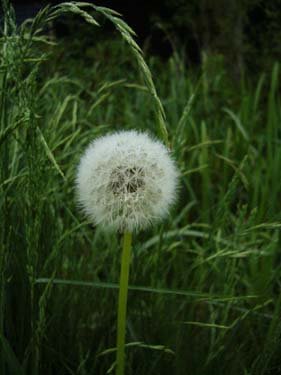
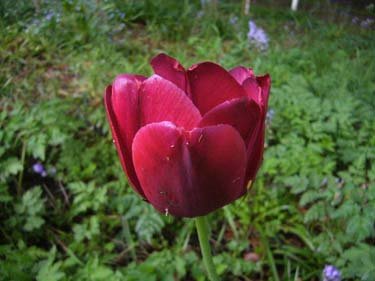
During my recent trip to the UK, I was in Camdridge for two days. Jetlagged, I was up at 4:30 am and found myself wandering near the river Cam. Some pictures from those days:

Cam River is narrow but pretty.


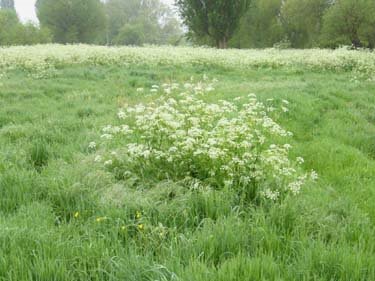
Meadows nearby were full of flowers


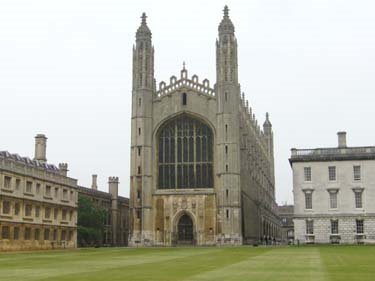
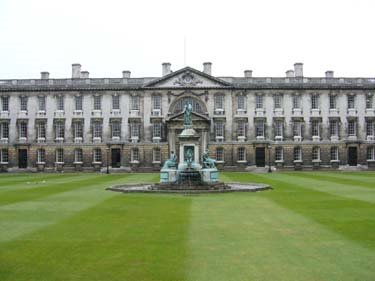
Kings College


Bridge over Cam

Sunday, May 28, 2006

Interesting People in London

During my visit to London, I "ran into" some interesting people.

I was walking by a bookstore on the way to a meeting, when I saw a sign saying Pele, the legendary footballer, would be book-signing at 6PM Thursday. It took me a couple of moments to realize it was Thursday and very close to 6. I am no closet Paparazzi, but I was not about to pass up on a Pele sighting.

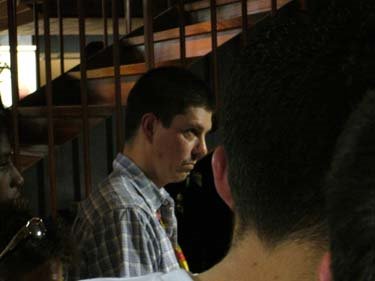
Here is the picture I got (you can see I failed the Paparazzi test :-)). But it was great to see this legend:


Weirder, here was a guy in the crowd who looked exactly like Scott McNealy!


Another time our delegation was invited to a dinner. The guest speaker was the Queen's son, Andrew, the Duke of York (Fergie's ex):


This was the place setting for the dinner. Over the top, but hey it is royalty!


In his speech, Andrew went to bat for the British IT industry, urging the invited foreign businessmen to do business with UK companies. Perhaps more Bangladeshi leaders can do the same for the IT industry here?

Bangladeshis in London

I lived in London from 1975 to 1977. Those were dark days for Bangladeshis (indeed, all immigrants) in London. Racism was rampant and economically the Bangladeshis inhabited the bottom of the food chain.

Two weeks ago I visited London as part of a business delegation. I had some meetings in Brick Lane and got to re-visit some of the "slums" I remembered from earlier days. Boy have things changed!

Bangladeshis (specially 2nd and 3rd generation) are now an upwardly-mobile group in the UK. Brick Lane thrives with rushing young people running their own businesses.

Not only do Bangladeshis own over 20000 restaurants in the UK, they sometimes co-opt other cuisine and give it a Bangladeshi taste. Eg, "Perfect Fried Chicken", a Bangladeshi-owned chain, takes the traditional Doner Kabab (Gyros) and fries it with chilis and Bengali spices to turn out a Bangladeshi Doner Kabab. I thought a good Doner Kabab could not be improved but these guys proved me wrong.

Bangladeshis hold many high-profile positions in the UK. For example, Irene Khan, the chief of Amnesty International, is from Bangladesh. So is the new mayor of Tower Hamlet Borough. The Qureshi family is probably a record-breaker in having three elected officials, called "Councillors", in London. And of course, Anwar Choudhury, the British High Commissioner in Dhaka.

In the (rather fat) book "Probashir Katha", Nurul Islam chronicles how the Bangladeshis - most of them from Sylhet - arrived in the UK. For example, Bangladeshi sailors fought alongside the British in the First world war and are mentioned in War Memorials in London. During the 1970s, several Bangladeshis were killed in racist violence.

But the persistence of this community - particularly in educating their younger generations - has paid off. I congratulate them on their success.

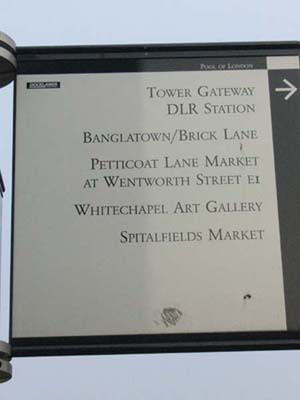
A signpost on Tower Bridge pointing to Banglatown:


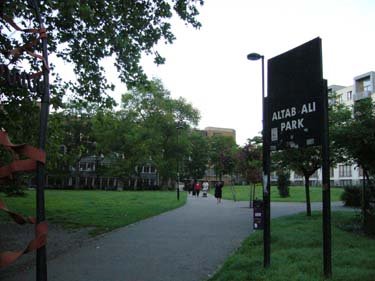
A park in memory of Altab Ali, killed by racists in 1978:

Friday, May 26, 2006

Center of Excellence for IT in Bangladesh

I have been thinking about this idea for a while, and wanted to write down my thoughts.

Why?
----

One way that Bangladesh can attain higher success in IT is to achieve excellence in smaller sub-areas of IT. Currently the IT industry in Bangladesh is trying to do too many things with too few skilled people. If we want to achieve success on a broad front of IT, we need tens of thousands of quality IT graduates every year. This is not realistic.

Therefore, we need to pick our battles carefully. Our kids are very intelligent. If we can focus them more in one or two areas, we can establish Bangladesh as a dominant player in certain subareas of IT.

For example, certain Eastern European countries are well-known as developers of Software Tools such as compilers, debuggers etc. The Philippines has established a reputation in animation. Many ATM-banking software packages come from Russian companies. Certain parts of Canada are well known for digital video expertise. And so on.

Once we establish technical excellence in an area, this will lead to more people being trained in this area and one hopes the critical mass needed for take-off will be created.


What Will it do?
----------------

In each Center of Excellence, a number of students (15? 20?)will work with academic and industry people and build software of industrial quality. They will learn to work as teams, use the tools and technologies needed, and under the guidance of a project lead, execute a project. Once the software is done it will be distributed as open-source software.


Why Will it Work?
-----------------

The emergence of open source software is one of the biggest reasons why CoE will work. This kind of software gives a head-start to anyone wanting to build a software project in many areas.

Another reason why it will work is that many bright young students are eager to sink their teeth into knotty, cutting-edge problems. Many CS/CSE students graduate without having built any real-world software because they were so busy learning the fundamentals. They are very eager to learn how to build "real" software.

Finally it will work because it will improve the employment prospects of the students.


Who Will Fund it?
-----------------

Such a Center will need to be heavily subsidized, with the understanding that perhaps, after 3 or more years, some revenue-generating work may be created. However, that should not be the goal of the CoE.

We cannot expect the students to pay high tuitions, although some fees must be charged so that students feel compelled to attend to get their money's worth.

What are the Subareas?
----------------------

Obviously the subareas must improve the employment prospects of the students. At the same time, they must be technically challenging. And they must be growth areas, globally.

Some possible areas are: Web 2.0 technologies, animation, database tuning, GIS, etc.

Is a CoE the Same as a "S/W Finishing School?"
--------------------------------------------

Not really. The difference is in the focus. While both want to make software engineers out of CS/CSE graduates, a CoE also wants to build up a critical mass of skills in a certain technological area so we can compete with the rest of the world in that area.

Who Will Run it?
----------------

A CoE must be run jointly by one or more universities and the IT industry. The former will contribute ideas, students, and skilled resources. The latter will contribute engineering discipline, solving tough engineering problems, and mentoring. Management can be done jointly.

Barriers to Venture Capital

Venture Capital is a powerful and effective way for doing big and interesting things in cutting-edge technologies. VC enables entrepreneurs to pursue their dreams by providing funds for their projects in exchange for a share of the business they are creating. VC have enabled many success stories in Silicon Valley (eg, Sun, Google, Cisco) as well as in other parts of the world.

A VC investment is not a loan. If you are an investor, risks in funding a VC project are very high. If the venture fails - happens 90% of the time - you lose your investment. But gains are also high, with 100x returns not uncommo in a successful venture.

The other day I was talking to someone from the British govt who has worked in Bd for several years on promoting different types of businesses. When I found out that he had an investment banking background, I asked him what were the barriers to creating a Venture Capital friendly environment here.

He mentioned two top items: no "exit strategy", and the lack of minority rights.

"Exit strategy" is how a VC investor realizes their gains in a successful venture. In the West, when a VC-funded company turns into a successful business, it is either floated (IPO) in the share market (in which case the investor makes a ton of money from selling their share of the company), or it is sold to a bigger company (in which case usually the investor's share also becomes a lot of money.) In Bangladesh, this person pointed out, neither is a viable option. The stock market is not vibrant, and there is no practice of buying out companies.

Minority rights was unfamiliar to me. So he explained it. VC investors are usually minority shareholders in a company (ie, they own < 50%). In the West, with this much ownership, they still have lots of rights and power within the company. However, in Bd, in a company boardroom, the majority shareholder has much greater power over the rights of the minority shareholder.

I plan to dig in more. I have heard lots of businessmen in Bd are sitting on tons of money, and we need to enable them to profitably put this equity back into the economy. A VC culture would be a boon to our IT business and help create an economy based on higher value goods and services.

Wednesday, May 10, 2006

Driving in Dhaka

During my first few weeks in Dhaka, I was constantly stressed by the driving. I mostly relied on a driver, but was worried he was going to hit someone or something. Amazingly, nowadays I am relaxed in the car.

Some unwritten rules I have gathered (remember, you drive on the left here):

If you are at an intersection and want to turn right, it is best to be on the leftmost lane and swerve all the way to the right at the last possible moment. This helps keep everyone awake and provides free brake-check for parties on the right.

Rickshawallahs will not brake unless faced with a situation where the cost of not braking is significantly higher than the cost of braking. One such situation is a policeman with a big stick. Impending collision with a speeding car does not constitute a reason for a rickshawallah to brake. After all, it is easy for the car driver to brake and resume, but it is much harder for the rickshawallah to do that.

If you are a CNG driver, then the amount of arrogance you show while saying "No" to a prospective passenger's trip request should be directly proportional to how exhausted/sweaty/pitiful the passenger looks.

If you are a bus driver, nothing will dare get in your way. Do as you please.

Honking is an act of courtesy. You should honk whenever there is the remotest chance that the person (or vehicle) in front of you is unaware of you. Sometimes you should honk to make sure your horn is working. You should do this preferably between 2am and 4am.

If you are near a pedestrian overpass, you should be really watchful for pedestrians. Whenever they see an overpass, Bangladeshis have the curious need to cross the road. Since it is easier to dash in front of speeding cars and jump over traffic islands than it is to climb the overpass, most people will opt to get in the way of your car. The govt should have built overpasses for the cars at major pedestrian intersections in order to save the pedestrians so much inconvenience.

110V Electronics

Some NRBs asked me how our 110v electronics from the US have fared in Bangladesh.

I was fortunate to find Mr. Latif of Hardy Electronics. He converted all my stereo equipment from 110v to 220v. He also built a transformer for my laser printer, and later fixed it when it was accidentally connected directly to 220V. He is amazingly competent.

Computers are not a problem because they run on 110-240.

Smaller devices (boomboxes, telephones, faxes, scanners, etc) run with step-up transformers I got in the US. You can buy them here for much less. Rule of thumb is to use a transformer with 2x the wattage of the device. So, for example, if you have a boombox that consumes 50W, you should use a 100W transformer.

Our lamps from the US were converted to local receptacles and wiring. That seems to work.

The only things that I have not figured out yet are the high wattage 110V kitchen equipment (coffeemaker etc). If anyone has an idea let me know. (And when I get that coffemaker working, I will start searching for freshly-roasted French Roast. Never a dull moment :-) )

Tuesday, May 09, 2006

Easier to Post Comments

I changed the settings of this blog so anyone can post comments now.

Friday, May 05, 2006

The Padma/Jagadish Chandra Bose

Early Friday morning, a friend and I went to Mawa Ghat on the river Padma, a 50-minute drive from Dhaka, to explore and take pictures.

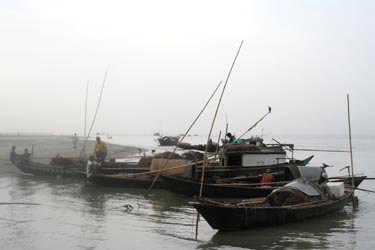
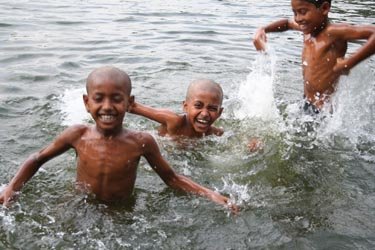
The Padma was wide even at this dry season. We found a fish-market on the sandy bank. Fish was brought in by numerous boats, and sold here for the markets in Dhaka. Children were playing everywhere. Mawa village lay next to the market, with narrow lanes and tin-roof houses.

From Mawa we drove to the ancestral home of (late) Sir Jagadish Chandra Bose - one of Indian subcontinent's most eminent scientists - in Dohar. Sir Bose invented wireless radio (local lore claims he divulged his findings to Marconi who walked off with the credits). He was also a great botanist, the first to prove conclusively that plants have lives.

Sir Bose's home is over many acres of land, and includes several buildings, ponds, orchards, etc. It has been converted into various schools and living quarters for school employees. Though there were statues and pictures of him, we found no documentation or introduction to his work. Sad.

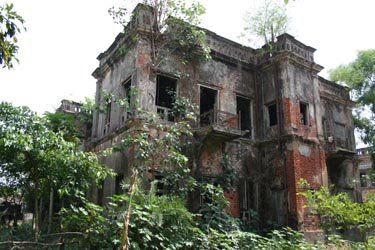
From there we visited the old mansion of a (Hindu) Zaminder with directions from a local acquaintance. We found the palace to be in poor repair. Some remnants pointed to the glory of old days, including ancient broken water pumps that ran on diesel and pumped water up to a rooftop tank so the Zamindar family could take showers. I am not sure who owns the property now. In fact, I could not even find the name of the original Zaminder.

Then it was off to nearby Bhagyakul market where my companions tasted the famous local "maaTha" - a lemony, sweetened yogurt drink. I abstained for bacteriophobic reasons, but relented in the end. A sip of the drink was delicious, not as thick as Lassi, but made invigorating by fresh lemon juice.

We returned home by noon. Thanks to Dr. Zia for showing me these places. Now the pictures.

The Famous Hilsa Fish of the Padma


Boats on the Padma


Dad feeding coconut-water to kid


Man with suitcase and fish


Boy who works on a boat


Windows in Mawa village


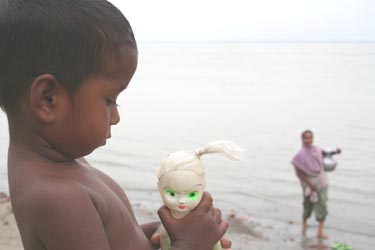
Girl with doll on riverbank


Cute kid at Mawa village


Entrance to JC Bose's home


Compound of one building in JC Bose's home


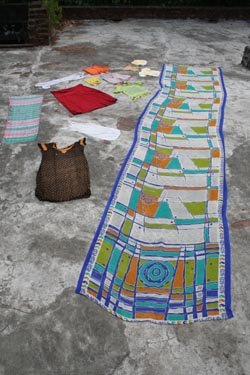
Drying clothes on roof of JC Bose's home


Roof-antennas in the house where the man who invented wireless radio once lived:


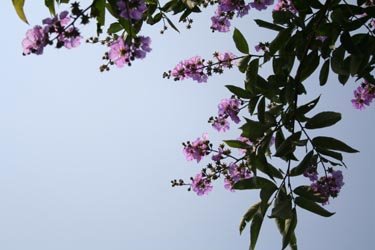
Jarul flowers in another building in JC Bose home:


A hijol tree on the pond; hijol's decomposed bark is good fish food:


Old Zamindar mansion


Pond belonging to Zamindar home


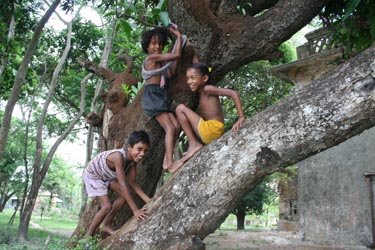
Kids climbed this tree for its flower

Stories from DS Business Awards

I attended this Award ceremony tonight. A great service from the Daily Star, to recognize business leaders and inspire budding entrepreneurs.

Couple of stories I found inspiring:

Business Person of the Year was Mr. Fazlur Rahman, Chairman of City Group of Industries, which employs 10000 people in 18 industries. I heard a story about him. When he was 9 years old, Mr. Rahman, who comes from a poor family in old Dhaka, went to the local grocery store to buy a few ounces of cooking oil on credit (I guess the family was short on cash). When he was turned down, he came home and swore to his Mother, "One day I will make an oil factory." And sure enough, his first factory was an Oil Mill (today they make Teer Cooking Oil as well as a zillion other things.) What an inspiration!

The last 5 years in the US, with increasing outdoor activities such as camping, hiking, biking, etc I grew fond of outdoors wear. The North Face is my favorite brand among technical outdoor clothing, because of their high quality (strong, lightweight, quick-drying, insulating, etc.) And guess what, much of their high-performance clothing is made in Bangladesh. The factory is Youngone, a Korean-Bangladeshi company, which won an award tonight.

The reason I found Youngone so inspiring is because this is cutting-edge stuff they make, not me-too products. Their philosophy of specializing in one thing and becoming really good at it has really paid off. They have proved that Bangladesh can create products w-a-a-a-y up the value chain.

I believe such an approach will work for the local IT industry.

Wednesday, May 03, 2006

My Letter in Time Magazine

Time magazine (Asia edition) on May 8, 2006 published my letter (in its entirety) regarding the Bangladesh article.

I can't find a link, so I will just quote the email I sent them.

Dear Sir,

Natives of Bangladesh, me and my wife worked in Silicon Valley for over 20 years in both engineering and managerial roles before deciding to return here in 2005. A key factor that helped us decide was the growth of the economy. Time-Asia's April 3rd cover story validates our thinking.

However, your story placed too little emphasis on the entrepreneurs and the development visionaries and too much emphasis on the politicians.

Too often, the progress of Bangladesh has been because of the efforts of the former and *despite* the efforts and petty bickerings of the latter.

Ihtisham Kabir

Friday, April 28, 2006

Things to do in Sylhet

Sylhet is my hometown, although I left at 9 and am a little estranged.

Here are some nice places that I discovered (or rediscovered):

a) Area around parjatan motel - nice spot, lots of nice views from a hill top on Airport road
b) Shahjalal University - pretty campus about 10 km N of town
c) Zakaria Resort - near Khadimnagar, a hilltop resort with 360 views and entertainment park including ferris wheel and toy train
d) Hazrat Shahjalal's tomb - he was an amazing holy man, worth a visit if you are religious
e) MC College (aka Sylhet Govt College) another nice campus
f) Forest Dept Land - some nice forests on north-east side of town, near Baluchar. There was a picnic spot but it may have shut down.
g) Tea gardens - Lakkatura and Malnichhara are very close to town. Bicycling possible on the trails (though I have not tried it.)

If you like shopping, Manipuri patterned saris etc in Police Line.

In summary, places just a little on the outskirts are nice. Avoid the center, specially Zindabazar and Bandar, unless you like crowds and traffic jams.

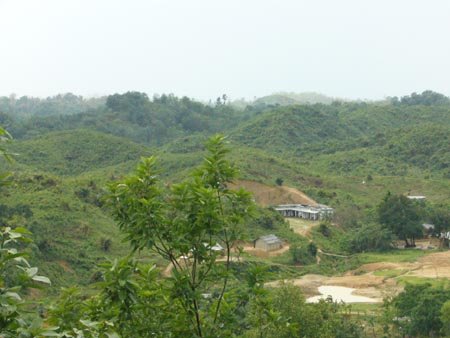
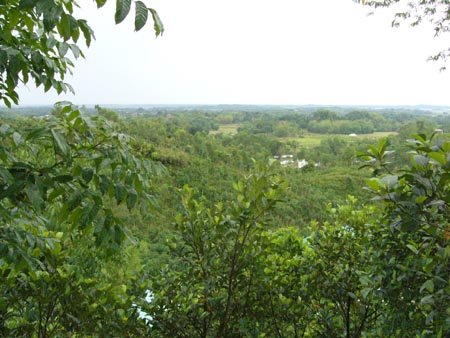
One view from top of Zakaria Resort:


View to the East from Zakaria:


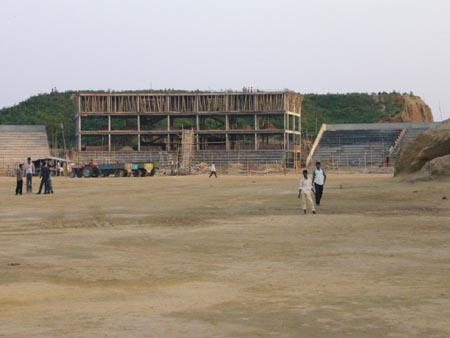
Stadium under construction near Lakkatura:


Storm Lilly:


What tractors were really made for:


Another type of Lilly:

Bye Scott

This has nothing to do with Bangladesh but since I worked at Sun for 15 years, I have some opinions about Scott McNealy who just gave up the CEO position.

My favorite quote from Scott was simply: "Character matters". He is extremely strong on personal integrity. I think this was the main reason why he hates Microsoft. He saw them as breaking the law (which was the verdict of the Federal anti-trust case against Microsoft.)

I know some personal details of Scott's life that I don't want to go into (my kids went to the same school as his) - except to say that in these details emerged glimpses of a life lived as if character mattered.

Scott made Sun from zero into a 20 Billion dollar company. It is extremely unlikely that without Java and other Sun innovations, the Internet would be what it is today.

His weakness was refusing to do large layoffs when the bubble burst. His mistake was holding on to people who were less than competent for their job levels (and some of them are still at Sun unfortunately.)

But boy does he have vision! Scott sees the (tech) future more clearly than any other tech luminary I have seen or known.

A Bus Trip

In recent years, bus service in Bangladesh has improved. Recently I travelled Dhaka-Sylhet-Dhaka by private bus. I was amazed at the high quality.

Planning the trip, I called various bus companies and Shohag appeared the most courteous and professional. Yes, they had many busses from Dhaka to Sylhet, what time would I like to leave, etc. Then the surprising question, "Would you like to travel by Business Class or Economy Class sir?" The prices were Tk 600 ($9) and 400 ($6) respectively so I said why not, this is the time to splurge.

When I got to the "terminal" at my "reporting time" and on to my assigned seat A1, a comfortably wide seat in front of the bus with at least 3 feet of legroom, I found a small pillow that appeared stuck on the seatback, uncomfortably behind by top vertebrum. I could not dislodge it and so asked for help. No problem: an ingenious sliding mechanism, using sewn-in ribbons, allowed the pillow to be slid up to behind the seatback.

In addition to the reclining seatback I also had a foot rest that popped out, an airline-like swivelling LCD TV (Business class exclusive), a massage system (which I could not get to work) and headphone audio system (which was also dicey.) Like planes, there was a mesh pocket attached to the back of the seat in front (in my case, on a panel in the front.) There were reading lights and individually controllable AC vents.

A "flight attendant" accompanied us and made several excruciatingly polite announcements in Bangla. My favorite one was when we arrived at our only break and pit-stop when he said "I hope my dear passengers will be able to satisfy all their needs at this stop." As in go to the bathroom.

Oh yeah, the bus had no bathroom. That was the only drawback. But that one stop it made halfway into the 5-hour trip was enough. Of course if you have diarrhoea you are dead.

Shortly after starting the attendant stuffed bottled water, a Cola can, a packet of crackers and two AlpenLiebe candies (Indian version of Werther's) into the mesh pocket.

The attendant also sprayed air-freshener a few times up and down the bus, near the floor. So, no odor problems.

There was a 15"(?) TV mounted on the top where they showed Bangladeshi programs. I enjoyed a program showing the "best of" Close-Up talent contest (though the headset jacks needed to be prodded often.) They also showed Mr. Bean episodes plus some dramas. But no Hindi stuff. However, the LCD monitor in Business Class had a second channel where they showed Bollywood.

All the Shohag employees were smartly dressed in beige shirts, ties and black pants. Most were polite but good salespeople at the same time.

The ride was ok, although the driver was quite generous with his honking (loud and shrill) and with tailgating and swerving around vehicles in front. The horn of this monster bus has a special sound that warns everyone in front to get out of the way.

The trip to Sylhet, estimated to be 4.5 hours, took five. On the way back the journey took 7.5 hours because we were stuck at Jatrabari (entrance to Dhaka) for about 3 hours. (Ugh. How I hate Jatrabari.)

Before the AC busses, passengers had suffered mightily over the years because of the difficulty in obtaining tickets for Biman or Railways (usually graft-related.) Now Biman and Rail tickets are no problem, because competition from busses have straightened them out.

Short of actually flying, these busses have emulated (with success) airline service every step of the way. In addition to the cabin service, they issue airline-like tickets and a check-in service with luggage tags for checking in larger bags into the bus belly.

Years ago, when my wife and I were travelling in Mexico, we were surprised by their assigned seating busses and polite service and wondered by Bangladeshi busses could not provide better service. No more - world-class bus service has come to Bangladesh.

I congratulate those who made these high-quality busses happen. The in-depth thought to every bit of customer experience shows in the meticulous execution.

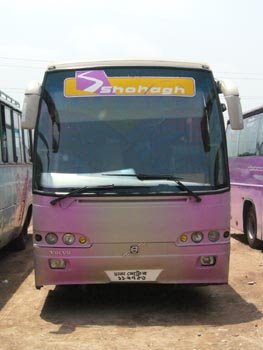
Now, please tell your drivers to drive a little more carefully on the highway, ok? Oh yeah, what's with the ugly pink color?

Here is the bus:



And here is the view from inside:

Saturday, April 22, 2006

Hartal = Bike-to-work day?

Today is a hartal day so I biked to work. It's about 6 km from my house to the office and it took me 30 minutes.

Since the streets were reasonably empty, I breathed only an acceptable amount of fumes. The lowlight was when I got stuck behind one of those ancient "murir tin" busses. That stuff coming out of their exhaust is noxious!

I noticed at the outset the rear tire was low on air, so I tried to find one of those roadside stands where the rickshaws get their tires pumped. The first one I found had to use an adapter of sorts to fit his pump into the tire of the Schwinn hybrid. When he finished and disengaged the adapter, he must have let out some air, because the tire did not look that much better. While I was biking and searching for another pump at the roadside stands, I saw many shoe-polishers, couple of "juta-shelais" (cobblers) and even one guy who had laid out a shaving brush and assorted shaving paraphernelia. Eventually I found another pump, but he said he could not do it, and I needed a "car pump". I asked a Rickshawallah, is there a pump place nearby, to which he nodded and said over there, pointing to nowhere in particular.

And so it went. But I got to work ok.

The only place with signs of trouble was in Mohakhali where some serious looking men were sitting in the middle of the street, wearing punjabis, and looking solemn. They were surrounded by the police, who looked like they were protecting the sit-inners. About 5 yards down the road, there were broken bricks and rocks on the street. Further on, saw broken glass so some car or bus must have been attacked.

Wednesday, April 19, 2006

The Curse of Bollywood

The noted Bengali author and columnist Dr. Zafar Iqbal wrote on Bollywood influence in his column "Shada-shidhey Katha." He said something to the effect that "up to some years ago I could boast never having seen a Hindi movie, but now I cannot. I have to travel by bus from Sylhet to Dhaka, and they show these movies in the busses where you are a captive audience."

It is extremely unfortunate that despite our rich and varied culture, we in Bangladesh have allowed Bollywood to take such a hold of our imagination. Every day on my way to work I have to see pictures of Karina Kapur and Ashwariya Rai on Pepsi and Lux advertisements. (Aren't there pretty girls in this country?) I have to hear Hindi songs blaring from stores and cars. And I think about all the bus passengers being subjected to nasty doses of Hindi movies.

What's your problem, you ask? Hindi movies are great entertainment. Let the masses enjoy.

First, there is the cultural imperialism issue. We support Hindi songs and movies at the expense of our own songs and movies. So the revenues, the adulation, and the enouragement - all of that goes to Bollywood instead of local talent. In the meantime more of our local traditions face extinction every day.

But my second, stronger objection is along aesthetic lines, not patriotic (or xenophobic) ones. Bollywood movies appeal to our cheap sentiments. They aim to give us instant gratification. They require no thought, reflection or spiritual involvement from us. Instead of raising our spirit and intellect higher, they bring them lower. Contrast this against the gems of Bangla culture: the sublime spirituality of Baul songs; Tagore's veneration of nature; Nazrul's poems of angry youth; the powerful (and sometimes humorous) plays that are staged in Dhaka; even the bantering, playful songs that Momtaz belts out on lost and cheated love. These give us reason to think, to feel and often to transcend our day-to-day realities and raise us to a higher plain.
Hindi movies, on the other hand, are like an overdose of chocolate that give us constipation the next day. They cheapen us, debase us as human beings.

The formulaic predictability of Hindi movies reminds me of Harry Chapin's immortal comments about a Country and Western song: "Next the song talked about a truck because it had already covered motherhood." So the Hindi movie must address the love triangle and the twisted villain because it has already addressed the separated-at-birth-but-evil twin brother.

It is extremely important to remember that the people who create Hindi movies are very hard-working, creative people. The irony is that their creation forces us to see the world as a dumbed-down, hero-zero place, stifling our own creativity. You know that song "Margaritaville?" "Living on sponge cake/watching the sun bake" etc. Jimmy Buffett's song creates visions of a laid-back life on the beaches of the Caribbean, drenched in alcohol, whiling away the sunny days. Guess what, Buffett is an extremely creative workaholic who sometimes works 20-hour days to create his music.

Similarly Bollywood honchos, themselves very creative and energetic people, create trash to stupify the masses.

One ray of hope I see comes from watching the Dhaka crowds participating in Pohela Boishakh cultural events, the long lines I saw waiting to enter the Ekushey Boimela, and the immense popularity of local bands who write their own Bangla songs (usually with far richer meaning than Hindi movie songs) or do remixes of classic Bangla folks songs. Although Hindi culture has infiltrated Bangladesh, one hopes that the infiltration has stopped growing and may be reversed soon.

Friday, April 14, 2006

Pohela Boishakh

Today is Pohela Boishakh, the beginning of the Bengali Year.

Many changes since the last time I spent Pohela Boishakh in Bangladesh. Most of it for the better: lots of parties ("functions"), women wearing attractive cotton saris on the streets (why can't they come out more often? Sometimes Dhaka seems like a city of men!), and a strong sense of happiness and cultural unity all over.

The best part of the day was when we were driving in front of a Garments factory. Suddenly a few hundred young women, workers at the factory, poured out of the gates, all wearing the same stunningly beautiful red-and-white sari. The saris were a gift from the company. What a breathless spectacle.

Back in my days,
We did not greet people with "shubho noboborsho" - it sounds too artificial
We did not eat Panta Bhat and Ilish Machh - this one is a shopkeeper's trick
We did not jam up all the main roads of the town heading off to the parties

To Pohela Boishakh I say "My, you have grown! Just like the rest of the country."

Monday, April 10, 2006

Birds

Birds have a larger presence in my life here than they had in the US.

For example, during my morning run today, I saw no less than 10 varieties: Shalik (why do they hang around the roads anyways?), Doyel (the national bird with signature white stripes), Fingey (which is, confusingly enough, called "Fesa" by the locals around here; in flight, its tail makes a long V), playful Chorui (sparrow), ugly but respected (because they eat trash) Darkak and Patikak (two varieties of crow), the ever-elegant Bulbuli, as well as 2-3 types I could not recognize. Just when I thought I had my fill a large Chil (eagle?) landed on top of a Debdaru tree.

Every morning, way-y-y before dawn, the birds start singing loud and clear - perhaps more so than a sleepy person might like.

I do miss the hummingbirds that used to buzz around the berries growing on the holly tree in my Los Altos backyard. As well as those black squirrels, prevalent in Palo Alto and Los Altos, that some claimed were the result of a Stanford genetics experiment gone awry.

In any case, Bangladesh must be a heaven for birders. Good tourist sell, methinks.

Sure Looks Like we are on a Roll

Looking good so far. Tomorrow should be suspenseful.
Whatever the outcome of the match, I doubt we will be
hearing the Aussies dissing Bd cricketers anytime soon.
http://http://news.bbc.co.uk/sport1/hi/cricket/4894964.stm

Sunday, April 09, 2006

Are we on a roll?

I am not a great cricket fan, but this made my heart sing
http://news.bbc.co.uk/sport1/hi/cricket/4890418.stm

Urm, aren't these the same Aussies who dissed us some months ago?

Monday, April 03, 2006

Cover of Time Magazine

A positive story on Bangladesh on the cover of Time (Asia) magazine.

http://www.time.com/time/asia/covers/501060410/story.html

Great story, sweet antidote to Henry "bottomless" Kissinger and his ilk.

My only reservation is that the story pays too much attention to the politicians and not enough to the entrepreneurs who are the real force behind the progress.

BTW, I found out about this cover story from the News From Bangladesh site