Friday, August 25, 2006

Khilkhet Bicycle Ride (Photos)

I went on a 4-hour bicycle trip through Rupganj, east of Khilkhet, with my biking buddies today.

Crossing Basundhara housing we took a small boat (chhip nouka) across the water to get to Khilkhet proper (this let us avoid Airport Road). The boat was small and shaky, and it took two trips for the three of us with our bicycles.

We biked past at least half a dozen new "cities" being developed (Jamuna City plus others.) There was major land reclamation going on, with sand - dredged from under the Padma and brought here in large boats - being pumped from those boats via fat pipes into the desired locations. This sand is used to raise the level of the land; if you look at Dhaka using Google Earth you can see the bright white sand patches in the northeast part of town.

On these bicycling trips, since I wear a helmet and western garb, and am out with the "foreigners", most people don't think I am Bangladeshi - until I wish them a Salam or ask "Kemon Achhen?" at which point they turn to their neighbor with a surprised expression, saying "oiTato Bangla, dekhsen?" (apparently "Bangla" has become short for "Bangladeshi.")

I bantered with many people in this way. Then it was my turn to be surprised. We were coming down from a bridge heading towards a bunch of kids who were watching us. I guess they were arguing whether I was a Bangladeshi, because as I passed by one of them yelled at me in Bangla, "tire-er pump gesey ga" (your tires are deflating) and I immediately looked at my tires. This of course resolved their argument; they laughed and clapped and one of them said to the others: "Koisilam na oiTa Bangla!" ("Didn't I tell you he is a Bangladeshi?")

We stopped for a tea break at a village called Moshur. Acting as interpreter for my friends' questions, I asked the villagers if the lack of rain had affected their crops. No they said, because they plant a variation of IRRI rice that is planted in Kartik (September) so the rains are not critical for it. In fact, their sugar cane harvest was good this year because of low rains. The rice, once ready, will sell for Tk10/kg (unhusked). Per acre they expect about 95 Maunds of unhusked rice (1 Maund =40kg).

What else do they grow? "We have fisheries over there where we grow Shorputi, Rui, Carp and Tilapia." And no Pangas, I asked. "Nope, Pangas is cheap and yields no profit."

In another village a babytaxi with mike went around announcing "Great news, great news, on Saturday from 10am-3pm, mothers will get free health checkups for their children at such and such place."

Some pictures:

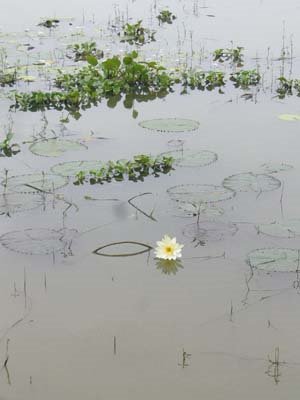
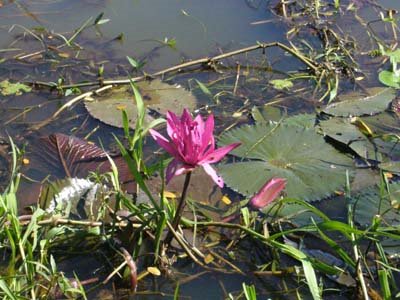
Shaplas have started to bloom. They come in many shades including white...

and pink:

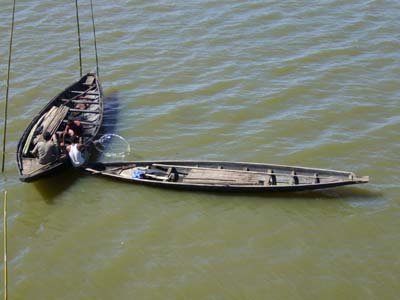
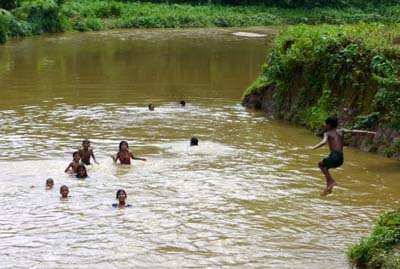
A good season for fishing, either with a borshi (fishing pole)...


...or with nets:


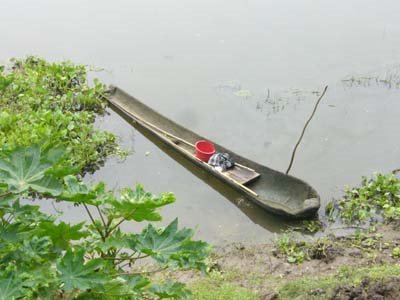
Dugout boat made from tree-trunk:

Two friends who were walking down the street near Moshuri:


Photography studio at Moshuri:


The mom wasn't sure about being photographed but the child did not mind:


Joyride bus:


Many thanks to Stefan and Peter for giving me company on this trip.

Tuesday, August 22, 2006

Death

Death seems to be a lot closer, and more present, since we returned to Bangladesh over a year ago.

For example, some months ago I was at a local Club signing up for membership. I gave my money to the accounts person in the office, a polite young man, who took care of my paperwork. A few days later I was at the Club ordering food at a counter, when I noticed a collection box at the far end of a table. You know, a cardboard box with a slot on the top for collecting money for a cause. Moving closer, I noticed a picture on the box - and as I got even closer I see the same young man. It was a collection for his family, because a couple of days after I met him, he was run over by a bus on the road while jogging.

When we were living in the US death seemed far, but here it always seems to be lurking around the corner.

Part of that is because here we have many more older relatives and friends than we had in the US. Partly, it is because we just know more people, and their older relatives die, and so on.

Statistically, the life expectancy is less than the US, which also contributes. Not sure about the per-capita accident rates, though.

When I go to the prayer services for those who have departed, those leading the prayers also talk a lot about death.

Newspapers have "nth" death anniversary notices for eminent people almost every day.

My favorite story about death:

Many years ago, in the Middle East, a rich man's servant comes to him one morning, shaking with fear. "Master, master, I was in the market and saw Death. And he looked at me in that special way. I want to run away as far as I can from here."

The master, who liked this servant very much, said "I'll give you my fastest horse and you can go all the way to fay-away Samarra." So the servant takes off.

Later in the day master goes to the market and looks for Death. When he finds him, he says, "Why did you startle my servant this morning?"

"It is I who was startled," protested Death, "because I'm meeting him in far-away Samarra later this evening. What was he doing so far away from there?"

(Another version of this story, which I heard at a recent Kulkhani (a prayer service for the departed father of a close friend), has Hazrat Idris (AS) in it. He feels that he has not worshipped Allah enough in his lifetime and asks Allah for an extension of his life so he can complete his prayers. He is taken all the way to the fourth heaven where he has a chance to ask Azrael (who is responsible for taking the life out of each human.) He asks Azrael for the extension, and Azrael says, "Funny, I just now got the order to take your life right away, and I was wondering how I was going to go all the way down to earth from here in time to do it.")

Monday, August 14, 2006

View From the Train (Photos)

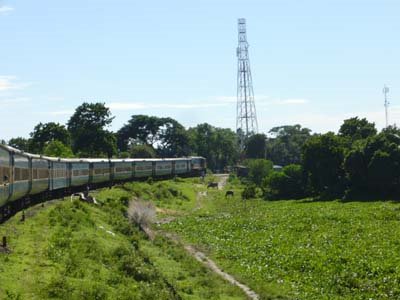
I took the train from Dhaka to Srimongol last Saturday. I saw these from my window:

My train was called "Parabat Express":


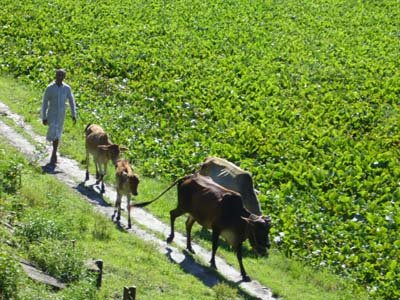
Man walking cows to the field:


Farmers transplanting rice seedlings; harvest in Aghrahayan:


Typical river scene:


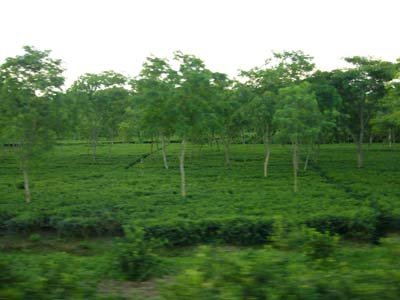
Tea garden:


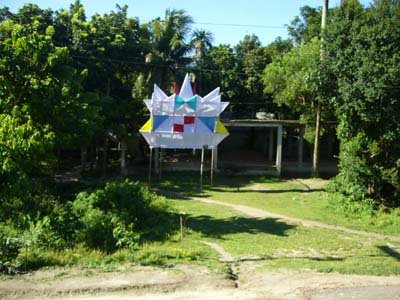
Decorated gate for a village wedding:


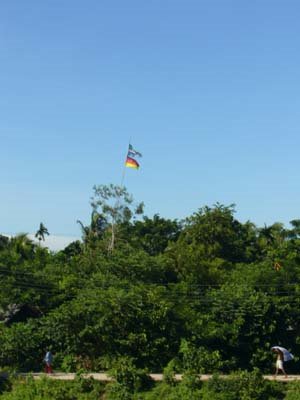
Flags supporting world cup soccer:


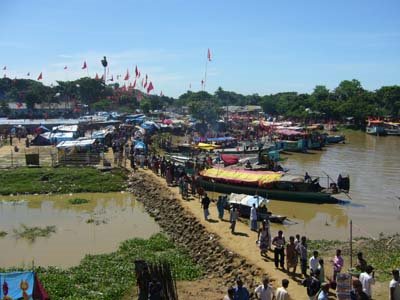
An Uros party (celebrating the death anniversary of a local saint):


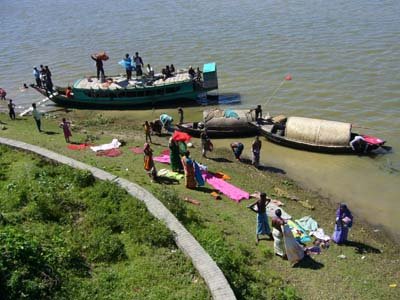
Boats of Bedey people (who live their lives on boats):


Man building a temporary home:


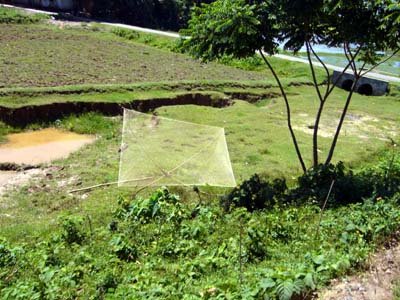
Fishing net being dried in the sun:


Helping get water out of a boat:


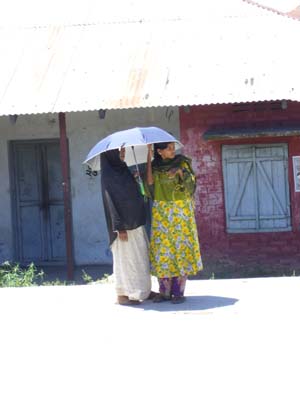
Mother and daughter at a train station in the (hot) noonday sun:


Train going the opposite direction:


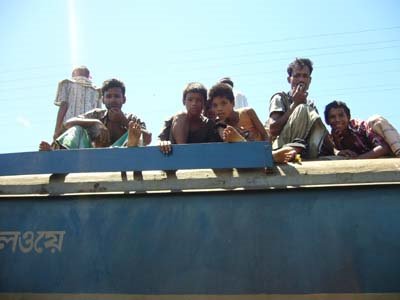
People on the roof:


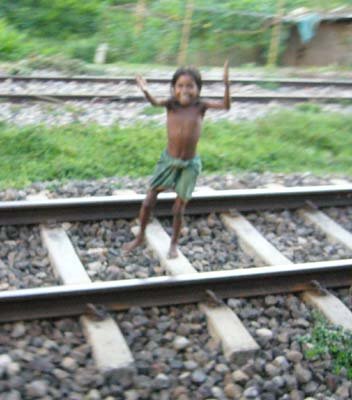
Girl on tracks:


Note: this was a First Class seat. A/C Class windows are fixed shut and will not offer these views. Trip was 4.5 hours.

Friday, August 04, 2006

Srimongol Bike Ride (Photos)

Yesterday I went for a 40-mile bike ride through the tea gardens in Srimongol. With me was Stefan (a biking buddy) who planned this trip and came prepared with an older edition of Lonely Planet Bangladesh with a map of this area (the current edition does not.) We started out in Kamalganj and biked in a loop through many tea estates including Srigobindapur, Dolai, Balicchera, Husseinabad and Phulbari.

The starting point for this loop was the HEED bungalow in Kamalganj. From there we followed the main road towards Shamshernagar until reaching a large intersection, where we turned right. Then we pretty much followed this road all the way, looping through various gardens and emerging on the main road again near Srimongol.

The road varied from paved to brick to sand. We did not encounter significant mud despite the rainy season.

It was a daytrip from Dhaka. Left Dhaka by car: 6:30am; arrived at Kamalganj: 9:30am; done biking: 3:30pm; left for Dhaka by car: 4pm; arrived home: 8:30pm.

It was beautiful in a serene, peaceful kind of way. Here are some pictures. Many thanks to Stefan for taking the initiative for the trip and navigating.

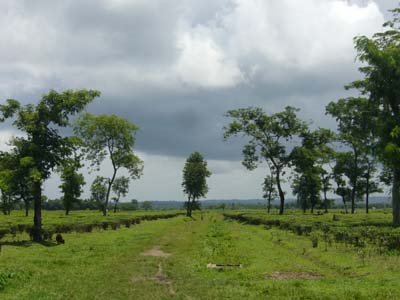
We ran into some spectacular landscapes. In the distance it was raining, but we luckily managed to stay dry:


The path was pretty though the brick portions of it jarred every bone in my body!


Many people used biycles in the villages. The boy in the foreground is too small to sit on the saddle but can ride by threading his leg through the frame's triangle. Later we met two boys who had bicycled from Shamshernagar to Srimongol (19km) for fun.


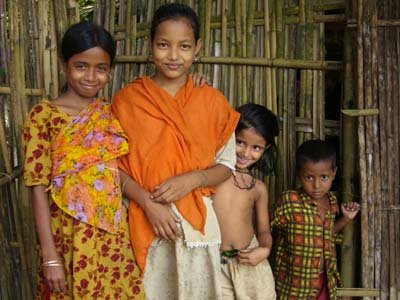
Once we lost our way and ran into these kids in a village...


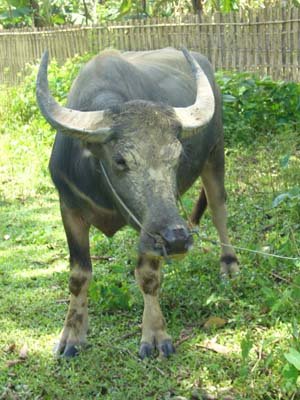
... and then this Mohish (water buffalo) with whom I was very careful not to get into an argument!


School was over near Srigobindopur:


This father and son pair were working in the tea field:


In the garden, women waited to weigh the tea they had collected. Life must be hard when so much of it depends on weight - be it tea-leaves, rubber-latex, fruits, firewood or fish.


Other workers got a lunch break...


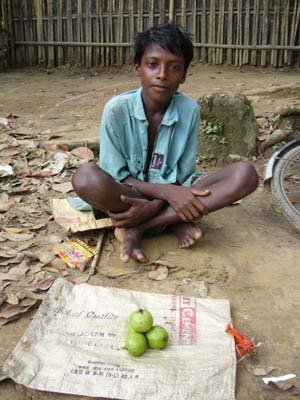
...While a boy offered guavas for sale near a labor village.


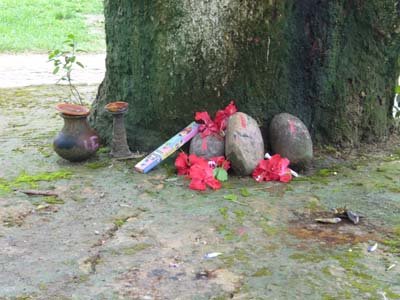
On a mandap at the foot of a large tree were remains of a prayer offering:


A drying sari lit up the landscape...


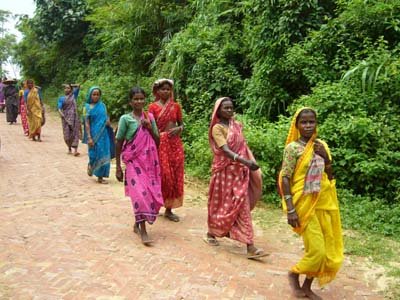
... as did this group who had just finished their weighing:


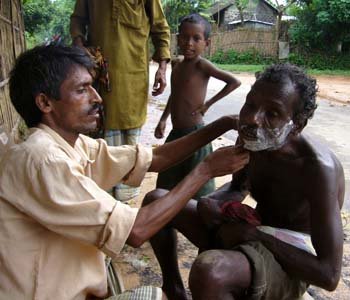
Meanwhile, it was time for the Friday shave for one of the men -


...but - as usual - the children had a better idea!


Postscript: Several years ago, I photographed the tea workers extensively. You can see some of them in my photo exhibit at the Fixing Shadows online Gallery, for example, this girl

Tuesday, August 01, 2006

Local Delights

One of the most delightful things about coming back to Bangladesh is the access to second-tier local fruits. The top-tier ones, such as mangoes and lichis, were available in the US. But the smaller ones (such as "Lotkon" (Bhubi in Sylheti), Orboroi (Leboir in Sylhet), Guavas (specially the small ones with red inside, called "Syedi Shofri" in - guess where? - Sylhet), Kamrangas, Jamruls, Amlokis, Koromcha, Panifol, Makhna, etc etc - parade through here during the year, one after another.

These fruits played a bigger role in my childhood than the top-tier ones because they were more easily accessible.

They are not just eaten fresh, but some in Bharta, others as "Tok", some in Jelly, and yet others in Aachar (eg, Leboir makes an excellent sweet achar.)

I tasted a Bhubi after 30 years. The taste and flavor were as exquisite to me as they had been years ago.

Attracting Large IT Companies

Tony Blair visited Silicon Valley last week, partly to lobby for bringing more companies to the UK, partly to understand what makes the Valley tick.

Sun CEO Jonathan Schwartz was at a lunch with Blair. Here is what he says about attracting their business to your country.

"So if you want to attract companies like Sun to your economy, focus on investing in education, in your students, and in your leaders. Focus on educating your policy makers as to why you're committed to education - not to build presitigious institutions, but to invest in progress, academic as well as economic. Focus on the value of broad based talent as a competitive weapon, don't be distracted by cost reducing labor."

http://blogs.sun.com/roller/page/jonathan

Friday, July 21, 2006

Bara Katra, Chhota Katra (Photos)

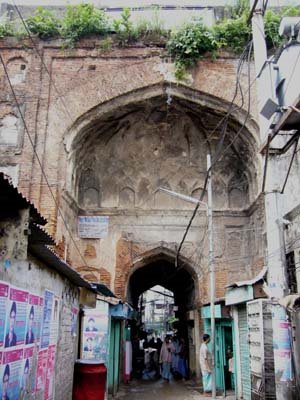
Bara Katra is one of Dhaka's oldest buildings, built in 1644 by Mir Abdul Qasem. It was originally an enclosed quadrangle on the Buri Ganga, with a marvellous entrance/gate with four wings and 22 rooms. The remains include the entrance and the tower. In a sad an delapidated state, one needs to use one's imagination to visualize the grandeur that this place must have held.

Here is the front of the entrance:


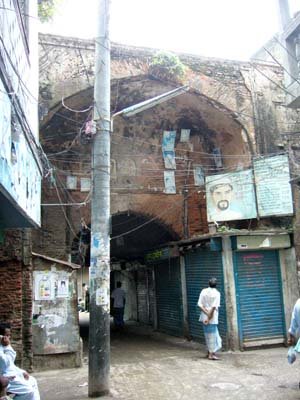
and the rear:


The tower:


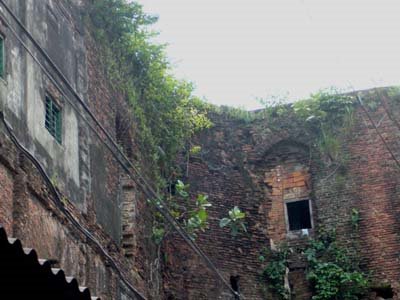
Back side of the edifice:


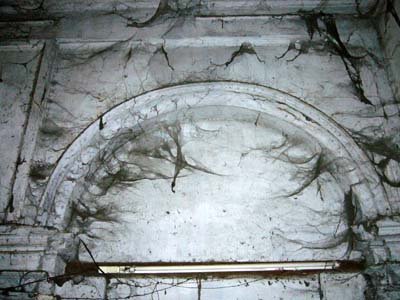
Underside of the archway with decorations:


Living quarters under the archway. The archway also contained a few stores.


Inside Bara Katra is a Madrasa now. A kind man showed me around. Interior views:


Stairs inside Bara Katra:


Chhota Katra was built by Shaista Khan in 1663. D'Oyly mentions it in his "Antiquities of Dhaka." It is similar to Bara Katra, but even less remains.

Entrance of Chhota Katra:


Inside Chhota Katra was an umbrella-making shop with these walls:


View from top of Chhota Katra looking to the river:


Having recently visited Italy and seen the amount of tourist revenue they must get out of old monuments, I am convinced that if we take steps to save/restore these monuments, our investment will be paid back many times. Why is it that we so easily let our irreplaceable buildings slide to destruction?

I got the historical facts from "Discover the Monuments of Bangladesh" by Dr. Nazimuddin Ahmed, published by UPL.