Some NRBs asked me how our 110v electronics from the US have fared in Bangladesh.
I was fortunate to find Mr. Latif of Hardy Electronics. He converted all my stereo equipment from 110v to 220v. He also built a transformer for my laser printer, and later fixed it when it was accidentally connected directly to 220V. He is amazingly competent.
Computers are not a problem because they run on 110-240.
Smaller devices (boomboxes, telephones, faxes, scanners, etc) run with step-up transformers I got in the US. You can buy them here for much less. Rule of thumb is to use a transformer with 2x the wattage of the device. So, for example, if you have a boombox that consumes 50W, you should use a 100W transformer.
Our lamps from the US were converted to local receptacles and wiring. That seems to work.
The only things that I have not figured out yet are the high wattage 110V kitchen equipment (coffeemaker etc). If anyone has an idea let me know. (And when I get that coffemaker working, I will start searching for freshly-roasted French Roast. Never a dull moment :-) )
Wednesday, May 10, 2006

Tuesday, May 09, 2006
Friday, May 05, 2006
The Padma/Jagadish Chandra Bose
Early Friday morning, a friend and I went to Mawa Ghat on the river Padma, a 50-minute drive from Dhaka, to explore and take pictures.
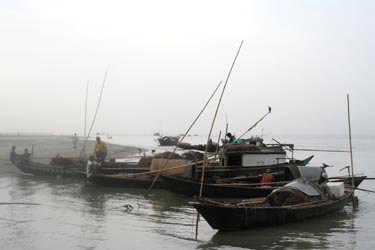
The Padma was wide even at this dry season. We found a fish-market on the sandy bank. Fish was brought in by numerous boats, and sold here for the markets in Dhaka. Children were playing everywhere. Mawa village lay next to the market, with narrow lanes and tin-roof houses.
From Mawa we drove to the ancestral home of (late) Sir Jagadish Chandra Bose - one of Indian subcontinent's most eminent scientists - in Dohar. Sir Bose invented wireless radio (local lore claims he divulged his findings to Marconi who walked off with the credits). He was also a great botanist, the first to prove conclusively that plants have lives.
Sir Bose's home is over many acres of land, and includes several buildings, ponds, orchards, etc. It has been converted into various schools and living quarters for school employees. Though there were statues and pictures of him, we found no documentation or introduction to his work. Sad.
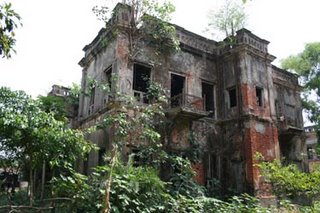
From there we visited the old mansion of a (Hindu) Zaminder with directions from a local acquaintance. We found the palace to be in poor repair. Some remnants pointed to the glory of old days, including ancient broken water pumps that ran on diesel and pumped water up to a rooftop tank so the Zamindar family could take showers. I am not sure who owns the property now. In fact, I could not even find the name of the original Zaminder.
Then it was off to nearby Bhagyakul market where my companions tasted the famous local "maaTha" - a lemony, sweetened yogurt drink. I abstained for bacteriophobic reasons, but relented in the end. A sip of the drink was delicious, not as thick as Lassi, but made invigorating by fresh lemon juice.
We returned home by noon. Thanks to Dr. Zia for showing me these places. Now the pictures.
The Famous Hilsa Fish of the Padma

Boats on the Padma

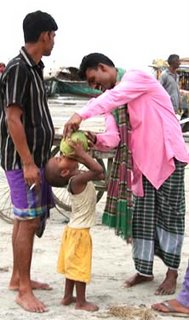
Dad feeding coconut-water to kid
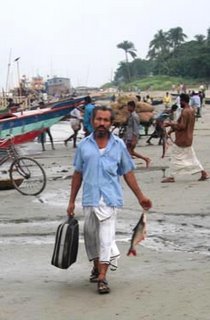
Man with suitcase and fish
Boy who works on a boat

Windows in Mawa village

Girl with doll on riverbank
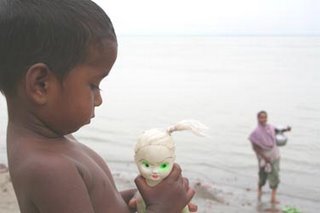
Cute kid at Mawa village

Entrance to JC Bose's home

Compound of one building in JC Bose's home

Drying clothes on roof of JC Bose's home

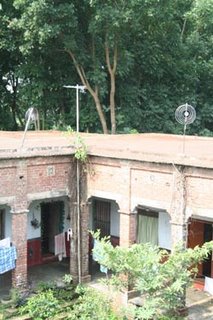
Roof-antennas in the house where the man who invented wireless radio once lived:
Jarul flowers in another building in JC Bose home:

A hijol tree on the pond; hijol's decomposed bark is good fish food:

Old Zamindar mansion
Pond belonging to Zamindar home

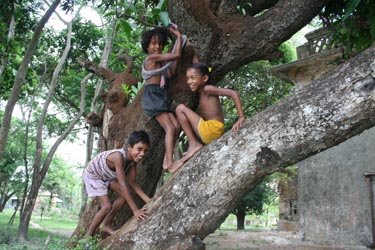
Kids climbed this tree for its flower

The Padma was wide even at this dry season. We found a fish-market on the sandy bank. Fish was brought in by numerous boats, and sold here for the markets in Dhaka. Children were playing everywhere. Mawa village lay next to the market, with narrow lanes and tin-roof houses.
From Mawa we drove to the ancestral home of (late) Sir Jagadish Chandra Bose - one of Indian subcontinent's most eminent scientists - in Dohar. Sir Bose invented wireless radio (local lore claims he divulged his findings to Marconi who walked off with the credits). He was also a great botanist, the first to prove conclusively that plants have lives.
Sir Bose's home is over many acres of land, and includes several buildings, ponds, orchards, etc. It has been converted into various schools and living quarters for school employees. Though there were statues and pictures of him, we found no documentation or introduction to his work. Sad.
From there we visited the old mansion of a (Hindu) Zaminder with directions from a local acquaintance. We found the palace to be in poor repair. Some remnants pointed to the glory of old days, including ancient broken water pumps that ran on diesel and pumped water up to a rooftop tank so the Zamindar family could take showers. I am not sure who owns the property now. In fact, I could not even find the name of the original Zaminder.
Then it was off to nearby Bhagyakul market where my companions tasted the famous local "maaTha" - a lemony, sweetened yogurt drink. I abstained for bacteriophobic reasons, but relented in the end. A sip of the drink was delicious, not as thick as Lassi, but made invigorating by fresh lemon juice.
We returned home by noon. Thanks to Dr. Zia for showing me these places. Now the pictures.
The Famous Hilsa Fish of the Padma

Boats on the Padma
Dad feeding coconut-water to kid

Man with suitcase and fish

Boy who works on a boat

Windows in Mawa village

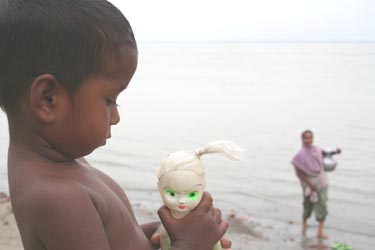
Girl with doll on riverbank
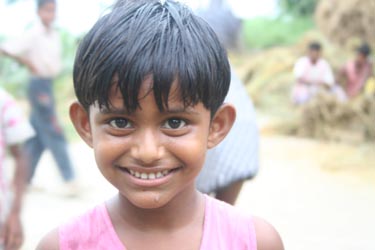
Cute kid at Mawa village
Entrance to JC Bose's home

Compound of one building in JC Bose's home

Drying clothes on roof of JC Bose's home
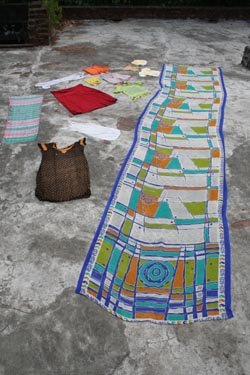
Roof-antennas in the house where the man who invented wireless radio once lived:

Jarul flowers in another building in JC Bose home:
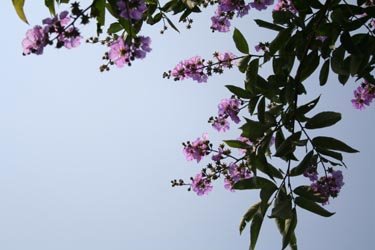
A hijol tree on the pond; hijol's decomposed bark is good fish food:

Old Zamindar mansion
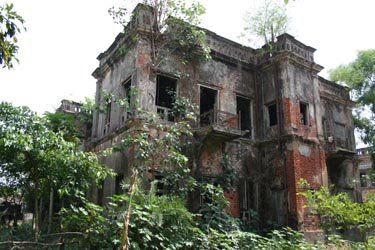
Pond belonging to Zamindar home

Kids climbed this tree for its flower
Stories from DS Business Awards
I attended this Award ceremony tonight. A great service from the Daily Star, to recognize business leaders and inspire budding entrepreneurs.
Couple of stories I found inspiring:
Business Person of the Year was Mr. Fazlur Rahman, Chairman of City Group of Industries, which employs 10000 people in 18 industries. I heard a story about him. When he was 9 years old, Mr. Rahman, who comes from a poor family in old Dhaka, went to the local grocery store to buy a few ounces of cooking oil on credit (I guess the family was short on cash). When he was turned down, he came home and swore to his Mother, "One day I will make an oil factory." And sure enough, his first factory was an Oil Mill (today they make Teer Cooking Oil as well as a zillion other things.) What an inspiration!
The last 5 years in the US, with increasing outdoor activities such as camping, hiking, biking, etc I grew fond of outdoors wear. The North Face is my favorite brand among technical outdoor clothing, because of their high quality (strong, lightweight, quick-drying, insulating, etc.) And guess what, much of their high-performance clothing is made in Bangladesh. The factory is Youngone, a Korean-Bangladeshi company, which won an award tonight.
The reason I found Youngone so inspiring is because this is cutting-edge stuff they make, not me-too products. Their philosophy of specializing in one thing and becoming really good at it has really paid off. They have proved that Bangladesh can create products w-a-a-a-y up the value chain.
I believe such an approach will work for the local IT industry.
Couple of stories I found inspiring:
Business Person of the Year was Mr. Fazlur Rahman, Chairman of City Group of Industries, which employs 10000 people in 18 industries. I heard a story about him. When he was 9 years old, Mr. Rahman, who comes from a poor family in old Dhaka, went to the local grocery store to buy a few ounces of cooking oil on credit (I guess the family was short on cash). When he was turned down, he came home and swore to his Mother, "One day I will make an oil factory." And sure enough, his first factory was an Oil Mill (today they make Teer Cooking Oil as well as a zillion other things.) What an inspiration!
The last 5 years in the US, with increasing outdoor activities such as camping, hiking, biking, etc I grew fond of outdoors wear. The North Face is my favorite brand among technical outdoor clothing, because of their high quality (strong, lightweight, quick-drying, insulating, etc.) And guess what, much of their high-performance clothing is made in Bangladesh. The factory is Youngone, a Korean-Bangladeshi company, which won an award tonight.
The reason I found Youngone so inspiring is because this is cutting-edge stuff they make, not me-too products. Their philosophy of specializing in one thing and becoming really good at it has really paid off. They have proved that Bangladesh can create products w-a-a-a-y up the value chain.
I believe such an approach will work for the local IT industry.
Wednesday, May 03, 2006
My Letter in Time Magazine
Time magazine (Asia edition) on May 8, 2006 published my letter (in its entirety) regarding the Bangladesh article.
I can't find a link, so I will just quote the email I sent them.
Dear Sir,
Natives of Bangladesh, me and my wife worked in Silicon Valley for over 20 years in both engineering and managerial roles before deciding to return here in 2005. A key factor that helped us decide was the growth of the economy. Time-Asia's April 3rd cover story validates our thinking.
However, your story placed too little emphasis on the entrepreneurs and the development visionaries and too much emphasis on the politicians.
Too often, the progress of Bangladesh has been because of the efforts of the former and *despite* the efforts and petty bickerings of the latter.
Ihtisham Kabir
I can't find a link, so I will just quote the email I sent them.
Dear Sir,
Natives of Bangladesh, me and my wife worked in Silicon Valley for over 20 years in both engineering and managerial roles before deciding to return here in 2005. A key factor that helped us decide was the growth of the economy. Time-Asia's April 3rd cover story validates our thinking.
However, your story placed too little emphasis on the entrepreneurs and the development visionaries and too much emphasis on the politicians.
Too often, the progress of Bangladesh has been because of the efforts of the former and *despite* the efforts and petty bickerings of the latter.
Ihtisham Kabir
Friday, April 28, 2006
Things to do in Sylhet
Sylhet is my hometown, although I left at 9 and am a little estranged.
Here are some nice places that I discovered (or rediscovered):
a) Area around parjatan motel - nice spot, lots of nice views from a hill top on Airport road
b) Shahjalal University - pretty campus about 10 km N of town
c) Zakaria Resort - near Khadimnagar, a hilltop resort with 360 views and entertainment park including ferris wheel and toy train
d) Hazrat Shahjalal's tomb - he was an amazing holy man, worth a visit if you are religious
e) MC College (aka Sylhet Govt College) another nice campus
f) Forest Dept Land - some nice forests on north-east side of town, near Baluchar. There was a picnic spot but it may have shut down.
g) Tea gardens - Lakkatura and Malnichhara are very close to town. Bicycling possible on the trails (though I have not tried it.)
If you like shopping, Manipuri patterned saris etc in Police Line.
In summary, places just a little on the outskirts are nice. Avoid the center, specially Zindabazar and Bandar, unless you like crowds and traffic jams.
One view from top of Zakaria Resort:
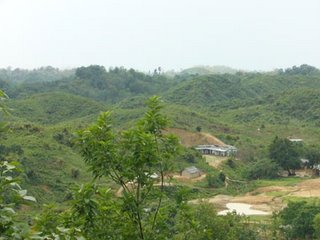
View to the East from Zakaria:

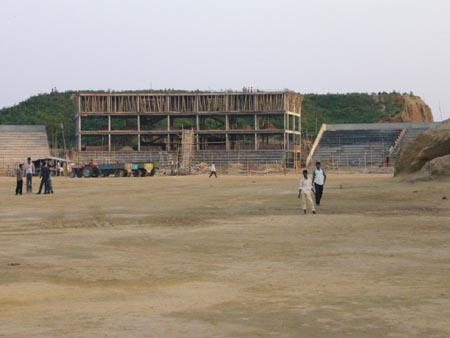
Stadium under construction near Lakkatura:
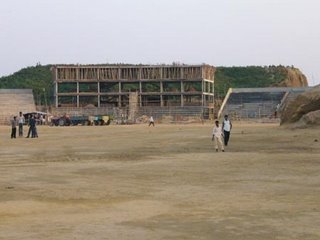
Storm Lilly:

What tractors were really made for:

Another type of Lilly:

Here are some nice places that I discovered (or rediscovered):
a) Area around parjatan motel - nice spot, lots of nice views from a hill top on Airport road
b) Shahjalal University - pretty campus about 10 km N of town
c) Zakaria Resort - near Khadimnagar, a hilltop resort with 360 views and entertainment park including ferris wheel and toy train
d) Hazrat Shahjalal's tomb - he was an amazing holy man, worth a visit if you are religious
e) MC College (aka Sylhet Govt College) another nice campus
f) Forest Dept Land - some nice forests on north-east side of town, near Baluchar. There was a picnic spot but it may have shut down.
g) Tea gardens - Lakkatura and Malnichhara are very close to town. Bicycling possible on the trails (though I have not tried it.)
If you like shopping, Manipuri patterned saris etc in Police Line.
In summary, places just a little on the outskirts are nice. Avoid the center, specially Zindabazar and Bandar, unless you like crowds and traffic jams.
One view from top of Zakaria Resort:
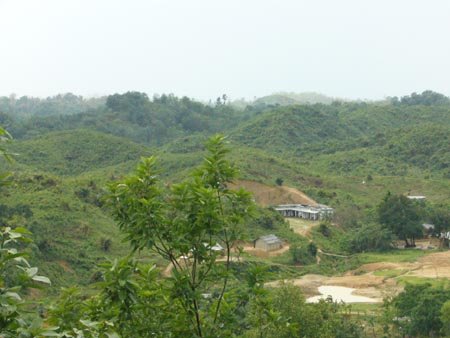
View to the East from Zakaria:
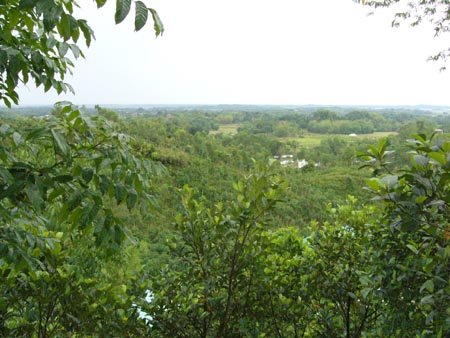
Stadium under construction near Lakkatura:
Storm Lilly:

What tractors were really made for:

Another type of Lilly:

Bye Scott
This has nothing to do with Bangladesh but since I worked at Sun for 15 years, I have some opinions about Scott McNealy who just gave up the CEO position.
My favorite quote from Scott was simply: "Character matters". He is extremely strong on personal integrity. I think this was the main reason why he hates Microsoft. He saw them as breaking the law (which was the verdict of the Federal anti-trust case against Microsoft.)
I know some personal details of Scott's life that I don't want to go into (my kids went to the same school as his) - except to say that in these details emerged glimpses of a life lived as if character mattered.
Scott made Sun from zero into a 20 Billion dollar company. It is extremely unlikely that without Java and other Sun innovations, the Internet would be what it is today.
His weakness was refusing to do large layoffs when the bubble burst. His mistake was holding on to people who were less than competent for their job levels (and some of them are still at Sun unfortunately.)
But boy does he have vision! Scott sees the (tech) future more clearly than any other tech luminary I have seen or known.
My favorite quote from Scott was simply: "Character matters". He is extremely strong on personal integrity. I think this was the main reason why he hates Microsoft. He saw them as breaking the law (which was the verdict of the Federal anti-trust case against Microsoft.)
I know some personal details of Scott's life that I don't want to go into (my kids went to the same school as his) - except to say that in these details emerged glimpses of a life lived as if character mattered.
Scott made Sun from zero into a 20 Billion dollar company. It is extremely unlikely that without Java and other Sun innovations, the Internet would be what it is today.
His weakness was refusing to do large layoffs when the bubble burst. His mistake was holding on to people who were less than competent for their job levels (and some of them are still at Sun unfortunately.)
But boy does he have vision! Scott sees the (tech) future more clearly than any other tech luminary I have seen or known.
A Bus Trip
In recent years, bus service in Bangladesh has improved. Recently I travelled Dhaka-Sylhet-Dhaka by private bus. I was amazed at the high quality.
Planning the trip, I called various bus companies and Shohag appeared the most courteous and professional. Yes, they had many busses from Dhaka to Sylhet, what time would I like to leave, etc. Then the surprising question, "Would you like to travel by Business Class or Economy Class sir?" The prices were Tk 600 ($9) and 400 ($6) respectively so I said why not, this is the time to splurge.
When I got to the "terminal" at my "reporting time" and on to my assigned seat A1, a comfortably wide seat in front of the bus with at least 3 feet of legroom, I found a small pillow that appeared stuck on the seatback, uncomfortably behind by top vertebrum. I could not dislodge it and so asked for help. No problem: an ingenious sliding mechanism, using sewn-in ribbons, allowed the pillow to be slid up to behind the seatback.
In addition to the reclining seatback I also had a foot rest that popped out, an airline-like swivelling LCD TV (Business class exclusive), a massage system (which I could not get to work) and headphone audio system (which was also dicey.) Like planes, there was a mesh pocket attached to the back of the seat in front (in my case, on a panel in the front.) There were reading lights and individually controllable AC vents.
A "flight attendant" accompanied us and made several excruciatingly polite announcements in Bangla. My favorite one was when we arrived at our only break and pit-stop when he said "I hope my dear passengers will be able to satisfy all their needs at this stop." As in go to the bathroom.
Oh yeah, the bus had no bathroom. That was the only drawback. But that one stop it made halfway into the 5-hour trip was enough. Of course if you have diarrhoea you are dead.
Shortly after starting the attendant stuffed bottled water, a Cola can, a packet of crackers and two AlpenLiebe candies (Indian version of Werther's) into the mesh pocket.
The attendant also sprayed air-freshener a few times up and down the bus, near the floor. So, no odor problems.
There was a 15"(?) TV mounted on the top where they showed Bangladeshi programs. I enjoyed a program showing the "best of" Close-Up talent contest (though the headset jacks needed to be prodded often.) They also showed Mr. Bean episodes plus some dramas. But no Hindi stuff. However, the LCD monitor in Business Class had a second channel where they showed Bollywood.
All the Shohag employees were smartly dressed in beige shirts, ties and black pants. Most were polite but good salespeople at the same time.
The ride was ok, although the driver was quite generous with his honking (loud and shrill) and with tailgating and swerving around vehicles in front. The horn of this monster bus has a special sound that warns everyone in front to get out of the way.
The trip to Sylhet, estimated to be 4.5 hours, took five. On the way back the journey took 7.5 hours because we were stuck at Jatrabari (entrance to Dhaka) for about 3 hours. (Ugh. How I hate Jatrabari.)
Before the AC busses, passengers had suffered mightily over the years because of the difficulty in obtaining tickets for Biman or Railways (usually graft-related.) Now Biman and Rail tickets are no problem, because competition from busses have straightened them out.
Short of actually flying, these busses have emulated (with success) airline service every step of the way. In addition to the cabin service, they issue airline-like tickets and a check-in service with luggage tags for checking in larger bags into the bus belly.
Years ago, when my wife and I were travelling in Mexico, we were surprised by their assigned seating busses and polite service and wondered by Bangladeshi busses could not provide better service. No more - world-class bus service has come to Bangladesh.
I congratulate those who made these high-quality busses happen. The in-depth thought to every bit of customer experience shows in the meticulous execution.
Now, please tell your drivers to drive a little more carefully on the highway, ok? Oh yeah, what's with the ugly pink color?
Here is the bus:

And here is the view from inside:

Planning the trip, I called various bus companies and Shohag appeared the most courteous and professional. Yes, they had many busses from Dhaka to Sylhet, what time would I like to leave, etc. Then the surprising question, "Would you like to travel by Business Class or Economy Class sir?" The prices were Tk 600 ($9) and 400 ($6) respectively so I said why not, this is the time to splurge.
When I got to the "terminal" at my "reporting time" and on to my assigned seat A1, a comfortably wide seat in front of the bus with at least 3 feet of legroom, I found a small pillow that appeared stuck on the seatback, uncomfortably behind by top vertebrum. I could not dislodge it and so asked for help. No problem: an ingenious sliding mechanism, using sewn-in ribbons, allowed the pillow to be slid up to behind the seatback.
In addition to the reclining seatback I also had a foot rest that popped out, an airline-like swivelling LCD TV (Business class exclusive), a massage system (which I could not get to work) and headphone audio system (which was also dicey.) Like planes, there was a mesh pocket attached to the back of the seat in front (in my case, on a panel in the front.) There were reading lights and individually controllable AC vents.
A "flight attendant" accompanied us and made several excruciatingly polite announcements in Bangla. My favorite one was when we arrived at our only break and pit-stop when he said "I hope my dear passengers will be able to satisfy all their needs at this stop." As in go to the bathroom.
Oh yeah, the bus had no bathroom. That was the only drawback. But that one stop it made halfway into the 5-hour trip was enough. Of course if you have diarrhoea you are dead.
Shortly after starting the attendant stuffed bottled water, a Cola can, a packet of crackers and two AlpenLiebe candies (Indian version of Werther's) into the mesh pocket.
The attendant also sprayed air-freshener a few times up and down the bus, near the floor. So, no odor problems.
There was a 15"(?) TV mounted on the top where they showed Bangladeshi programs. I enjoyed a program showing the "best of" Close-Up talent contest (though the headset jacks needed to be prodded often.) They also showed Mr. Bean episodes plus some dramas. But no Hindi stuff. However, the LCD monitor in Business Class had a second channel where they showed Bollywood.
All the Shohag employees were smartly dressed in beige shirts, ties and black pants. Most were polite but good salespeople at the same time.
The ride was ok, although the driver was quite generous with his honking (loud and shrill) and with tailgating and swerving around vehicles in front. The horn of this monster bus has a special sound that warns everyone in front to get out of the way.
The trip to Sylhet, estimated to be 4.5 hours, took five. On the way back the journey took 7.5 hours because we were stuck at Jatrabari (entrance to Dhaka) for about 3 hours. (Ugh. How I hate Jatrabari.)
Before the AC busses, passengers had suffered mightily over the years because of the difficulty in obtaining tickets for Biman or Railways (usually graft-related.) Now Biman and Rail tickets are no problem, because competition from busses have straightened them out.
Short of actually flying, these busses have emulated (with success) airline service every step of the way. In addition to the cabin service, they issue airline-like tickets and a check-in service with luggage tags for checking in larger bags into the bus belly.
Years ago, when my wife and I were travelling in Mexico, we were surprised by their assigned seating busses and polite service and wondered by Bangladeshi busses could not provide better service. No more - world-class bus service has come to Bangladesh.
I congratulate those who made these high-quality busses happen. The in-depth thought to every bit of customer experience shows in the meticulous execution.
Now, please tell your drivers to drive a little more carefully on the highway, ok? Oh yeah, what's with the ugly pink color?
Here is the bus:

And here is the view from inside:

Saturday, April 22, 2006
Hartal = Bike-to-work day?
Today is a hartal day so I biked to work. It's about 6 km from my house to the office and it took me 30 minutes.
Since the streets were reasonably empty, I breathed only an acceptable amount of fumes. The lowlight was when I got stuck behind one of those ancient "murir tin" busses. That stuff coming out of their exhaust is noxious!
I noticed at the outset the rear tire was low on air, so I tried to find one of those roadside stands where the rickshaws get their tires pumped. The first one I found had to use an adapter of sorts to fit his pump into the tire of the Schwinn hybrid. When he finished and disengaged the adapter, he must have let out some air, because the tire did not look that much better. While I was biking and searching for another pump at the roadside stands, I saw many shoe-polishers, couple of "juta-shelais" (cobblers) and even one guy who had laid out a shaving brush and assorted shaving paraphernelia. Eventually I found another pump, but he said he could not do it, and I needed a "car pump". I asked a Rickshawallah, is there a pump place nearby, to which he nodded and said over there, pointing to nowhere in particular.
And so it went. But I got to work ok.
The only place with signs of trouble was in Mohakhali where some serious looking men were sitting in the middle of the street, wearing punjabis, and looking solemn. They were surrounded by the police, who looked like they were protecting the sit-inners. About 5 yards down the road, there were broken bricks and rocks on the street. Further on, saw broken glass so some car or bus must have been attacked.
Since the streets were reasonably empty, I breathed only an acceptable amount of fumes. The lowlight was when I got stuck behind one of those ancient "murir tin" busses. That stuff coming out of their exhaust is noxious!
I noticed at the outset the rear tire was low on air, so I tried to find one of those roadside stands where the rickshaws get their tires pumped. The first one I found had to use an adapter of sorts to fit his pump into the tire of the Schwinn hybrid. When he finished and disengaged the adapter, he must have let out some air, because the tire did not look that much better. While I was biking and searching for another pump at the roadside stands, I saw many shoe-polishers, couple of "juta-shelais" (cobblers) and even one guy who had laid out a shaving brush and assorted shaving paraphernelia. Eventually I found another pump, but he said he could not do it, and I needed a "car pump". I asked a Rickshawallah, is there a pump place nearby, to which he nodded and said over there, pointing to nowhere in particular.
And so it went. But I got to work ok.
The only place with signs of trouble was in Mohakhali where some serious looking men were sitting in the middle of the street, wearing punjabis, and looking solemn. They were surrounded by the police, who looked like they were protecting the sit-inners. About 5 yards down the road, there were broken bricks and rocks on the street. Further on, saw broken glass so some car or bus must have been attacked.
Wednesday, April 19, 2006
The Curse of Bollywood
The noted Bengali author and columnist Dr. Zafar Iqbal wrote on Bollywood influence in his column "Shada-shidhey Katha." He said something to the effect that "up to some years ago I could boast never having seen a Hindi movie, but now I cannot. I have to travel by bus from Sylhet to Dhaka, and they show these movies in the busses where you are a captive audience."
It is extremely unfortunate that despite our rich and varied culture, we in Bangladesh have allowed Bollywood to take such a hold of our imagination. Every day on my way to work I have to see pictures of Karina Kapur and Ashwariya Rai on Pepsi and Lux advertisements. (Aren't there pretty girls in this country?) I have to hear Hindi songs blaring from stores and cars. And I think about all the bus passengers being subjected to nasty doses of Hindi movies.
What's your problem, you ask? Hindi movies are great entertainment. Let the masses enjoy.
First, there is the cultural imperialism issue. We support Hindi songs and movies at the expense of our own songs and movies. So the revenues, the adulation, and the enouragement - all of that goes to Bollywood instead of local talent. In the meantime more of our local traditions face extinction every day.
But my second, stronger objection is along aesthetic lines, not patriotic (or xenophobic) ones. Bollywood movies appeal to our cheap sentiments. They aim to give us instant gratification. They require no thought, reflection or spiritual involvement from us. Instead of raising our spirit and intellect higher, they bring them lower. Contrast this against the gems of Bangla culture: the sublime spirituality of Baul songs; Tagore's veneration of nature; Nazrul's poems of angry youth; the powerful (and sometimes humorous) plays that are staged in Dhaka; even the bantering, playful songs that Momtaz belts out on lost and cheated love. These give us reason to think, to feel and often to transcend our day-to-day realities and raise us to a higher plain.
Hindi movies, on the other hand, are like an overdose of chocolate that give us constipation the next day. They cheapen us, debase us as human beings.
The formulaic predictability of Hindi movies reminds me of Harry Chapin's immortal comments about a Country and Western song: "Next the song talked about a truck because it had already covered motherhood." So the Hindi movie must address the love triangle and the twisted villain because it has already addressed the separated-at-birth-but-evil twin brother.
It is extremely important to remember that the people who create Hindi movies are very hard-working, creative people. The irony is that their creation forces us to see the world as a dumbed-down, hero-zero place, stifling our own creativity. You know that song "Margaritaville?" "Living on sponge cake/watching the sun bake" etc. Jimmy Buffett's song creates visions of a laid-back life on the beaches of the Caribbean, drenched in alcohol, whiling away the sunny days. Guess what, Buffett is an extremely creative workaholic who sometimes works 20-hour days to create his music.
Similarly Bollywood honchos, themselves very creative and energetic people, create trash to stupify the masses.
One ray of hope I see comes from watching the Dhaka crowds participating in Pohela Boishakh cultural events, the long lines I saw waiting to enter the Ekushey Boimela, and the immense popularity of local bands who write their own Bangla songs (usually with far richer meaning than Hindi movie songs) or do remixes of classic Bangla folks songs. Although Hindi culture has infiltrated Bangladesh, one hopes that the infiltration has stopped growing and may be reversed soon.
It is extremely unfortunate that despite our rich and varied culture, we in Bangladesh have allowed Bollywood to take such a hold of our imagination. Every day on my way to work I have to see pictures of Karina Kapur and Ashwariya Rai on Pepsi and Lux advertisements. (Aren't there pretty girls in this country?) I have to hear Hindi songs blaring from stores and cars. And I think about all the bus passengers being subjected to nasty doses of Hindi movies.
What's your problem, you ask? Hindi movies are great entertainment. Let the masses enjoy.
First, there is the cultural imperialism issue. We support Hindi songs and movies at the expense of our own songs and movies. So the revenues, the adulation, and the enouragement - all of that goes to Bollywood instead of local talent. In the meantime more of our local traditions face extinction every day.
But my second, stronger objection is along aesthetic lines, not patriotic (or xenophobic) ones. Bollywood movies appeal to our cheap sentiments. They aim to give us instant gratification. They require no thought, reflection or spiritual involvement from us. Instead of raising our spirit and intellect higher, they bring them lower. Contrast this against the gems of Bangla culture: the sublime spirituality of Baul songs; Tagore's veneration of nature; Nazrul's poems of angry youth; the powerful (and sometimes humorous) plays that are staged in Dhaka; even the bantering, playful songs that Momtaz belts out on lost and cheated love. These give us reason to think, to feel and often to transcend our day-to-day realities and raise us to a higher plain.
Hindi movies, on the other hand, are like an overdose of chocolate that give us constipation the next day. They cheapen us, debase us as human beings.
The formulaic predictability of Hindi movies reminds me of Harry Chapin's immortal comments about a Country and Western song: "Next the song talked about a truck because it had already covered motherhood." So the Hindi movie must address the love triangle and the twisted villain because it has already addressed the separated-at-birth-but-evil twin brother.
It is extremely important to remember that the people who create Hindi movies are very hard-working, creative people. The irony is that their creation forces us to see the world as a dumbed-down, hero-zero place, stifling our own creativity. You know that song "Margaritaville?" "Living on sponge cake/watching the sun bake" etc. Jimmy Buffett's song creates visions of a laid-back life on the beaches of the Caribbean, drenched in alcohol, whiling away the sunny days. Guess what, Buffett is an extremely creative workaholic who sometimes works 20-hour days to create his music.
Similarly Bollywood honchos, themselves very creative and energetic people, create trash to stupify the masses.
One ray of hope I see comes from watching the Dhaka crowds participating in Pohela Boishakh cultural events, the long lines I saw waiting to enter the Ekushey Boimela, and the immense popularity of local bands who write their own Bangla songs (usually with far richer meaning than Hindi movie songs) or do remixes of classic Bangla folks songs. Although Hindi culture has infiltrated Bangladesh, one hopes that the infiltration has stopped growing and may be reversed soon.
Friday, April 14, 2006
Pohela Boishakh
Today is Pohela Boishakh, the beginning of the Bengali Year.
Many changes since the last time I spent Pohela Boishakh in Bangladesh. Most of it for the better: lots of parties ("functions"), women wearing attractive cotton saris on the streets (why can't they come out more often? Sometimes Dhaka seems like a city of men!), and a strong sense of happiness and cultural unity all over.
The best part of the day was when we were driving in front of a Garments factory. Suddenly a few hundred young women, workers at the factory, poured out of the gates, all wearing the same stunningly beautiful red-and-white sari. The saris were a gift from the company. What a breathless spectacle.
Back in my days,
We did not greet people with "shubho noboborsho" - it sounds too artificial
We did not eat Panta Bhat and Ilish Machh - this one is a shopkeeper's trick
We did not jam up all the main roads of the town heading off to the parties
To Pohela Boishakh I say "My, you have grown! Just like the rest of the country."
Many changes since the last time I spent Pohela Boishakh in Bangladesh. Most of it for the better: lots of parties ("functions"), women wearing attractive cotton saris on the streets (why can't they come out more often? Sometimes Dhaka seems like a city of men!), and a strong sense of happiness and cultural unity all over.
The best part of the day was when we were driving in front of a Garments factory. Suddenly a few hundred young women, workers at the factory, poured out of the gates, all wearing the same stunningly beautiful red-and-white sari. The saris were a gift from the company. What a breathless spectacle.
Back in my days,
We did not greet people with "shubho noboborsho" - it sounds too artificial
We did not eat Panta Bhat and Ilish Machh - this one is a shopkeeper's trick
We did not jam up all the main roads of the town heading off to the parties
To Pohela Boishakh I say "My, you have grown! Just like the rest of the country."
Monday, April 10, 2006
Birds
Birds have a larger presence in my life here than they had in the US.
For example, during my morning run today, I saw no less than 10 varieties: Shalik (why do they hang around the roads anyways?), Doyel (the national bird with signature white stripes), Fingey (which is, confusingly enough, called "Fesa" by the locals around here; in flight, its tail makes a long V), playful Chorui (sparrow), ugly but respected (because they eat trash) Darkak and Patikak (two varieties of crow), the ever-elegant Bulbuli, as well as 2-3 types I could not recognize. Just when I thought I had my fill a large Chil (eagle?) landed on top of a Debdaru tree.
Every morning, way-y-y before dawn, the birds start singing loud and clear - perhaps more so than a sleepy person might like.
I do miss the hummingbirds that used to buzz around the berries growing on the holly tree in my Los Altos backyard. As well as those black squirrels, prevalent in Palo Alto and Los Altos, that some claimed were the result of a Stanford genetics experiment gone awry.
In any case, Bangladesh must be a heaven for birders. Good tourist sell, methinks.
For example, during my morning run today, I saw no less than 10 varieties: Shalik (why do they hang around the roads anyways?), Doyel (the national bird with signature white stripes), Fingey (which is, confusingly enough, called "Fesa" by the locals around here; in flight, its tail makes a long V), playful Chorui (sparrow), ugly but respected (because they eat trash) Darkak and Patikak (two varieties of crow), the ever-elegant Bulbuli, as well as 2-3 types I could not recognize. Just when I thought I had my fill a large Chil (eagle?) landed on top of a Debdaru tree.
Every morning, way-y-y before dawn, the birds start singing loud and clear - perhaps more so than a sleepy person might like.
I do miss the hummingbirds that used to buzz around the berries growing on the holly tree in my Los Altos backyard. As well as those black squirrels, prevalent in Palo Alto and Los Altos, that some claimed were the result of a Stanford genetics experiment gone awry.
In any case, Bangladesh must be a heaven for birders. Good tourist sell, methinks.
Sure Looks Like we are on a Roll
Looking good so far. Tomorrow should be suspenseful.
Whatever the outcome of the match, I doubt we will be
hearing the Aussies dissing Bd cricketers anytime soon.
http://http://news.bbc.co.uk/sport1/hi/cricket/4894964.stm
Whatever the outcome of the match, I doubt we will be
hearing the Aussies dissing Bd cricketers anytime soon.
http://http://news.bbc.co.uk/sport1/hi/cricket/4894964.stm
Sunday, April 09, 2006
Are we on a roll?
I am not a great cricket fan, but this made my heart sing
http://news.bbc.co.uk/sport1/hi/cricket/4890418.stm
Urm, aren't these the same Aussies who dissed us some months ago?
http://news.bbc.co.uk/sport1/hi/cricket/4890418.stm
Urm, aren't these the same Aussies who dissed us some months ago?
Monday, April 03, 2006
Cover of Time Magazine
A positive story on Bangladesh on the cover of Time (Asia) magazine.
http://www.time.com/time/asia/covers/501060410/story.html
Great story, sweet antidote to Henry "bottomless" Kissinger and his ilk.
My only reservation is that the story pays too much attention to the politicians and not enough to the entrepreneurs who are the real force behind the progress.
BTW, I found out about this cover story from the News From Bangladesh site
http://www.time.com/time/asia/covers/501060410/story.html
Great story, sweet antidote to Henry "bottomless" Kissinger and his ilk.
My only reservation is that the story pays too much attention to the politicians and not enough to the entrepreneurs who are the real force behind the progress.
BTW, I found out about this cover story from the News From Bangladesh site
Friday, March 31, 2006
Hong Kong and Kunming
Our children had this week off from school, so we searched for deals and found a great airline fare to Kunming, China from China Eastern Airlines. Furthermore, for a paltry ten dollars more, they offered a Dhaka-Hong Kong-Kunming-Dhaka ticket, with a layover in Kunming. For me, this was the proverbial offer you cannot refuse...
This was the first time I had been to Hong Kong. My impression was one of polite efficiency. When our taxi arrived at the hotel, the lobby was empty except for a concierge reading the paper and the reception clerk. But as soon as the concierge saw me, he leaped into action. I told him that I had no HK dollars to pay for the taxi; he ran to the clerk, got the change, ran out to unload our luggage from the taxi and settled with the driver - all in about 30 breathless seconds!
Money permeates everything in Hong Kong. There are huge malls and expensive cars all over; everyone is an expert salesman. But there are pleasant interludes, like the HK Zoological and Botanical Gardens, and the Star Ferry to mainland from Hong Kong Island.
On the way back we stopped in Kunming. What a pleasant surprise. Kunming, with 4 million people, is capital of China's Yunnan province. It a clean, open city, with wide avenues, parks, a pedestrian-only downtown where one can while away the entire day, and very. very pleasant weather. Developing (and Westernizing) at a breakneck speed.
The famous food of Kunming is "over-the-bridge" noodles. The story behind this dish is this: once there was a scholar and his wife. The scholar studied some ways from home. When his wife brought him lunch every day, she had to cross a bridge over a stream; along the way lunch got cold. So one day she decided to take a pot of hot broth with a layer of oil on top, and all the noodle ingredients separately. When she reached her destination, she found that that oil had kept the broth hot, and dropping the noodle ingredients into the broth made for a delicious and hot lunch for her husband.
Same principle as Japanese Shabu Shabu or Swiss Fondue - cook the ingredients in the hot broth of the soup.
We tried it. Although the story is interesting, the noodles were not too good. Oh well.
Language was a HUGE problem in Kunming. Even proper nouns had to be translated to Chinese. Luckily people were very friendly and often went out of their way to be helpful. Often the hotel clerk wrote out our destination in Chinese on a card. Then we gave this card to the taxi driver. Curiously, on several instances, when we approached Chinese couples for directions, the male sort of pushed the female forward to deal with us and then acted busy with other stuff (presumably so as not to deal with the aggravation?)
We saw very few children on the streets/shops/restaurants at Kunming. Basketball appeared to be popular both in HK and Kunming, judging from the numbers of courts and kids playing. Thanks Yao Ming!
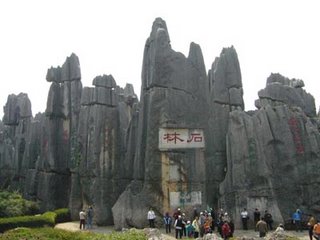
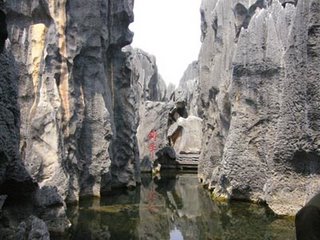
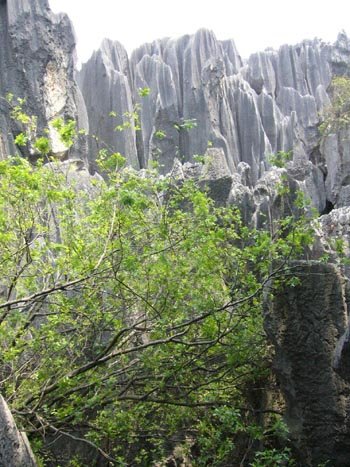
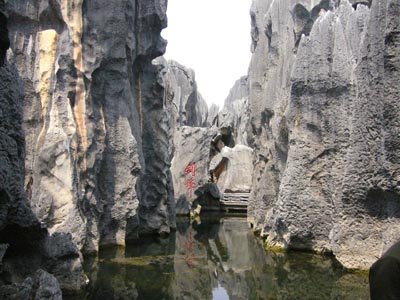
By far, the highlight of our trip was the Stone Forest, a vast field of limestone formations about 86km east of Kunming. This place reminded me partly of Zion National Park, partly of Bryce, but it was also unique in its own way. One difference from the US: Chinese have happily written large signs in many places in the Stone Forest. Apparently they have different views over the "sanctity" of national parks. There were many local Chinese visitors, and a carnival-like atmosphere permeated the more popular spots in the "Forest". Nonetheless, it is a good place to spend a day or two exploring and climbing.
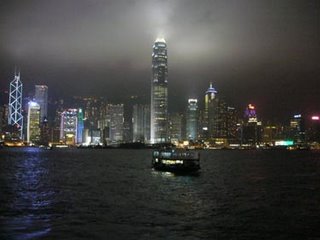
Hong Kong Skyline by night:
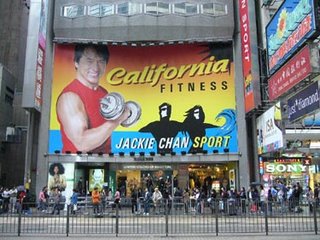
In Hong Kong, consumerism rules over mere mortals:

Jackie Chan sells California to Hong Kong:
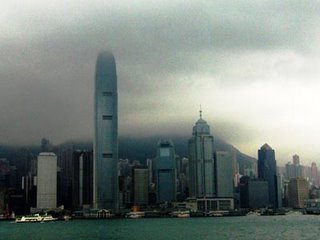
This day reminded me of the recent King Kong movie:
Dazzling orchids at the Hong Kong Botanical Gardens:

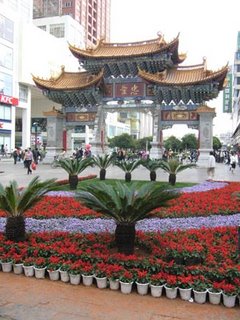
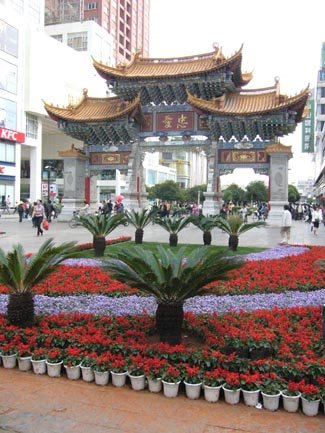
Kunming's pedestrian-only center:
Stone Forest entrance:
View inside Stone Forest:
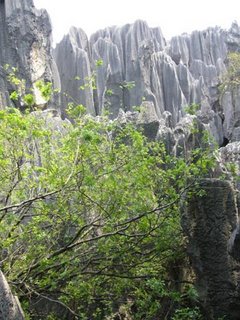
More Stone Forest:
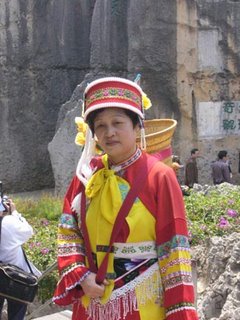
"Sani" Tribeswoman in Stone Forest:
This was the first time I had been to Hong Kong. My impression was one of polite efficiency. When our taxi arrived at the hotel, the lobby was empty except for a concierge reading the paper and the reception clerk. But as soon as the concierge saw me, he leaped into action. I told him that I had no HK dollars to pay for the taxi; he ran to the clerk, got the change, ran out to unload our luggage from the taxi and settled with the driver - all in about 30 breathless seconds!
Money permeates everything in Hong Kong. There are huge malls and expensive cars all over; everyone is an expert salesman. But there are pleasant interludes, like the HK Zoological and Botanical Gardens, and the Star Ferry to mainland from Hong Kong Island.
On the way back we stopped in Kunming. What a pleasant surprise. Kunming, with 4 million people, is capital of China's Yunnan province. It a clean, open city, with wide avenues, parks, a pedestrian-only downtown where one can while away the entire day, and very. very pleasant weather. Developing (and Westernizing) at a breakneck speed.
The famous food of Kunming is "over-the-bridge" noodles. The story behind this dish is this: once there was a scholar and his wife. The scholar studied some ways from home. When his wife brought him lunch every day, she had to cross a bridge over a stream; along the way lunch got cold. So one day she decided to take a pot of hot broth with a layer of oil on top, and all the noodle ingredients separately. When she reached her destination, she found that that oil had kept the broth hot, and dropping the noodle ingredients into the broth made for a delicious and hot lunch for her husband.
Same principle as Japanese Shabu Shabu or Swiss Fondue - cook the ingredients in the hot broth of the soup.
We tried it. Although the story is interesting, the noodles were not too good. Oh well.
Language was a HUGE problem in Kunming. Even proper nouns had to be translated to Chinese. Luckily people were very friendly and often went out of their way to be helpful. Often the hotel clerk wrote out our destination in Chinese on a card. Then we gave this card to the taxi driver. Curiously, on several instances, when we approached Chinese couples for directions, the male sort of pushed the female forward to deal with us and then acted busy with other stuff (presumably so as not to deal with the aggravation?)
We saw very few children on the streets/shops/restaurants at Kunming. Basketball appeared to be popular both in HK and Kunming, judging from the numbers of courts and kids playing. Thanks Yao Ming!
By far, the highlight of our trip was the Stone Forest, a vast field of limestone formations about 86km east of Kunming. This place reminded me partly of Zion National Park, partly of Bryce, but it was also unique in its own way. One difference from the US: Chinese have happily written large signs in many places in the Stone Forest. Apparently they have different views over the "sanctity" of national parks. There were many local Chinese visitors, and a carnival-like atmosphere permeated the more popular spots in the "Forest". Nonetheless, it is a good place to spend a day or two exploring and climbing.
Hong Kong Skyline by night:

In Hong Kong, consumerism rules over mere mortals:

Jackie Chan sells California to Hong Kong:
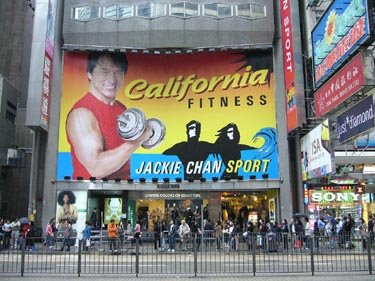
This day reminded me of the recent King Kong movie:

Dazzling orchids at the Hong Kong Botanical Gardens:

Kunming's pedestrian-only center:
Stone Forest entrance:
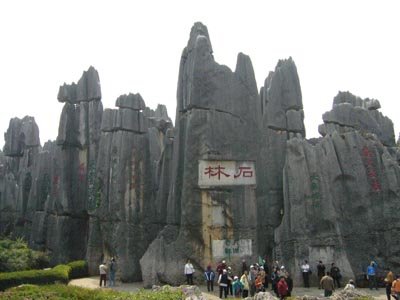
View inside Stone Forest:
More Stone Forest:
"Sani" Tribeswoman in Stone Forest:

Sunday, March 19, 2006
A Tagore Moment
We were returning home after a day in the hills of Srimongol. From the car we saw glimpses of the sun setting behind the green tea hills. We caught only a few seconds of the large orange disk as it set, but the misty green hills, the orange sun and the pink-purple sky flooded my mind with songs of Tagore. I found myself humming "Godhuli gogoney meghey dhekechhilo tara/ aamar ja kotha chhilo hoye gelo shaara" (at sunset the clouds covered the stars; all the things I wanted to say were done).
But it was a cloudless sky, so the song did not quite work. Then the perfect Tagore couplet, describing nature, came to mind: "hetha mondo modhur kanakani joley stholey, shyamal maaTir dhoratoley/hetha maThey maThey rongeen phuler aalimpon, boner pothey aadhar aalor aalingon" (here on this brown earth, bittersweet whisperings amongst earth and sea/tapestries of flowers in the fields, embraces of light and shadow on a forest path)
From where did the poet arrive at this beautiful place? He describes his origin thus: "Oi aalok maatal shorgo shobhar mohangon/ shethai chhilo kon jugey mor nimontron" (I had a long-standing invitation to stay in the heavens, flooded with starlight) But he did not stay: "Mon laglo na, tai gaaner shagor paari diye elem choley" (My heart did not want to stay there, so I crossed the ocean of songs and arrived here on this world).
Does he miss the heavens? Does he want to return? Nope. "Aamar mon laglo re, tai eikhanatei din kaTiyei, khelar chholey" (My heart is stuck here, so I am going to spend my days playing here).
Sort of Garden of Even in reverse. At this green-orange sunset moment, this song of Tagore brought the cosmic and the personal together for me. Like so many of this other works do.
(I am grateful to the late Dr. Syed Mujtaba Ali for his essay on Rabindra Sangeet
where I first understood the meaning of the song quoted.)
But it was a cloudless sky, so the song did not quite work. Then the perfect Tagore couplet, describing nature, came to mind: "hetha mondo modhur kanakani joley stholey, shyamal maaTir dhoratoley/hetha maThey maThey rongeen phuler aalimpon, boner pothey aadhar aalor aalingon" (here on this brown earth, bittersweet whisperings amongst earth and sea/tapestries of flowers in the fields, embraces of light and shadow on a forest path)
From where did the poet arrive at this beautiful place? He describes his origin thus: "Oi aalok maatal shorgo shobhar mohangon/ shethai chhilo kon jugey mor nimontron" (I had a long-standing invitation to stay in the heavens, flooded with starlight) But he did not stay: "Mon laglo na, tai gaaner shagor paari diye elem choley" (My heart did not want to stay there, so I crossed the ocean of songs and arrived here on this world).
Does he miss the heavens? Does he want to return? Nope. "Aamar mon laglo re, tai eikhanatei din kaTiyei, khelar chholey" (My heart is stuck here, so I am going to spend my days playing here).
Sort of Garden of Even in reverse. At this green-orange sunset moment, this song of Tagore brought the cosmic and the personal together for me. Like so many of this other works do.
(I am grateful to the late Dr. Syed Mujtaba Ali for his essay on Rabindra Sangeet
where I first understood the meaning of the song quoted.)
Sunday, March 12, 2006
Another Hartal Day
Today is another half-day hartal. I took a rickshaw to work.
I don't know what happens to these rickshawwallahs on hartal days. Finding the streets free, they go berserk and think they can pedal the rickshaws at any speed they want. Perhaps it is the exhilaration of freedom. My rickshaw almost ran into five people, two children going to school, one taxi coming at a right angle, couple of thela-garis, one van-gari, one tiny bus carrying soft drinks and several tempos with terrified people dangling from the back. I lost count of how many potholes he ran over without slowing down. No doubt I will be sore from this and my blood pressure is probably still high from the tension.
Maybe I will bike to work the next hartal.
I don't know what happens to these rickshawwallahs on hartal days. Finding the streets free, they go berserk and think they can pedal the rickshaws at any speed they want. Perhaps it is the exhilaration of freedom. My rickshaw almost ran into five people, two children going to school, one taxi coming at a right angle, couple of thela-garis, one van-gari, one tiny bus carrying soft drinks and several tempos with terrified people dangling from the back. I lost count of how many potholes he ran over without slowing down. No doubt I will be sore from this and my blood pressure is probably still high from the tension.
Maybe I will bike to work the next hartal.
Monday, March 06, 2006
Two in the Basket!
Today Bangla Bhai, the second high-profile terrorist suspect in Bangladesh, was captured. Together with the capture of Shaiukh Abdur Rahman last week, this makes two in the basket.
Word on the street is that tracing of mobile phones being used by the suspects played a part in their being caught.
Word on the street is that tracing of mobile phones being used by the suspects played a part in their being caught.
Friday, March 03, 2006
Capture of a Terrorist Mastermind
Abdur Rahman, who is the alleged mastermind of several terrorist attacks in Bangladesh including the first ever suicide bombings in this country, was captured yesterday in Sylhet.
http://www.thedailystar.net/2006/03/03/d6030301011.htm
I remember the first time those bombs went off. I was at North South University, talking to some academic types about hands-on training for their computer science graduates when a professor walked in ash-faced and announced that over 50 bombs had gone off simultaneously (ok, many of them were really tiny, but still...) all over the country. It was August 17, exactly 3 weeks after we had returned here. And I was thinking, "Ooops...".
It would be fair to say that the nation heaved a sigh of relief at the capture.
The foreign media did not pay much attention to this capture story, although they had given quite a bit of coverage to the bombings. Go figure.
http://www.thedailystar.net/2006/03/03/d6030301011.htm
I remember the first time those bombs went off. I was at North South University, talking to some academic types about hands-on training for their computer science graduates when a professor walked in ash-faced and announced that over 50 bombs had gone off simultaneously (ok, many of them were really tiny, but still...) all over the country. It was August 17, exactly 3 weeks after we had returned here. And I was thinking, "Ooops...".
It would be fair to say that the nation heaved a sigh of relief at the capture.
The foreign media did not pay much attention to this capture story, although they had given quite a bit of coverage to the bombings. Go figure.
Subscribe to:
Posts (Atom)