
Friday, March 09, 2007
I Like These Signs
The "do not pee here" signs are sometimes hilarious. This one threatens 10 strikes by shoe, as well as Tk 50 ($0.75) fine. Is that you Gopal Bhaar?


Thursday, March 08, 2007
Book Talk
My brother brought me Francine Prose's "Reading Like a Writer" which I am reading like a reader, heh-heh. Seriously, the book reminds one to read slowly in order to understand and appreciate the craft of writing. Each word and sentence is the result of a decision made by the writer, and one can fully appreciate the nuances only by slow and deliberate reading.
This is true of any creative art, of course. Take photography for instance. If you want to learn to be a photographer by looking at photographs, then study the lighting, the location in space, the instant the shutter was pressed, how the space inside the frame is organized, how colors (or shades of grey) are used, etc.
One interesting tidbit about Prose's book: in the list of "must-read" books at the end, she has only one book on "how to write" amongst a mass of fiction - the evergreen Elements of Style by Strunk and White. I have used this book for 25+ years and still go back to it.
----------
Both Etc and Words n Pages in Gulshan are closed due to the crackdown on building code violations. Kudos to owners of WnP for their honesty in admitting to customers they have "a small legal problem" - unlike other restaurants and businesses, partially bulldozed, claiming they are closed because they are "renovating."
----------
Finished reading J. Lahiri's The Namesake. Syed Manzoorul Islam, in his story Reshmi Rumal, says he was carrying Namesake and Tagore's Chhinnopotro during a train ride. He tried to read the former for an hour, did not like it, then tried "Thakur Mohashoi-er Chhinnopotro" and liked it. Well I thought Namesake was a quick and light read, specially interesting to me because my children were born and raised in the US.
-----------
I understand Bangladeshi writer Tahmima Anam's book launch took place this week in London. The book is the first opus in English around the 1971 War of Bangladesh Independence. I hope it reaches many people who don't know about our history. Am looking forward to reading it.
-----------
That book I bought at Boi Mela, called Bangladesher Protno Shompod, passed its second test last week. How? Back in Dec 2005, I asked about a mysterious ruin near Bhairab Bridge. Recently, Mr. Anwar left a comment on the blog saying it was Hatir Pul of Bariura in Sarail, and sure enough, the above book has a section on this bridge and on Bariura. Quick, someone take this book from me before I spend the rest of my life wandering around Bd checking out historical ruins!
(BTW, the first test was before I bought it - I wanted to find the location of Shankarpasha mosque in Sylhet - which I had been trying to locate - and it had good directions.)
Tuesday, February 27, 2007
The Garrulous Taxi Driver
I had to take a CNG across town the other day. Turned out the driver was talkative with a lot of opinions. (A CNG is a small three-wheeled taxi, running on Compressed Natural Gas, popular in Dhaka.)
Of Bangladeshis he said, "We are the most luxury-loving people in the world." Why, I asked. "Because for only 12 Taka you can get a half-hour ride on a super-luxurious Volvo bus from Mirpur to Farm Gate. A bus that costs 1.5 Crore (about $210,000)! People seem to love it, too" he complained.
His other complaint was about the rich people. There are many families who have 4 or 5 cars now. Not only that, they change models every couple of months. "What do they need so many cars for? No wonder the roads are all clogged up."
We got on the rich people track after he complained how hard it was to make money. "We have to pay Tk 600 every day as rental for this CNG. We have to sweat so much just to earn Tk 200 daily income." He said he was hoping that the rental would drop to 500 soon.
We passed by a strip mall in Gulshan-1 where, among a row of about 10 almost identical storefronts, one had been demolished (because of unpermitted construction.) "Don't you think it is unfair to pick out only one while the others are intact?" I asked. "Not at all, that is a warning sign to the others. If they don't fix their storefronts, they will go, too," he said sternly.
He was optimistic about the country's economy, as I found out in a roundabout way, when he said that the Rangs Building was coming down for sure (this is a controversial Dhaka landmark, reputed to have been built unpermitted.) "But think about it," I said, "there are at least 1000 people who work in that building. Each one supports at least 4 or 5 others. That's a lot of people who will be out of a job." "No problem," he said, "they can get other jobs. They have to just look - there are plenty of jobs."
While he was talking he forgot to tell me that he was almost out of CNG. So we made an unplanned stop in Tejgaon Industrial Area for 15 minutes while he waited in the CNG fillup line, while I took a quick stroll in the underbelly of industrial Dhaka.
Back on the road, he ranted about the CNG business. "These CNGs should have cost only 1-1.5 lac Taka ($1500-2000) but because of the corruption and everyone taking their cuts, the owner had to pay 3-4 lac. That's why poor people like me have to pay Tk 600 a day for renting it," he complained.
Well at least he is not burning petrol. The bill for filling up with CNG (to last him 1.5 days of schlepping people around town) came to Tk 45, about seventy cents.
We reached our destination. The meter read Tk 80 ($1.10) for about 8 miles. I paid him an extra Tk 10 bakhseesh, and with freshly filled CNG tanks our garrulous driver went off to find his next passenger (and captive audience.)
Sunday, February 25, 2007
Heroes
Heroes are hard to find, but sometimes you find them in unexpected places. For me, my Father is one such hero. Only two days ago, my Aunt (Mejofufu - who is much older than my Father) refreshed my memory about his involvement in the 1952 Language Movement. He was a student in Dhaka University, and was staying at my Aunt's house. One morning he wanted to go to school in a hurry. "Give me daal bhaat, or whatever is cooked" he asked my Aunt, "I have a long day." Yeah, long because we was demonstrating for Bangla with the other students. But then he got clubbed by the police and passed out on the street. He was taken to Dhaka Medical, and later an Ambulance brought him back to my Aunt's house. Luckily he recovered.
My Father rarely discusses this episode of his life but to those who know he is a true Bhasha Shainik. Who knows, maybe one day he will get recognition for his sacrifices.
There is also my Mother who passed away too soon. In her short life her grace and kindness touched everyone who met her. She was the pivotal point for our extended family to remain united. She was also an amazing cook who trained my tastebuds and gave me my taste for elegant food. She had helped so many people in so many ways that I am sure their blessings will carry the day for her.
Among my contemporaries, there is Dr. Qader, who supervises the Intensive Care Unit at the Children's Hospital. There were many opportunities in this talented doctor's life when he could have taken a job abroad (or a more lucrative one at a private place in Dhaka.) But his goal in life seems to be saving children's lives - specially those who don't have any alternative. An unsung hero, but one who has made a huge difference in many many lives.
Another contemporary, Ali Ishtiaq, worked in Silicon Valley and had a luxurious lifestyle there, which he traded-in three years ago to be with his ailing parents in Dhaka. He has taken incredibly good care of them, moving them to an airy, open apartment and looking after them in every possible way. His mother passed away three days ago. She breathed her last with her head on his lap as the car was speeding to the Emergency. Few of us get (or make) this kind of opportunity to take care of our parents.
On the public front, there is Dr. Yunus. Let's hope his political venture works out best for him and the country. There are two others I respect. One is Shykh Siraj, whose TV show Hridoye Maati o Manush has revolutionized agriculture in Bangladesh by giving ideas, courage and inspiration to the nation's farmers. The other is Magistrate Rokon-ud-Dowla whose tireless hunting for food adulteration has exposed many nasty food businessmen.
Well, the list goes on, but I want to mention one other person who passed away today. I met him very late, after he had fallen ill, but I was always touched by his soft-spoken manners and by his kindness. He was a pioneering civil engineer of Bangladesh, a founder of The Engineers, who not only built many structures here but also overseas. He was Mr. Manzur Husain and I hope that his soul finds peace.
Friday, February 23, 2007
Bicycling Tour of Old Dhaka
I took seven bicycling friends (all expats) on a "guided" tour of old Dhaka today. We picked Friday to avoid traffic congestion.
The plan was to bicycle from Gulshan 2 to see old Dhaka sights. These are ordered to start in the southeast and end at the northwest.
1. Shakhari Bazar (aka Shakhari Patti)
2. Ruplal House
3. Pink Palace
4. Armenian Church
5. Bara Katara
6. Lalbagh Fort
7. (if time permits) Khan Mohammed Mridha's mosque
At the end of the tour our cars met us in front of Lalbagh Fort.
We started from Gulshan 2 at 7:15am and bicycled through Tejgaon industrial area, Maghbazar, Kakrail and turned into Najrul Islam road, made a left into Bangabandhu Avenue and then on to Nawabpur Road. Straightforward, but there were still a few busses on the road, specially near Maghbazar.
From Nawabpur Road we turned right into the road leading to Shakhari Patti, then walked our biycles. We looked through some open doors to see the narrow and deep houses of Shakhari Patti. Two monkeys entertained us perched on second floor verandas and windows. The triple-arch facade of an old house also attracted my friends' interest. But despite many requests I could not get anyone at Shakhari Patti to let us into a house and see the inside. Too early in the morning?
We bicycled out of SP and went around Bahadur Shah Park (after a quick briefing on 1857 Sepoy Revolution) by North Brook Road towards Farashganj. As we entered the spice trading area, we ran into a jam caused by trucks delivering wholesale spices and had to walk our bicycles. We found Ruplal House and admired its exterior.
RH is inhabited by families of Armed Forces, and at first they refused us permission to go inside. I tried to reason with the guards (the interior courtyard is very nice and gives one a sense of times past) to no avail. As we were turning around disappointed, they changed their mind and said ok, but strictly no photography.
After checking out RH, we crossed into the road that runs in front of the river (Lalkuthi Road) and bicycled towards Ahsan Manzil. Here I made a mistake. I kept going straight to show a nice view of Ahsan Manzil from Sadarghat Road. Should have turned right and taken Patuatuli Road instead, because the front of AM was a horrid, claustrophobic jam that lasted for several hundred feet. Trucks delivering wholesale fruits had blocked the road and zillions of people and Van Garis carrying smaller loads were also trying to move. It took us 15 minutes to cross this part, but my friends took this little adventure in good humor.
Then we went under the Buriganga bridge ramp and back into Islampur Road. Shortly we turned right towards the Armenian Church dating from 1781. The caretaker let us in and opened it up for us. It was a surprising island of tranquility - with memorials, one statue, and lots of green. We also went to the roof and enjoyed the scenery.
Onwards on Islampur Road, we headed towards Chawk Bazar where we turned left into a narrow alley to see Bara Katara, Dhaka's oldest building (1644), now the home of a Madrasah. After we viewed the exterior dome, a teacher graciously showed us inside and took us to the roof for some nice views. Inside the Katara, some rooms and passages looked really old - could be original.
After this we bicycled to Lalbagh Fort. Since we had time, we biked another half km and saw Khan Mohammed Mosque. This pretty mosque is build on a platform. The basement served - and still does - as a dormitory.
Back we came to Lalbagh Fort. My friends did not mind the differential in admission between Bangladeshi admission (Tk. 5) and foreigner admission (Tk. 50) - they were happy to pay it and hoped the money be used for upkeep. The grounds of the Fort were well-kept and beautiful. I overheard a boss type barking instructions to a gardener on how to prune and beautify the garden. We spent time around Pari Bibi's (Shaista Khan's daughter) Mausoleum. Then we headed to the Hammam Khana (no, not for a shower!) and the museum.
We finished at noon. My friends all enjoyed the trip. One commented that even though he had visited some of the same places before by car, the bicycle trip afforded him a level of immediacy not available in a car.
I am planning Part 2 of this trip. Let's see... Tara masjid, Goal Talab, Hossaini Dalan, Nurjahan House, what else???
Wednesday, February 21, 2007
21st February
Five thousand years from now, when we are all dust, and today's nations are but small chapters in history books, what will anyone remember about Bangladesh? I believe it will be Language. If nothing else, they will remember that this proud, stubborn people rose up against a much larger force to exercise their right to speak, read and write in their mother language. And this rebellion ultimately gave birth to the nation Bangladesh.
Bangladesh remembers those who have given their lives for her language, Bangla, on this day, Ekushey February. All day long the city reverberates with this song:
Aamar bhaer roktey rangano ekushey February
Aami key bhulitey pari
(21st February, glowing with blood my brothers have shed
How can I forget?)
As I wandered in the city today, I saw thousands carrying flowers, some with black badges, yet others with the national flag. The flowers are left at the Shaheed Minar in memory of those who fought for Bangla. There were people from all walks of life - old, young, rich, poor, man, woman. Love for one's language knows no boundaries.
On this day I am filled with respect for those made this sacrifice, and I pray for their departed souls.
Thursday, February 15, 2007
Boi Mela (Photos)
I went to the Ekushey Boi Mela (book fair) yesterday. It is on Bangla Academy grounds and runs until Feb 28th.
What it's all about...

The road leading to the Mela covered by banners.

Onyoprokash was the busiest seller - one buyer gets change over heads.

The environment (specially trees) lent some drama (the sign says Shikor - "root")

Three veiled women who were shopping for books.

This man could not wait until getting home to read his new acquisition.

Publishers found novel ways to market books.

Salam, one of the first martyrs of the Language Movement

Friends looking through a publisher's catalog.

A selection of Bangla IT books in the Mela.

Parents' duties don't stop with purchasing the books :-)

I liked the Boi Mela a lot, but next time I will leave the camera behind. It was schizophrenic and stressful playing reader and photographer simultaneously.
I bought one book, called "Bangladesher Protno-Shompod" (Archaeological Treasures of Bangladesh) that is encyclopedic - and has directions to many many historical buildings and ruins.
Sunday, February 11, 2007
Two Points of View
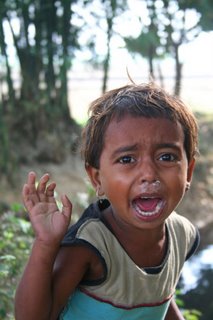
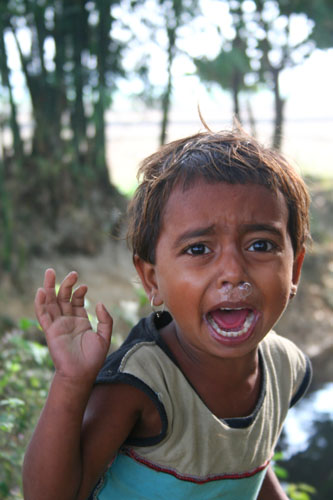
Little Girl: Man, what a horrible morning! There I was, up bright and early, but Abbu and Ammu wanted to sleep in. I heard Bhaiya and Apu playing by the pond, so I came to join them. Bummer, they would't take me in their game. What could I do? No one would even get me a hanky to clean my nose. So I decided to sit by the pond, stare at the water, and think. Then I hear a noise, turn around, and - YIKES! - this big man had snuck up behind me with a black shiny thing in his hand, pointing it at me. I screamed. I am sure he had a sack in which he wanted to carry me off. And he kept on saying "foto foto." What the heck is a foto? I screamed and screamed and ran for my life, even though Bhaiya and Apu tried to stop me and look at that horrible man. No way. I want Ammu. Ammu! AMMU!
Me: I am bicycling through this village early in the morning, enjoying the scenery and taking pictures. I see two kids playing on the yard by a pond, and another little girl sitting by the pond, staring into the water, lost in thought. It was a perfect moment. Not wanting to disturb her, I parked my bicycle a few feet away and approached the child from behind, very quietly. Just as I composed the photo through the viewfinder and touched the shutter, she heard me and turned around. She froze for a split second, eyes widening in fear, then found her voice, started screaming and ran away. I said "it's just a photo, don't worry, I won't hurt you" and her brother and sister tried to calm her down but to no avail. So I went back to my bicycle and waited for a few minutes. Then I checked back - her screaming had stopped and she had calmed down. But the poor thing was traumatized enough for one day, so I left.
The photo:
Me: I am bicycling through this village early in the morning, enjoying the scenery and taking pictures. I see two kids playing on the yard by a pond, and another little girl sitting by the pond, staring into the water, lost in thought. It was a perfect moment. Not wanting to disturb her, I parked my bicycle a few feet away and approached the child from behind, very quietly. Just as I composed the photo through the viewfinder and touched the shutter, she heard me and turned around. She froze for a split second, eyes widening in fear, then found her voice, started screaming and ran away. I said "it's just a photo, don't worry, I won't hurt you" and her brother and sister tried to calm her down but to no avail. So I went back to my bicycle and waited for a few minutes. Then I checked back - her screaming had stopped and she had calmed down. But the poor thing was traumatized enough for one day, so I left.
The photo:
Sunday, February 04, 2007
Brahmins and Naval Architects (Photos)
Last Friday we went for a 50-km bicycle ride out of Dhaka. It was a very foggy day:

We biked east and then south of Dhaka, the last 5 km along the banks of the Sheetalakhya. This was my first time on that road. We spotted a shipbuilding yard on the bank and stopped to take a look. Workers were building a large, 200+ feet long ship.

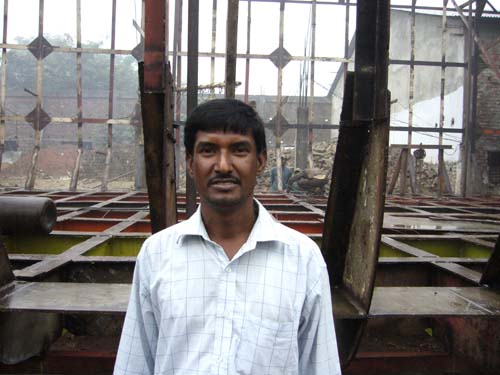
This gentleman is the owner of the operation. He said the metal comes from Chittagong, and is built into the ship which is sent back to Chittagong by river. Then it is used to move materiel between Chittagong and Dhaka. Takes about 8-9 months to make such a large ship. All the work is done on the premises.

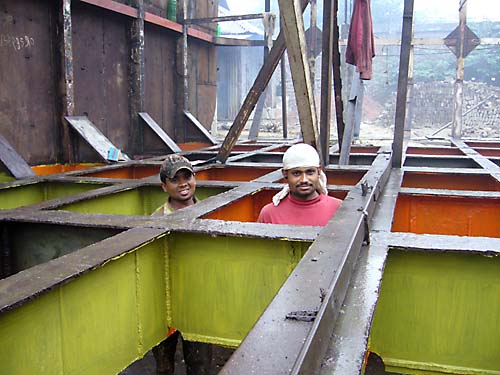
These two workers were painting the hull. They used a rag instead of paintbrushes to reach all the nooks and crannies (to seal them from rusting?)

I asked them about Keraniganj, where I had seen large boat building facilities. They said it had shifted here due to people moving into Keraniganj area (gentrification.)
I hope to be back when they lower the boat onto the river. That should be quite a sight.
On our way back, Peter spotted some color at a distance from the road and we stopped to investigate. We walked to a field behind a village. It turned out a Hindu Puja - and an accompanying Mela - was in progress. It was called Purnima Puja or Dhamai(?) Puja. This priest was leading the prayers.

The air was festive, with music and drums.

The people praying were mostly women.

The mela offered toys for the kids.

This gentleman asked me to take his picture with his granddaughter. I said I thought it was her daughter - he looked so young. He gave a hearty laugh.

This girl had got her own balloon and was playing on the side by herself.

At night, it was full-moon, so indeed it was a Purnima. All in all, great day of exploring. Many thanks to my bicycling companions Peter and Mehreen.

We biked east and then south of Dhaka, the last 5 km along the banks of the Sheetalakhya. This was my first time on that road. We spotted a shipbuilding yard on the bank and stopped to take a look. Workers were building a large, 200+ feet long ship.

This gentleman is the owner of the operation. He said the metal comes from Chittagong, and is built into the ship which is sent back to Chittagong by river. Then it is used to move materiel between Chittagong and Dhaka. Takes about 8-9 months to make such a large ship. All the work is done on the premises.
These two workers were painting the hull. They used a rag instead of paintbrushes to reach all the nooks and crannies (to seal them from rusting?)
I asked them about Keraniganj, where I had seen large boat building facilities. They said it had shifted here due to people moving into Keraniganj area (gentrification.)
I hope to be back when they lower the boat onto the river. That should be quite a sight.
On our way back, Peter spotted some color at a distance from the road and we stopped to investigate. We walked to a field behind a village. It turned out a Hindu Puja - and an accompanying Mela - was in progress. It was called Purnima Puja or Dhamai(?) Puja. This priest was leading the prayers.

The air was festive, with music and drums.
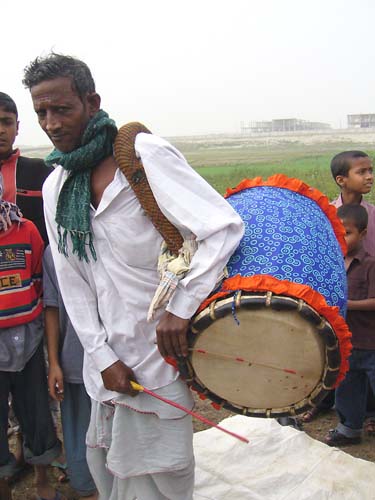
The people praying were mostly women.
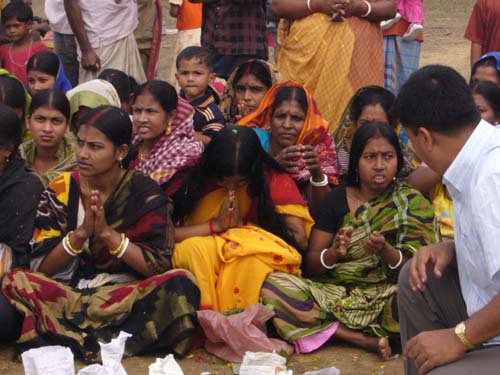
The mela offered toys for the kids.
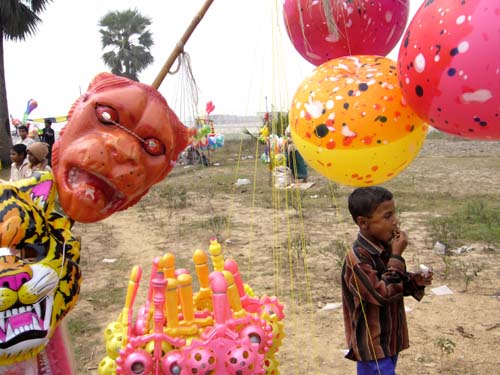
This gentleman asked me to take his picture with his granddaughter. I said I thought it was her daughter - he looked so young. He gave a hearty laugh.

This girl had got her own balloon and was playing on the side by herself.

At night, it was full-moon, so indeed it was a Purnima. All in all, great day of exploring. Many thanks to my bicycling companions Peter and Mehreen.
Thursday, February 01, 2007
Bank Experience
Some days ago, I had to go to a (govt) bank for some business. This is not my "normal" bank, but my Father maintains his account there. So I go there, say, once every 2-3 months. I was wearing a short sleeve shirt, casual pants and sneakers. I had to open the door myself despite the sentry sitting inside - he could not be bothered. The bank officials did their work for me, but only after my pushing and prodding. They were not exactly cooperative or helpful. And as I was leaving I barely restrained myself from yelling at the sentry because he would not get up and open the door for me.
So I was annoyed and weighed whether to go back and yell at all of them. After all, my Father has banked with them for 20+ years.
Instead, another opportunity presented itself. I had to return in a couple of days for another errand. But instead of preparing for a fight, I tried an experiment. I put on a nice shirt, creased pants, a blazer, and a pair of black leather shoes. And wore a serious scowl on my face.
Voila! At my approach, the sentry stood up, opened the door and saluted me smartly. The bank officials were all very cooperative and I got the errand done in record time!
Lesson: if you are going to a (govt) bank in Bd, dress better than anyone working in there and act mean!
Sunday, January 28, 2007
Laptop Repair
One of our laptops had an, erm, accident. Water was spilled on the keyboard. It refused to power up after that. We tried to dry it out for several days; still it would not work.
My friend Bappu pointed me to a repair shop in Elephant Road called Imex. It is a down-to-earth place on the second floor near "Bata Intersection." It is run by one Asif who has HP/Compaq certification for supporting PC and laptop repairs. I knew I was in good hands when I entered because Asif glanced at my (closed) laptop and guessed the right model number (1700T.)
Well, they fixed it! Luckily the motherboard was ok, but Asif had said they could even replace that if need be. Charge was Tk 1000 (for labor and some minor cleaning up and PC board re-soldering.)
Amazing.
Thursday, January 25, 2007
Boroi Season
Boroi season is in full swing here in Dhaka. Kids are having a blast, with the vendors posted strategically outside school gates. I have tried at least four varieties, though I am sure there are many more. Prices are high. If you buy from the posh side of town, you can pay a ridiculous Tk 100/kg for the premium Oval and Aapel Borois. In other places, the minimum is still a high Tk 60/kg.
That said, the Borois I tried were absolutely delicious. The Aapel (Apple) Boroi was the sweetest, but the oval one was the best overall because of its extra crunchy texture. And the round deshi boroi had great flavor with just a little tartness.
Here are some pictures.
Aapel Borois

Oval Borois

Deshi Borois
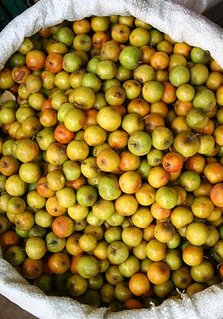
Incidentally, I tried a Boroi off of a tree in Ayutthaya, Thailand, recently and it tasted just like our Deshi Borois.
That said, the Borois I tried were absolutely delicious. The Aapel (Apple) Boroi was the sweetest, but the oval one was the best overall because of its extra crunchy texture. And the round deshi boroi had great flavor with just a little tartness.
Here are some pictures.
Aapel Borois

Oval Borois
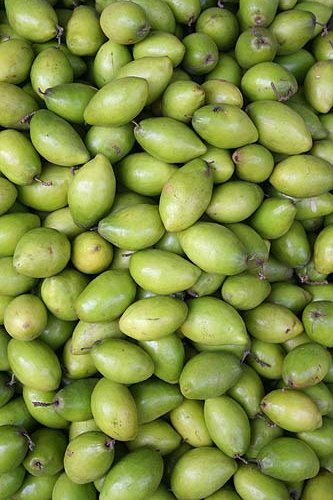
Deshi Borois

Incidentally, I tried a Boroi off of a tree in Ayutthaya, Thailand, recently and it tasted just like our Deshi Borois.
Friday, January 19, 2007
A Visit to the Clinic
I crashed my racing bicycle the other day (entirely my fault.) One of the resulting wounds needed checking out. A doctor friend recommended another doctor, who happens to work in a "middle-class" clinic near Kolabagan (as opposed to, say, Apollo or United Hospitals.) When I called the doctor he asked me to come by his clinic.
I went with some trepidation. My past experiences with most Dhaka doctors and clinics, from the 1970s and 80s, had been dreadful (unless I went to my doctor friend or cousin for help.) There were nightmarish memories of obnoxious doctors, waiting forever and not getting to see them, and bad diagnoses. My worries were made worse as I walked into the second floor, where the doctors' chambers was. There were many many people milling around, some standing because there were not enough chairs. There appeared to be no way of keeping track of the order of patients.
I looked around to find the receptionist and tell them about my arrival, but none was there. Eventually I found a payment booth and talked to the man there. He in turn yelled "Jahangir! Jahangir!". Turned out Jahangir was the receptionist and gatekeeper to the doctor I wanted to see, and he was in constant motion, moving around the patients, then to the doctor chambers, and so on. I gave him my information and asked him to convey to the doctor. A little later he said the doctor had asked me to wait, since he was doing an emergency surgery.
I settled into a chair and watched the other patients. A nervous father and mother brought in a teenager daughter with a big burn covering her forehead. The girl was completely quiet. People freely talked to strangers about what was afflicting them. The man sitting next to me apparently had a very bad pain in his foot for no apparent reason - as I overheard him talking to another fellow he had just met.
Many men were in blazers or suits and ties. They held X-Rays and Lab Reports like medals of valor. There was a window behind my chair from where one could buy snacks - at very reasonable prices. Potato chips were a hit. I guess you get hungry waiting for the doctor. A patient bought two sets of soft-drink and chips and gave one set to the payment booth man - saying "You need to eat" - and walked off.
Another doctor walked through the hallway to his office. A small procession of patients followed him to the door of his office, at which point his gatekeeper decided whom he could see. Some of the patients stood up respectfully and offered their salams as he passed them beaming in a divine manner.
After about an hour of waiting, I asked Jahangir how much longer. He said the doctor was almost done with the surgery and would be here shortly. So I sat down again. Although I was running out of patience, I told myself it was really really important that I not lose this waiting-game. Then it would become a black-mark in my experiences here.
The doctor finally arrived, about an hour after my arrival. He saw several patients (mostly young children and women) before seeing me. I was very impressed at the way he examined my wound, listened to me, and pointed out the diagnosis (nothing serious.) My impression of Bangladeshi doctors improved considerably after this encounter.
As I came out of the office I saw the crowd had thinned. Many had already seen their doctor. One guy was wondering aloud if he could get a rickshaw to take him to Nakhalpara. Some had given up and left for the night. Once I had gotten past the fear of the crowd, I came away with a renewed respect for the patience and forbearance of the middle-class Bangladeshi.
Friday, January 12, 2007
People, Space, Privacy
I wrote this essay for the Daily Star Weekend Magazine as an ongoing exploration of my re-education as a Bangladeshi.
Sunday, January 07, 2007
The Burnt Bus
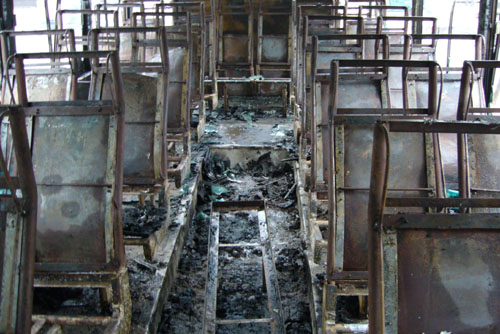
Yesterday morning, I overheard a bus conductor arguing about "trouble" near Wireless Gate in Mohakhali. Walking there, I found the remains of this burnt bus.
Stepping into it I was filled with sadness. I imagined all the passengers these seats had carried to and from work, or school, or friends and relatives' houses - even secret rendezvous. Some had gotten seats to sit, others had travelled standing, yet others maybe dangling from the door (don't see much of that these days.) How many Aamra and other Snack-wallahs had sold food inside here? And what about those small quarrels that passengers have with the conductors? Maybe a father had treated his son to Shishu Park on a Friday, sitting on that last row on the left? Maybe a beggar had sneaked past the conductor and sang sad songs to earn something? Had any pickpocket operated in this bus?
Well, there you have it. One less bus to take people where they need to go.
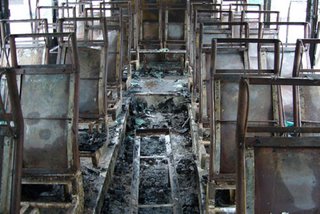
Stepping into it I was filled with sadness. I imagined all the passengers these seats had carried to and from work, or school, or friends and relatives' houses - even secret rendezvous. Some had gotten seats to sit, others had travelled standing, yet others maybe dangling from the door (don't see much of that these days.) How many Aamra and other Snack-wallahs had sold food inside here? And what about those small quarrels that passengers have with the conductors? Maybe a father had treated his son to Shishu Park on a Friday, sitting on that last row on the left? Maybe a beggar had sneaked past the conductor and sang sad songs to earn something? Had any pickpocket operated in this bus?
Well, there you have it. One less bus to take people where they need to go.
Wednesday, January 03, 2007
Procrastination and Resolutions
This time of the year is time for New Year's Resolutions. In this context, I think about an essay I read about procrastination.
The gist of the essay is that all procrastination is not bad. There is such a thing called "good procrastination". It is good to procrastinate (or put off) on the mundane chores of life if one is spending the time working on something really Important. This thought ties in nicely if we equate Resolutions with above Important things.
I always try to have only one or two Resolutions, but end up making too many, only to find them unmanageable. One year I tried breaking down into categories, and picking one from each. For example, health, family, religion, job, etc. That seemed to have worked better.
Of course, well-defined goals also work better. When I was working on my book on image processing (which took over a year) I had some clear things I wanted to accomplish - and it kept me on track.
I still believe the best resolutions are those which are ambitious (and planned.) For example, building a new software product, finishing that college degree, writing a book, learning a new language, etc. If one consistently works on a project for one year, it is bound to show some results one is proud of.
There is a danger to sticking to resolutions. New opportunities may be completely missed because of doggedly pursuing old resolutions. So maybe one of my resolutions should be "Execute on 'chance favors the prepared mind'?" Heh-heh :-)
Let's say that some of my most meaningful accomplishments from last year - such as reviving my interest in photography, bicycling the Bd countryside, or writing this blog - were not in any New Year's list. Nevertheless I am grateful for them.
So I have my resolutions. But I hold them close to my chest, and will look back December, Inshallah, to see what surprises life had in store.
Thursday, December 28, 2006
Travel Article on NYT
Many thanks to Satiprasad who pointed out this travel story on Bangladesh in NY Times. Nice to get the coverage.
Saturday, December 23, 2006
Which Language to Write
I was reading writer Mahmud Rahman's blog, where he discusses the language one chooses to write in, and its relationship to one's mother tongue. He approaches the issue from a writer's point of view - that is, the special problems that the writer faces when his or her mother tongue is different from the language that he or she chooses to write in. A fascinating topic.
That's a writer's dilemma, of course, but every time I write something in English - that, say, gets published in the Daily Star - something else bugs me: that the vast majority of educated Bangladeshis will not be able to read what I have written because they are educated in Bangla.
So for me, the big question is: who is the audience I write for? That is the basic question that I think many creative people must grapple with. In the subcontinent, Mulk Raj Anand and R. K. Narayan were the two early successful novelists in English - but look at what happened to Michael Madhusudan Dutta.
If you are a creative person, perhaps you have some thoughts? I have heard arguments that Satyajit Ray's Pather Pachali was really meant for a Western audience. But I have also read about Ray vehemently denying it. More importantly, can one argue that there ought to be a moral bias towards a particular type of audience the work of art is created for?
I have no confusion about who I write on this blog for. It is meant for our friends in the US, as well as anyone else, who is interested in the experiences of a returning NRB. As such, English is the way to go. But I also feel some loss at not being able to write as fluently in Bangla as I once did. My Bangla, as they say, "aRoshTo hoye gechhey." Something I want to fix in the future, definitely.
Saturday, December 16, 2006
A Little Flag Waving (Photos)
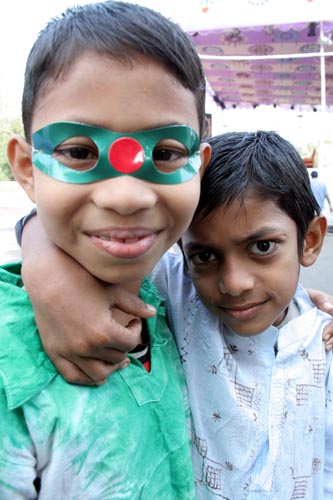
16th December is Victory Day for Bangladesh - a good day for flag waving :-)




Subscribe to:
Posts (Atom)