Creativity among engineers is important. I wrote an article for the Daily Star on how to inspire it.
http://www.thedailystar.net/2006/02/25/d602251602114.htm
Sunday, February 26, 2006

Heartbreak Weekend
What a wrenching weekend. First the fire in a garment factory in Chittagong that burned over 54 people to death. The next day a 6-story building collapses in Dhaka near the Nabisco factory in Tejgaon Industrial area, killing many and trapping many more.
All day stories about the collapsed building circulated. There were many people caught under the rubble alive, some were calling for help on the mobile. But we don't have the heavy equipment needed to lift the piles of rubble to rescue these people. Another story claimed that a lot more people died (official dead count was 16) and "they" were not admitting it.
There is something particularly heartrending about a situation where you know someone is trapped alive and yet they cannot be rescued and must slowly die. Like the Russian submarine that blew up some years ago, or the Mexican mine accident last week. And now this...
Why is it that we have money to make thousands of buildings yet don't have the money for the heavy-lifting equipment that could have saved these victims - the people who do the actual building?
All day stories about the collapsed building circulated. There were many people caught under the rubble alive, some were calling for help on the mobile. But we don't have the heavy equipment needed to lift the piles of rubble to rescue these people. Another story claimed that a lot more people died (official dead count was 16) and "they" were not admitting it.
There is something particularly heartrending about a situation where you know someone is trapped alive and yet they cannot be rescued and must slowly die. Like the Russian submarine that blew up some years ago, or the Mexican mine accident last week. And now this...
Why is it that we have money to make thousands of buildings yet don't have the money for the heavy-lifting equipment that could have saved these victims - the people who do the actual building?
Friday, February 17, 2006
A Bike Trip
Yesterday I went on a 5-hour, 35-km bike trip through the villages behind Khilkhet with some new friends. Making our way through the villages, we encountered charming children, enchanting scenery and friendly villagers.
We biked through the wide avenues of Bashundhara Housing and crossed a four-bamboo-wide bridge ("shako") to find ourselves in Khilkhet. Following a road, we crossed a river by boat, then followed the "path" and eventually looped back to the ferry. Although the terrain was mostly flat, scenery varied from wide open green fields to picturesque meandering rivers to tree-canopied paths connecting one village to another.
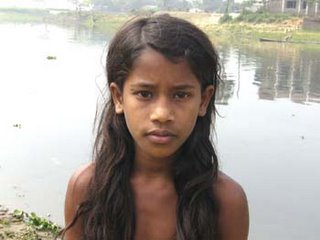
I was reminded once again why Bangladeshi villagers are quite possibly the friendliest people in the world. Several times kids offered to pluck ripe Kamrangas from the trees for us. At one household we had to dissuade women who wanted to go make Shemai for us. One girl, Khadeja, asked me if I had a daughter. When I said yes, she asked me to bring her to visit. Why, I asked. So I can see her and show her the village, said Khadeja. Don't forget my name, Khadeja of Bashabashi village, and I will be waiting to see your daughter.
In these villages cricket was the game of choice, followed by soccer. Few kids knew about the games of my childhood such as Kabadi or Dariabandha.
And of course everyone wanted to have their picture taken. Instant feedback of digital camera doubled the children's delight.
At the end of the journey we stopped at a tea stall in Khilkhet. We had tea/soft drinks and Christian bought some Samosas. Initially I worried about the bacteria, but then I relented and tried one. It was delicious and no, it did not make me sick.
All this within one hour of biking from Gulshan/Baridhara.
Many thanks to Nancy, Christian and Stefan for inviting me along on this trip.
Boats on the river Balu:

Field of green:

Bounty of tomatoes in a village:

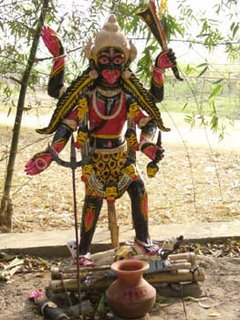
A statue of Hindu goddess Kali at a village mandap:
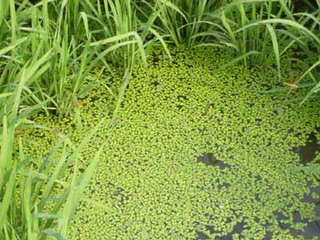
More green:
Khadeja of village Bashabashi:
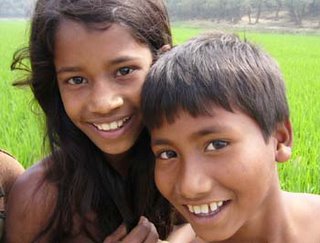
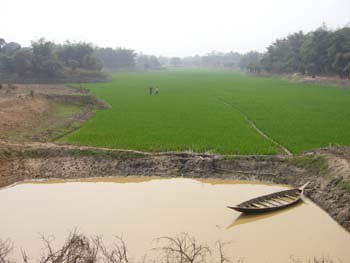
Khadeja and a friend:
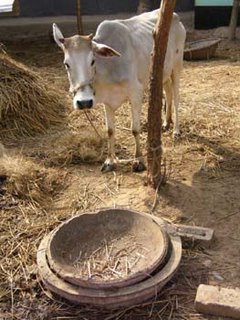
Do all cows have funny ears?
Path connnecting villages:

Another river scene:

Three brothers:

We biked through the wide avenues of Bashundhara Housing and crossed a four-bamboo-wide bridge ("shako") to find ourselves in Khilkhet. Following a road, we crossed a river by boat, then followed the "path" and eventually looped back to the ferry. Although the terrain was mostly flat, scenery varied from wide open green fields to picturesque meandering rivers to tree-canopied paths connecting one village to another.
I was reminded once again why Bangladeshi villagers are quite possibly the friendliest people in the world. Several times kids offered to pluck ripe Kamrangas from the trees for us. At one household we had to dissuade women who wanted to go make Shemai for us. One girl, Khadeja, asked me if I had a daughter. When I said yes, she asked me to bring her to visit. Why, I asked. So I can see her and show her the village, said Khadeja. Don't forget my name, Khadeja of Bashabashi village, and I will be waiting to see your daughter.
In these villages cricket was the game of choice, followed by soccer. Few kids knew about the games of my childhood such as Kabadi or Dariabandha.
And of course everyone wanted to have their picture taken. Instant feedback of digital camera doubled the children's delight.
At the end of the journey we stopped at a tea stall in Khilkhet. We had tea/soft drinks and Christian bought some Samosas. Initially I worried about the bacteria, but then I relented and tried one. It was delicious and no, it did not make me sick.
All this within one hour of biking from Gulshan/Baridhara.
Many thanks to Nancy, Christian and Stefan for inviting me along on this trip.
Boats on the river Balu:
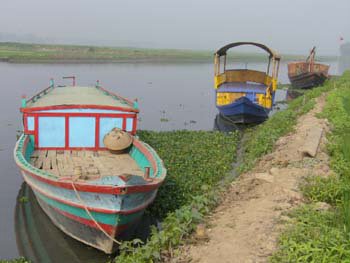
Field of green:
Bounty of tomatoes in a village:
A statue of Hindu goddess Kali at a village mandap:

More green:

Khadeja of village Bashabashi:

Khadeja and a friend:
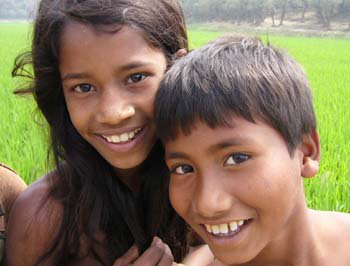
Do all cows have funny ears?

Path connnecting villages:
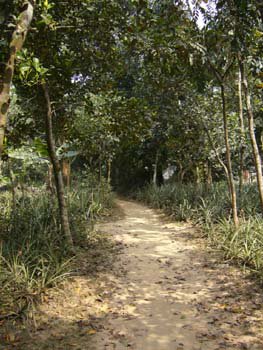
Another river scene:

Three brothers:

Thursday, February 16, 2006
Getting Used to Hartals
Yesterday was a Hartal. It turned out to be quite relaxing. I came to work in a rickshaw, enjoying the early spring breezes on reasonably empty Dhaka streets and smelling the flowers (or the bus exhaust fumes on unfortunate moments.) Returned home in a CNG, but by that time the streets were getting crowded with post-hartal crowds.
My mood was in sharp contrast to hartals that I faced when I first got here last July. I was always on edge - should I take a Rickshaw or a CNG or a taxi? Should I just stay at home? Is some crazy mob going to attack me on the streets? - when a hartal was announced. Getting to work was a big struggle.
Of course, getting used to hartals does not mean they are good. Take for example the transport strikes that took place around SAARC time late 2005. Transport strikes are supposed to affect public transportation only - buses etc, and not private cars. A person who is close to me - a persistent and dynamic businessman - had a potential investor visiting from the USA. My friend had spent months setting up the visit, and the investor was really interested in building a factory. Well, my friend was taking his visitor in his private microbus to show the site of a proposed factory near Mymensingh. On the way some transport workers stopped their microbus and asked some questions, but eventually let them go on. My friend was able to show the place to the investor. But the investor was so unnerved by the incident on the road that he got on the next available flight, saying something like, "Your country is not ready for my investment". My friend smiled sadly when he told me this story.
So, hartals may be nice for me to enjoy Dhaka, but they are very very very bad for the country. The good thing is that most working people (excepting shopkeepers) go to work anyways on hartal days.
My mood was in sharp contrast to hartals that I faced when I first got here last July. I was always on edge - should I take a Rickshaw or a CNG or a taxi? Should I just stay at home? Is some crazy mob going to attack me on the streets? - when a hartal was announced. Getting to work was a big struggle.
Of course, getting used to hartals does not mean they are good. Take for example the transport strikes that took place around SAARC time late 2005. Transport strikes are supposed to affect public transportation only - buses etc, and not private cars. A person who is close to me - a persistent and dynamic businessman - had a potential investor visiting from the USA. My friend had spent months setting up the visit, and the investor was really interested in building a factory. Well, my friend was taking his visitor in his private microbus to show the site of a proposed factory near Mymensingh. On the way some transport workers stopped their microbus and asked some questions, but eventually let them go on. My friend was able to show the place to the investor. But the investor was so unnerved by the incident on the road that he got on the next available flight, saying something like, "Your country is not ready for my investment". My friend smiled sadly when he told me this story.
So, hartals may be nice for me to enjoy Dhaka, but they are very very very bad for the country. The good thing is that most working people (excepting shopkeepers) go to work anyways on hartal days.
Saturday, February 04, 2006
On the Grounds of Bhawal Raja
Last weekend, I had the opportunity to explore the Bhawal Raja's grounds in the company of my friend Tutul's Mama who lives in Joydebpur. We explored the RajBari and the Shoshan, the two largest structures remaining. But the highlight of the trip was a private house belonging to a relative of Tutul's, which used to be the temple of the Raja's younger sister. Unlike the other structures, this house is well-preserved.
Why the fascination with Bhawal Raja? I heard the story of Bhawal from my mother when I was a child and it captured my imagination. Bhawal was a large Zamindari (estate) close to Dhaka with its headquarters in Joydebpur. In 1909, the heir to this estate, Raja Ramendra Narayan Roy, died in Darjeeling. The story involves the appearance, in 1922, of a Sadhu in Dhaka. When this Sadhu visited Joydebpur, many people thought he looked like Raja Ramendra Narayan Roy. These people included the Raja's own sister who was delighted to have her long-dead brother back.
Eventually a legal battle ensued over whether this Sadhu was really the Raja of Bhawal. On one side were the British government (who had taken over the estate at this point in time because of the lack of heirs) and the wife of the Raja. The other side consisted of the Sadhu, the Raja's sister as well as numerous others from Bhawal. The British side insisted that the Raja had died in Darjeeling and was cremated there. The Sadhu's side claimed he had not died; that his body was not cremated, but had been left just before cremation because of a storm; and that a nearby group of Sadhus had rescued and revived the Raja who went on to become a Sadhu.
Popular versions of the story cast more evi aspersions on the Raja's wife. It was alleged that she was having an affair with the Raja's doctor and the two of them conspired to have the Raja killed.
In the end, after 20+ years of legal wrangling, the Sadhu won the case and the property. However, two days after the final victory, he died of a stroke.
The case is revisited in the book "Princely Impostor?", by Partha Chatterjee, which I read last year. The book is fascinating if a tad too long, and after thorough research in archives in Dhaka, London and Calcutta, the author concludes that he cannot decide if the man who appeared after 12 years was indeed the Raja or an impostor.
Back to Joydebpur. The first stop was the RajBari. This has become a government office suite now, housing the District Commisioner's offices as well as various courts. Some parts of the building were locked because it was Friday, which is weekly holiday. But we were able to enter otherr parts and look around. Sadly this was the same building outside of which a suicide bomber killed several people in 2005.
The next stop was the Shoshan. When I saw it I thought it was a temple, because of the spires. As each Raja in the dynasty died, a his ashed were kept in a spot and a spire built around it. There were several spires, and the picture of one Raja (Ranendra Narayan Roy) was inside one of the spires. Overall the Shoshan was in a bad state of repair.
The final stop was Tutul's relative who lives in the Mondir of the King's sister. The family got this property as part of property exchange after Partition in 1947. This property had some beautiful tile work, nice external work, as well as beautiful wooden doors.
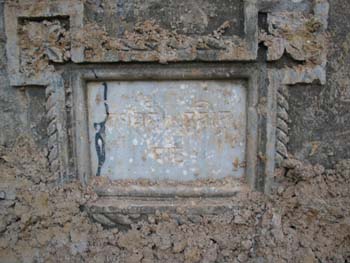
Lastly there was the Dighi (pond), with a Ghat that is now destroyed. The Ghat was Rani Shwarna Kumari's. A marble plaque announcing her name was still part of the old delapidated Ghat. It had pock marks from 1971, when Pakistani soldiers apparently went at it with their bayonets.
Many thanks to Tutul, Mukul, Zia and of course Mama for this encounter with a childhood fascination.
Now the pictures: First the palace courtyard.

This is the wing where the Rani lived:

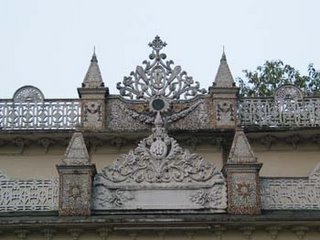
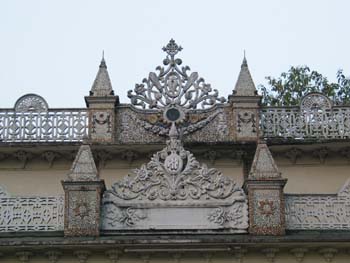
Workmanship on the top floor of the Rajbari:

Platform on 2nd floor from which Raja spoke to subjects (on the ground floor)
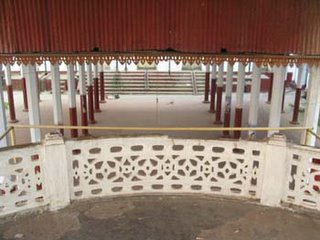
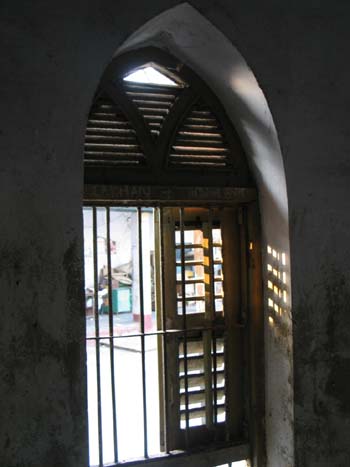
Window of a room in the RajBari:
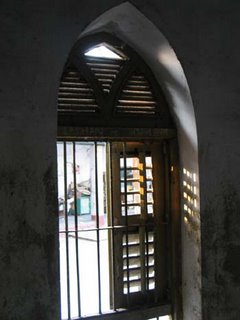
Spires of the Shoshan:

Picture of Raja Ranendra Narayan Roy inside the spire built around his ashes:

Tiles in the house that used to be Raja's sister's Mondir:

More tilework representing Krishna with Gopinis:
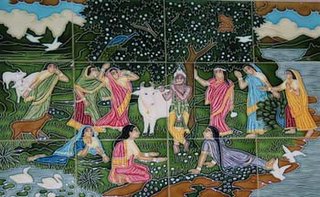
External work at the ex-Mondir:
Plaque on the Pukur Ghat:

Why the fascination with Bhawal Raja? I heard the story of Bhawal from my mother when I was a child and it captured my imagination. Bhawal was a large Zamindari (estate) close to Dhaka with its headquarters in Joydebpur. In 1909, the heir to this estate, Raja Ramendra Narayan Roy, died in Darjeeling. The story involves the appearance, in 1922, of a Sadhu in Dhaka. When this Sadhu visited Joydebpur, many people thought he looked like Raja Ramendra Narayan Roy. These people included the Raja's own sister who was delighted to have her long-dead brother back.
Eventually a legal battle ensued over whether this Sadhu was really the Raja of Bhawal. On one side were the British government (who had taken over the estate at this point in time because of the lack of heirs) and the wife of the Raja. The other side consisted of the Sadhu, the Raja's sister as well as numerous others from Bhawal. The British side insisted that the Raja had died in Darjeeling and was cremated there. The Sadhu's side claimed he had not died; that his body was not cremated, but had been left just before cremation because of a storm; and that a nearby group of Sadhus had rescued and revived the Raja who went on to become a Sadhu.
Popular versions of the story cast more evi aspersions on the Raja's wife. It was alleged that she was having an affair with the Raja's doctor and the two of them conspired to have the Raja killed.
In the end, after 20+ years of legal wrangling, the Sadhu won the case and the property. However, two days after the final victory, he died of a stroke.
The case is revisited in the book "Princely Impostor?", by Partha Chatterjee, which I read last year. The book is fascinating if a tad too long, and after thorough research in archives in Dhaka, London and Calcutta, the author concludes that he cannot decide if the man who appeared after 12 years was indeed the Raja or an impostor.
Back to Joydebpur. The first stop was the RajBari. This has become a government office suite now, housing the District Commisioner's offices as well as various courts. Some parts of the building were locked because it was Friday, which is weekly holiday. But we were able to enter otherr parts and look around. Sadly this was the same building outside of which a suicide bomber killed several people in 2005.
The next stop was the Shoshan. When I saw it I thought it was a temple, because of the spires. As each Raja in the dynasty died, a his ashed were kept in a spot and a spire built around it. There were several spires, and the picture of one Raja (Ranendra Narayan Roy) was inside one of the spires. Overall the Shoshan was in a bad state of repair.
The final stop was Tutul's relative who lives in the Mondir of the King's sister. The family got this property as part of property exchange after Partition in 1947. This property had some beautiful tile work, nice external work, as well as beautiful wooden doors.
Lastly there was the Dighi (pond), with a Ghat that is now destroyed. The Ghat was Rani Shwarna Kumari's. A marble plaque announcing her name was still part of the old delapidated Ghat. It had pock marks from 1971, when Pakistani soldiers apparently went at it with their bayonets.
Many thanks to Tutul, Mukul, Zia and of course Mama for this encounter with a childhood fascination.
Now the pictures: First the palace courtyard.
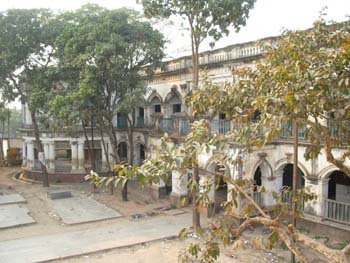
This is the wing where the Rani lived:

Workmanship on the top floor of the Rajbari:
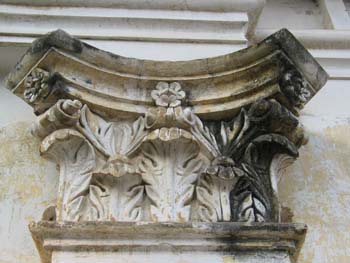
Platform on 2nd floor from which Raja spoke to subjects (on the ground floor)

Window of a room in the RajBari:
Spires of the Shoshan:

Picture of Raja Ranendra Narayan Roy inside the spire built around his ashes:

Tiles in the house that used to be Raja's sister's Mondir:
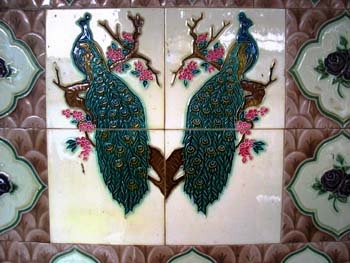
More tilework representing Krishna with Gopinis:

External work at the ex-Mondir:
Plaque on the Pukur Ghat:
Friday, January 20, 2006
Three Must-do's for NRB's to Settle in Bangladesh
If you are a Non-Resident Bangladeshi who wants to return to Bangladesh (for whatever reason - family, better prospects, homesickness...) the three things that, in my opinion, you should sort out before making the big move are:
1. Children's plans - if you have children who grew up overseas, then keep in mind that such a move will impact them a lot more than it will impact you, so you need to give careful thought to where they will go to school, their commute, what they will do in spare time, etc. Many families that returned to Bangladesh had to go back because the children were unhappy.
2. Finances - only you know what your financial needs will be, and you should have some plan to address those needs. There are two scales of expenses in Dhaka: local and imported. Local scale is reasonable; imported scale is 5x-10x more expensive. That is, Dhaka can very quickly become very expensive if you want to indulge in imported goods. Decide where you fit in, do some calculations, and make sure you have the income, either from overseas or from a job or business in Bangladesh.
3. Spousal alignment: Making the move to Bangladesh is a huge change. So you and your spouse must be united in facing the challenges.
1. Children's plans - if you have children who grew up overseas, then keep in mind that such a move will impact them a lot more than it will impact you, so you need to give careful thought to where they will go to school, their commute, what they will do in spare time, etc. Many families that returned to Bangladesh had to go back because the children were unhappy.
2. Finances - only you know what your financial needs will be, and you should have some plan to address those needs. There are two scales of expenses in Dhaka: local and imported. Local scale is reasonable; imported scale is 5x-10x more expensive. That is, Dhaka can very quickly become very expensive if you want to indulge in imported goods. Decide where you fit in, do some calculations, and make sure you have the income, either from overseas or from a job or business in Bangladesh.
3. Spousal alignment: Making the move to Bangladesh is a huge change. So you and your spouse must be united in facing the challenges.
Trip to Thailand
Visit to Thailand
We visited Phuket and Bangkok. Very nice, specially Phuket, with its soft sand beaches and warm, clear ocean.
Even though Bangladesh and Thailand were fairly close in development even 25 years ago, the Thais have really taken off.
How come?
Thais first had influx of US investment during the Vietnam was, then Japanese money for infrastructure. And of course money from tourism which they invested in the right way. Plus, they are an extremely clever, hardworking, and resourceful people.
Bangkok is one giant shop. Everyone is involved in selling something or other. And they understand the psychology of selling very well. So even if you don't need an item, you want to buy it because it appears cheap, attractive, etc.
Everything is cheap. For example, orange is 15baht/kg (ie, Tk. 22), compared to Tk. 70-80 in Dhaka. I was told that the Bd prices reflect all the added costs of Chadabaji, Ghush, middlemen, etc. If someone can eliminate some of these costs here, things would get a lot better.
I was amazed to find only one park in all of Bangkok: Lumpini Park. In this respect at least, Dhaka is an infinitely better city with so many parks running through it. I hope we don't sacrifice our green parks to development.
Thais are extremely nice to their visitors. In particular they are doubly nice to Caucasian visitors. In line for Guest Service Manager at the hotel I was staying in, I got a nice smile and a "Sawsdee Kha" when my turn came. But for the next person, who was Caucasian, the Manager jumped off the chair with a larger smile, almost ran towards the person to shake their hand, and ingratiated herself to no end. Similar behavior at the Stand-By Thai Airways counter at Bangkok Airport. Oh well. I guess this kind of behavior pays off. They get many many Western visitors.
Another example of Westophilia: during a guided tour of Vimanmek Palace, we are shown dozens and dozens of items that the King had imported from Germany, Austria, England, USA, and "Waterford of Iceland (yes, "Iceland")" but only one item that was brought in from Asia, a piece of cloth from India.
The Thais are clean and also fair in business. In two weeks I saw not one person spit or blow their nose or clear the throat and spit out cough. While sometimes they haggled hard, I never once felt they tried to cheat me.
And they work very very hard. Long hours setting up shop in the early morning, selling all day, and closing down late.
For a wealthy city, Bangkok has a disconcerting number of beggars. They are indeed pitiful. Positioned mostly at the numerous overhead pedestrian crossings, they sit with hands claspend, too embarrassed to catch your eye, meek and vulnerable beings. Perhaps they can learn to be more aggressive from Dhaka beggars.
Oh yeah, Bangkok people use those overhead pedestrian bridges all the time, unlike in Dhaka.
So: their hard work, foreign investment, pleasing the right audience, and their beautiful bounties of nature - all these have made Thailand successful.
A very nice trip, and I hope that Bangladesh can one day develop to the same level soon.
We visited Phuket and Bangkok. Very nice, specially Phuket, with its soft sand beaches and warm, clear ocean.
Even though Bangladesh and Thailand were fairly close in development even 25 years ago, the Thais have really taken off.
How come?
Thais first had influx of US investment during the Vietnam was, then Japanese money for infrastructure. And of course money from tourism which they invested in the right way. Plus, they are an extremely clever, hardworking, and resourceful people.
Bangkok is one giant shop. Everyone is involved in selling something or other. And they understand the psychology of selling very well. So even if you don't need an item, you want to buy it because it appears cheap, attractive, etc.
Everything is cheap. For example, orange is 15baht/kg (ie, Tk. 22), compared to Tk. 70-80 in Dhaka. I was told that the Bd prices reflect all the added costs of Chadabaji, Ghush, middlemen, etc. If someone can eliminate some of these costs here, things would get a lot better.
I was amazed to find only one park in all of Bangkok: Lumpini Park. In this respect at least, Dhaka is an infinitely better city with so many parks running through it. I hope we don't sacrifice our green parks to development.
Thais are extremely nice to their visitors. In particular they are doubly nice to Caucasian visitors. In line for Guest Service Manager at the hotel I was staying in, I got a nice smile and a "Sawsdee Kha" when my turn came. But for the next person, who was Caucasian, the Manager jumped off the chair with a larger smile, almost ran towards the person to shake their hand, and ingratiated herself to no end. Similar behavior at the Stand-By Thai Airways counter at Bangkok Airport. Oh well. I guess this kind of behavior pays off. They get many many Western visitors.
Another example of Westophilia: during a guided tour of Vimanmek Palace, we are shown dozens and dozens of items that the King had imported from Germany, Austria, England, USA, and "Waterford of Iceland (yes, "Iceland")" but only one item that was brought in from Asia, a piece of cloth from India.
The Thais are clean and also fair in business. In two weeks I saw not one person spit or blow their nose or clear the throat and spit out cough. While sometimes they haggled hard, I never once felt they tried to cheat me.
And they work very very hard. Long hours setting up shop in the early morning, selling all day, and closing down late.
For a wealthy city, Bangkok has a disconcerting number of beggars. They are indeed pitiful. Positioned mostly at the numerous overhead pedestrian crossings, they sit with hands claspend, too embarrassed to catch your eye, meek and vulnerable beings. Perhaps they can learn to be more aggressive from Dhaka beggars.
Oh yeah, Bangkok people use those overhead pedestrian bridges all the time, unlike in Dhaka.
So: their hard work, foreign investment, pleasing the right audience, and their beautiful bounties of nature - all these have made Thailand successful.
A very nice trip, and I hope that Bangladesh can one day develop to the same level soon.
Wednesday, December 28, 2005
Changing Software Business
I wrote this for the Daily Star summarizing the changes in software business.
http://www.thedailystar.net/2005/12/10/d512101602109.htm
Usually Microsoft is a late-mover in big changes like this. Wait till the smaller players have created the market and then strike.
http://www.thedailystar.net/2005/12/10/d512101602109.htm
Usually Microsoft is a late-mover in big changes like this. Wait till the smaller players have created the market and then strike.
What is This Mysterious Ruin?

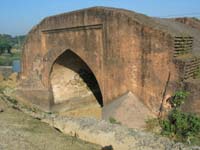

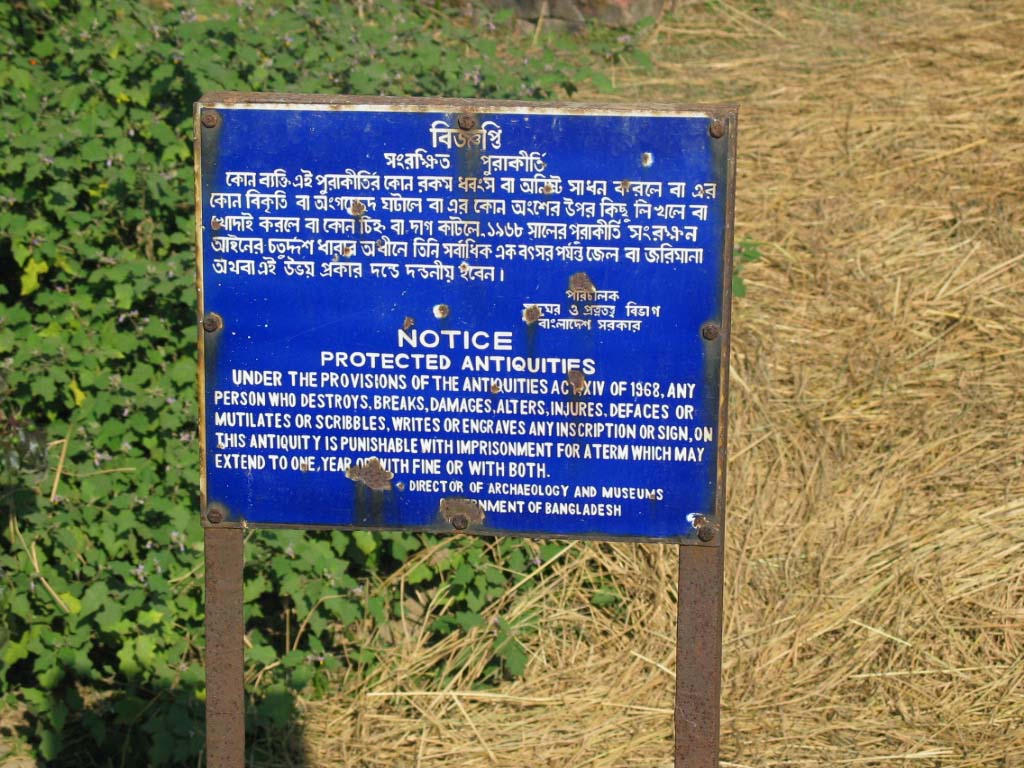
On the Dhaka-Sylhet highway, some ways after crossing the Bhairab bridge, on the left of the road, is this mysterious ruin. The sign is a warning not to damage it (or go to jail). But no details on what it is. Does anyone know?
Friday, December 23, 2005
State of Software in Bangladesh
I wrote how we can be more successful in software business for The Daily Star:
http://www.thedailystar.net/2005/11/26/d511261601108.htm
http://www.thedailystar.net/2005/11/26/d511261601108.htm
Thursday, December 22, 2005
A Trip to Cox's Bazar

We made a trip to Cox's Bazar over a three-day weekend: 15-17 December. The options for getting to CB are: a) bus; b) plane; c) drive. We drove. Started out at Dhaka at 7am; reached CB at 3pm. We drove straight through, did not stop anywhere.
To go south from Chittagong, you have to cross the Karnaphuli river. We got on the wrong bridge over the river. This was a really narrow, single-lane railway bridge. There was a flagman who held up traffic one way and let the traffic pass the other way. On our way back we crossed the river on a more conventional bridge.
Anyways, CB was very beautiful. Sunset on the beach was incredible. I was also very happy to see a lot of Bangladeshis enjoying this beautiful spot. Tourism has become big business in Bangladesh. Big Volvo busses ply the Dhaka-CB road, carrying many middle-class families to their vacations.

We ate at the hotel, but there is lots of places with good food in CB. There are shops selling souvenirs made from "jhinuk" - zillions of different kinds. And lots of "Burmese" shops selling unpredictable combinations of things: "Shaq" basketball shorts, a variety of knives, laser pointers, even a book-light!
Development is crazy. I counted over 20 multi-storied hotels that are open today, as well as many more under constrution. "Angel Drop", a tea shop that the Lonely Planet Guide raved about, was exceptional because of the open air design, and because no concrete was used. It looked very nice. But I was tired and wanted a cup of regular milky Bangladeshi tea only to be told they served coffee (instant) and milkless tea.

The beach sand was dark. The water was a little murky. Parts of the beach were littered with trash. Seems like we Bangladeshis like to share so much, we even share our trash with other beachgoers! Parts of the beach were covered by intricate, beautiful patterns created by tiny (1cm) crab.

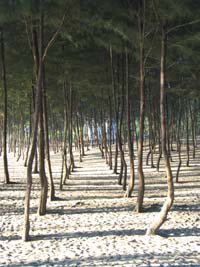
There was a large patch of "Jhau" trees on the beach. I assume that they break the force of the winds of the Norwesters that hit these parts during the monsoon.
We got on a speedboat for a short ride. There are other sports such as jet skis, "bananas", as well as dune buggies on the sand.

The Dhaka-Chittagong highway had at least 8 or 10 large rest stops. We stopped at "The Off Beat" which had a diverse menu offering everything from French Fries to noodles to biriyani to Korolla Bhaji. The Fries were so-so - I think
they mixed in a little turmeric. Later I found out that another favorite is Highway Inn. Apparently the Khichuri-Gosht at Highway Inn is amazing.
Next time I go, I am definitely going to take a trip to Teknaf and St Martin's. I understand SM is more pristine, and there is no electricity.
Subscribe to:
Posts (Atom)