Saturday, April 21, 2007

Tormooj (Watermelons)

The heat is on. Watermelons are in season.

It's a sweet antidote to the heat.


Boats coming into Dhaka are loaded with melons.


Unloading from the lower deck...


...and loading into a boat...


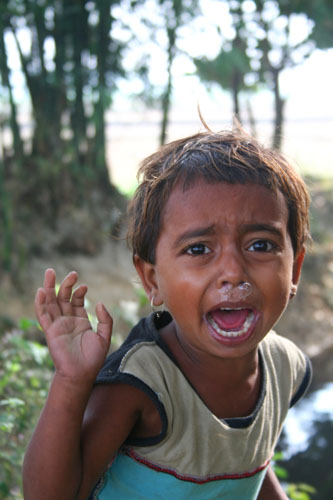
Boys who helped unload show their reward.


This boy had to swim ashore with his one.


Man taking melons home to village.


Melons on display after rain.


A more attractive display.


Another way to show off.

Saturday, April 14, 2007

Pohela Boishakh


Shubho Noboborsho - Happy (Bangla) New Year. Today is Party Time in Da Desh. As my ever-insightful friend Rahim says, the only holiday which is pure fun. No historical or religious connotations. Just enjoy the day.

So people were out for fun. Kids getting faces painted, playing with balloons and balls. Women wearing white and red saris. Friends walking hand in hand. Mothers, fathers, children - some grandparents. Eating choc-bars and potato chips, listening to singers and bands as they played on various stages in Ramna park and nearby. Some even dancing. Blowing soap-bubbles. More kids getting their faces painted than you can shake a stick at.

Some brought a tiffin carrier, a bedsheet and sat down and had a picnic lunch in the park. Smiling women tied each other's hair into jasmine flowered chignons. College boys showed up wearing the same fashion sunglasses and T shirts.

It was good to see everyone so happy.

Saturday, April 07, 2007

Green (Photos)

As Borsha (rainy season) approaches, green asserts itself in the countryside.

Tiny Jamburas starting their life.


Lily flower buds.


Patabahar leaves.


Rubber leaves.


Creepers.


Unknown (fern?).


Fern.


Weed.

Thursday, April 05, 2007

Water and Electricity

The weather heated up the last few days, as expected for April. All the air conditioners in the city turned on at the same time. So... load-shedding, a fancy term for "It's your turn to do without electricity for a couple of hours." (Reminds me of a story by Sanjib Chattopadhyay where he goes to the doctor for with a back pain and is told it is spondalitis. He is impressed by the name, then remarks, when it comes to afflictions, the more impressive sounding the name, the more painful it is.) Then some power station caught fire, so... more load shedding. The power station fire apparently prevented the Water Supply from pumping water, so... two days without running water. Feels a little like that backpacking trip I took in the Sierra Nevada going four days without a shower :-). It's going to be a long hot summer.

Bangles (photo)

Bangles for sale on Independence Day:

Sunday, April 01, 2007

E. B. White and Brevity (with some Mujtaba)

The other day I was invited to a gala dinner event. Towards the end of a most inspiring evening, and just before the dinner, the Chief Guest delivered his speech. Trouble was, it was a long delivery: we all felt the labor pains. At one point, he said "And I now digress to say that..." and the young man sitting next to me groaned, "Oh no, please please don't digress!" I felt bad for the CG, who, in his seriousness, had forgotten he was the last thing that stood between the audience and its dinner. He should have listened to E. B. White and Will Strunk's timeless advice: "Omit Needless Words."

Somehow in our cultural makeup, specially when using English, we just love to pile in the words. "With humble submission I beg to state that" was what the Brits taught the Indians to start letters with. That is gone, but now in its place, I once gave a speech to an august body in Rajshahi that started like this: "Distinguished Mayor of Rajshahi, Honored City Council Members, Respected representatives of XYZ Furrin Organization, Highly Regarded Members of Parliament and the rest of you riffraffs I mean honored ladies and gentlemen." Once was enough, never again I swore. [Ok, ok, I didn't really say riffraffs - just checking if you are paying attention.]

Ok, so what's the connection between verbosity in Bangladesh and an American writer? Simple: White's lessons and examples, if followed, would result in more precise and effective use of English words in our culture. Here is an introduction to his works and lessons.

Elwyn Brooks White (1899-1985) is best remembered for his essays, poems and sketches. He also wrote the classic children's stories Stuart Little and Charlotte's Web. With Will Strunk Jr, White was the co-author of The Elements of Style, a guidebook for writing well.

White’s essays are infused with a profound civility and respect for nature. A master of writing style, he was a persuasive champion of plain and direct writing. A gentle humor permeated his words.

Take, for example, his essay Riposte, where he discusses a recently published article, The Meaning of Brown Eggs, written by an Englishman. White is not pleased with the article’s attempt to categorize Americans based on their preference for white eggs over brown. "Why is it, do you suppose, that an Englishman is unhappy until he has explained America?" he asks, arguing, "... but one seldom meets an American who is all tensed up because he has yet to explain England."

At the end of A Listener’s Guide to the Birds, a poem describing various bird sounds, White signs his name in bird-watcher terms:
"E. B. WHITE (gray cheeks,
inconspicuous eye-ring,
frequents bars and glades)"

Or take the start of The World of Tomorrow, an essay on the World’s Fair in New York,: "I wasn't really prepared for the World's Fair last week, and it certainly wasn't prepared for me. Between the two of us there was considerable of a mixup."

I first encountered White's work in 1977, when I entered Cornell University, New York, as a freshman. To my dismay I discovered that all freshmen were required to take a full year of English writing classes. I thought this was a waste of time since I knew all there was to know about writing. After all, hadn’t I earned an “A” in O-Level English? The first essay I wrote for my class proved me wrong. My typewritten paper came back from the teacher covered with red (outright mistakes) and blue (suggestions for improvement) marks.

I was humbled. A friend saw my predicament and brought me The Elements of Style. Not since Class 3, when my father gave me a crash-course in English grammar, had I learned so much about writing in such a short time. Soon my run-on sentences stopped running, my modifiers stopped dangling and my infinitives were joined: I made it through the writing class.

That was in 1977. Since then, this little book - originally written by Strunk, then revised and updated by White – has been my constant companion. With twenty-two precise and clear rules of English grammar and an inspiring essay on writing style, it has shaped my thinking and helped me communicate my ideas clearly .

Some of these rules yield direct, forceful words. For example, using Rule 16, “Put Statements in Positive Form”, we write, “He usually came late” instead of “He was not very often on time.” Rule 15, “Use the active voice”, exhorts us to change, for example, “My first visit to Boston will always be remembered by me” into “I shall always remember my first visit to Boston.”

Other rules dispel confusions of grammar. Rule 1, “Follow the possessive singular of nouns by adding ‘s” is followed by examples “Charles’s tonsils”, “Burns’s poems”, and “the witch’s malice.” I also find Rule 10 useful: “Use the proper case of pronoun.” This rule lets me write “Will Jane or he be hired?” instead of “Will Jane or him be hired?”

An important theme in The Elements of Style is Rule No. 17, "Omit needless words." I let the book elaborate: "Vigorous writing is concise. A sentence should contain no unnecessary words, a paragraph no unnecessary sentences, for the same reason that a drawing should have no unnecessary lines and a machine no unnecessary parts. This requires not that the writer make all his sentences short, or that he avoid all detail and treat his subjects in only in outline, but that every word tell."

What a beautiful world it would indeed be if all needless words were omitted! What would the politicians say? Or all those people yakking on their mobile phones? And wouldn't Bollywood have to shorten all its movies to five minutes?

In addition to being influenced by Strunk's thoughts on brevity, White was also a fan of the American philosopher and writer Henry David Thoreau. Having built a house near a pond in Walden, Massachusetts, Thoreau had lived there, alone, for several seasons, sustaining himself with food he himself grew. The book Walden, which Thoreau wrote during this sojourn, remains a classic of philosophy and simple living.

White had read Thoreau's Walden so many times that he had memorized parts of it. He even thought that Walden's Table of Contents, wherein eighteen chapters are named using thirty nine words, was a lesson in brevity.

In the essay The Retort Transcendental, White speculated on how he could quote from Walden in answer to common questions.

For example, if he ran into a friend after a long time, and was asked, "Where have you been all this time?" White would reply, "If a man does not keep pace with his companions perhaps it is because he hears a different drummer." Or if he walks into a restaurant alone during a busy hour, and the headwaiter - unhappy about one person perhaps taking up a whole table - asks accusingly "All alone?" the proper Waldenian response is, "I feel it wholesome to be alone the greater part of the time. To be in company, even with the best, is soon wearisome and dissipating."

But even Thoreau is not immune from White’s humorous prodding. In A Slight Sound of Evening, an essay discussing Walden, White writes: “Thoreau said he required of every writer, first and last, a simple and sincere account of his own life. Having delivered himself of this chesty dictum, he proceeded to ignore it.”

Born in 1899, White attended Cornell from 1917 to 1921. During his senior year he was the chief editor of the college newspaper Cornell Daily Sun. Most of his professional life was spent working for the New Yorker and Harper's magazines. In 1937, he bought a farm in Maine and lived there with his family. He then split his time between writing and farming. Many of his essays have real-life, touching descriptions of his experiences with nature and animals at his farm.

Here is an example from his essay A Report in Spring: "No rain has fallen in several weeks. The gardens are dry, the road to the shore is dusty. The ditches, which in May are usually swollen to bursting, are no more than a summer trickle. Trout fishermen are not allowed on the streams; pond fishing from a boat is still permissible. The landscape is lovely to behold, but the hot, dry wind carries the smell of trouble." I don't know about you, but reading this I can feel the crackle of dry air on my skin.

While White covered many genres, for me he belongs squarely in the canon of nature writing, the crown jewel of American literature. Molded by America's pioneer spirit, wide open spaces and magnificent mountains and prairies, the writers of this genre - Thoreau, John Muir, Peter Matthiessen, Aldo Leopold, Edward Abbey, John McPhee, Barry Lopez and others – spent much time in the American wilderness and wrote about their experiences in a way that was both universal and personal.

White’s essays are powerful because they ring true, since they are borne out of his lived experience. But what makes them enjoyable is his way with words. As another American humorist James Thurber said, “No one can write a sentence like White.” And in the heart of White’s crisp sentences was his passion for brevity.

This love-affair with brevity has universal parallels, of course. The notion that a well-crafted creative work contains no more and no less than what is necessary to express the artist’s vision is an old one.

Shakespeare excelled in precise and parsimonious use of words, lending punch to his writing. That is why we find it so easy, even after 400 years, to use one of his phrases to express a complex or subtle notion.

Tagore's songs are masterpieces because they have exactly the right number of words and notes: no more, no less. That's one reason they have the power to move us without being sentimental or maudlin.

The great classical composers, such as Mozart and Beethoven, also wrote their music in the same way. In the movie Amadeus, based on Mozart’s life, there is an exchange between Mozart and his benefactor, the pompous Emperor Joseph II. Mozart plays a piece he has just composed for the Emperor. The Emperor likes it, but since he is Emperor, he feels he must find a fault. “It has too many notes,” he says, “Cut a few”. The precocious Mozart quickly retorts, “Then which notes would your Majesty like me to cut?” For this the Emperor has no good answer.

Our own master stylist, Dr. Syed Mujtaba Ali, was also a proponent of brevity. In an essay on Bangali food habits, he says that our dinner parties serve too many dishes. When he complains the host, the usual reply is, “We did not know which dish you would like, so eat the one you like most.”

But that probably means the host does not know what his or her masterpiece is. "Does a novelist write a novel with five different endings and let you choose the one you want?” asks an exasperated Mujtaba.

Brevity adds another dimension to the well-executed creative work: we enjoy it without feeling the load of the artist’s hard work behind it. The artist or writer may have had to struggle and revise many times, but what we enjoy is the final, polished work, looking effortless. For example, when we see an Olympic diver, we marvel at his grace, though he never overtly reminds us of the years of hard work he has invested in preparing for this moment.

So it is with White’s work. A few sentences into one of White’s essays, my mind is usually filled with joy, hope, and a sense of well-being. But White was a generous craftsman: for those who want to create like him, he left instructions.

Sunday, March 25, 2007

Deikhya Chalan Na! (Can't You Look Where You're Going!)

Last week I was bicycling to a friend's house in Gulshan. I was riding my racing bike: lightweight but hard to control. Enjoying the unexpected cool in Choitro, I was gently ambling down Road 96. As I approached a T intersection, where a road from the left met 96, I saw two rickshaws coming down 96 from the opposite direction. They gave no indication of turning; I took a quick look left to make sure no one was coming from there. All clear, so I entered the intersection. At the last possible instant the front rickshaw decided to turn right into this road and almost hit me.

I swerved to the left, fought for control of the bike and came to a sharp stop at a gently sloping roadside ditch. Luckily, I jumped off without taking a fall.

I was furious. The rickshaw had made its turn and was moving away, about 20 feet from me. "Deikhya chalan na!" I yelled after him, meaning "Can't you look where you are going?"

That's when the rickshaw-wallah turned his head towards me. I was waiting for this moment, so I could pin him with my angry glare. Instead, I got the second shock of the day. The man had only one eye.

Sunday, March 18, 2007

Young Bangladesh


My uncle told me this story years ago. During President H. M. Ershad's time, a village was facing a disaster. Mr. Ershad had ordered officials to deal with the matter urgently. They had worked hard and disaster was averted. Now the President was visiting in a helicopter. When his helicopter landed in a field, it was completely surrounded by hundreds of joyous kids. Mr. Ershad apparently looked at the official next to him, pointed outside, and said, "We have averted disaster today, but what will happen tomorrow when all these kids must be taken care of?"

Well it looks many of those kids are doing Bangladesh proud today. One example is the really young team that defeated India at World Cup Cricket yesterday. There are several teenagers in the team. As the Daily Telegaph said,

"These Bangladeshis have an impish verve all their own. Their youngsters are not only ardent but cheeky and streetwise. They are the youngest Test nation but they don't die wondering."

Ah, all those years of eating chotpoti/fuchka and playing truant/cutting classes to practice cricket pays off! A day like this is enough to make a fan out of a crusty cricket-agnostic like myself.

Another example is GMB Akash, a young photojournalist, who was chosen in an important list of worldwide top 30 "New and Emerging Photographers to Watch in 2007". Akash is 30, the only South Asian in that list.

Yet another example is young novelist Tahmima Anam who I have mentioned on this blog before.

And so the list goes on. Naeem Mohaiemen, in an essay, commented on how young Bangladeshis who have been successful abroad rarely get the rave reviews they deserve in their homeland. Yes, they deserve more attention. Problem is that our culture has a historical tendency to tilt towards elders and towards the past.

But today I see a change. So many of the kids I meet at different occasions - from the classrooms and halls at BRAC U. where I teach, to budding software engineers at various firms or friend's houses, to school and college students I run into while wandering or photographing - show confidence, self-esteem, and yes, verve.

The future of Bangladesh is in good hands.

Saturday, March 17, 2007

Congratulations, Tigers!

Tigers, the Bd cricket team, beat India by 5 wickets in World Cup Cricket. Two days ago, Manzarul Rana a comrade of the Tigers, died in a motorcycle accident. Tigers were playing in his memory. Congratulation, Tigers!

Wednesday, March 14, 2007

Extra! Extra! Goodbye Bangladesh!

Words on the street:
---------

Hawker selling newspapers: "[In English] Goodbye Bangladesh. Goodbye Bangladesh. Sheikh Hasina going to the America. In Bangla] Case being prepared against Khaleda Zia. [Back to English] Goodbye Bangladesh. Goodbye Bangladesh."

---------

Boy to me: "Uncle why are you taking pictures?" "Just for me." "What will you do with them?" "Maybe make a book" "Who will be the author of the book."

This gives me pause. "Hmmm. Not sure. Let me think. Which authors do you like?"

"Not sure. Let me think."

----------

Shopkeeper: [In English]"Uncle do you have one minute. We wanted to talk with you."
Me: [In Bangla] "Arekdin aashbo - I'll come another day."
Shopkeeper: [crestfallen]"Oh, you are a Bangla! Ok, never mind."

----------

Child: "Uncle can you take my picture?" Okay. "Can you take a picture of my little brother here?" Okay. "How about one of me sitting?" Okay. "Wow, you can see the pictures? Looks fine. Hey guys, come take a look." Okay. "Uncle how about a picture of that dog? Do you see the dog over there?" No, I have to go now.

----------

Boy: "Uncle how about a picture? Take one. Please?" Me: "What class do you go to? What is 5 times 12? Do you do your homework or cheat? Have you listened to everything your parents said today?" Boy: "Uh, I have to go now."

----------

Tuesday, March 13, 2007

Seasons Turn

Seasons turn swiftly in Bangladesh, like some other things. Last week I was enjoying the cool breezes of the end of winter on my skin. Yesterday it was suddenly hot.

In the farm, in just three weeks, the bald trees...


...had turned green...


... with leaves dripping color.


Of course the usual suspects still prowled.


But the bright yellow flowers of fall that had attracted so many critters...


... were gone, the dying plant now busy creating seedlings in place of flowers.


Even the ugly roadside plants...


...jumped into spring by producing pretty flowers.


The creepers of the forest were also out looking for some action.


But the best part of spring were these intensely fragrant Jambura blossoms. Thakur Mohashoi, "Fagune tor aamer boler ghraan" is not nearly as sweet-smelling as these, but somehow "Faguney tor jamburar boler ghraney" does not sound so poetic!

Friday, March 09, 2007

Cat

Couldn't resist this cat at a jewellery store:

I Like These Signs

The "do not pee here" signs are sometimes hilarious. This one threatens 10 strikes by shoe, as well as Tk 50 ($0.75) fine. Is that you Gopal Bhaar?

Thursday, March 08, 2007

Book Talk

My brother brought me Francine Prose's "Reading Like a Writer" which I am reading like a reader, heh-heh. Seriously, the book reminds one to read slowly in order to understand and appreciate the craft of writing. Each word and sentence is the result of a decision made by the writer, and one can fully appreciate the nuances only by slow and deliberate reading.

This is true of any creative art, of course. Take photography for instance. If you want to learn to be a photographer by looking at photographs, then study the lighting, the location in space, the instant the shutter was pressed, how the space inside the frame is organized, how colors (or shades of grey) are used, etc.

One interesting tidbit about Prose's book: in the list of "must-read" books at the end, she has only one book on "how to write" amongst a mass of fiction - the evergreen Elements of Style by Strunk and White. I have used this book for 25+ years and still go back to it.

----------

Both Etc and Words n Pages in Gulshan are closed due to the crackdown on building code violations. Kudos to owners of WnP for their honesty in admitting to customers they have "a small legal problem" - unlike other restaurants and businesses, partially bulldozed, claiming they are closed because they are "renovating."

----------

Finished reading J. Lahiri's The Namesake. Syed Manzoorul Islam, in his story Reshmi Rumal, says he was carrying Namesake and Tagore's Chhinnopotro during a train ride. He tried to read the former for an hour, did not like it, then tried "Thakur Mohashoi-er Chhinnopotro" and liked it. Well I thought Namesake was a quick and light read, specially interesting to me because my children were born and raised in the US.

-----------

I understand Bangladeshi writer Tahmima Anam's book launch took place this week in London. The book is the first opus in English around the 1971 War of Bangladesh Independence. I hope it reaches many people who don't know about our history. Am looking forward to reading it.

-----------

That book I bought at Boi Mela, called Bangladesher Protno Shompod, passed its second test last week. How? Back in Dec 2005, I asked about a mysterious ruin near Bhairab Bridge. Recently, Mr. Anwar left a comment on the blog saying it was Hatir Pul of Bariura in Sarail, and sure enough, the above book has a section on this bridge and on Bariura. Quick, someone take this book from me before I spend the rest of my life wandering around Bd checking out historical ruins!
(BTW, the first test was before I bought it - I wanted to find the location of Shankarpasha mosque in Sylhet - which I had been trying to locate - and it had good directions.)

Tuesday, February 27, 2007

The Garrulous Taxi Driver

I had to take a CNG across town the other day. Turned out the driver was talkative with a lot of opinions. (A CNG is a small three-wheeled taxi, running on Compressed Natural Gas, popular in Dhaka.)

Of Bangladeshis he said, "We are the most luxury-loving people in the world." Why, I asked. "Because for only 12 Taka you can get a half-hour ride on a super-luxurious Volvo bus from Mirpur to Farm Gate. A bus that costs 1.5 Crore (about $210,000)! People seem to love it, too" he complained.

His other complaint was about the rich people. There are many families who have 4 or 5 cars now. Not only that, they change models every couple of months. "What do they need so many cars for? No wonder the roads are all clogged up."

We got on the rich people track after he complained how hard it was to make money. "We have to pay Tk 600 every day as rental for this CNG. We have to sweat so much just to earn Tk 200 daily income." He said he was hoping that the rental would drop to 500 soon.

We passed by a strip mall in Gulshan-1 where, among a row of about 10 almost identical storefronts, one had been demolished (because of unpermitted construction.) "Don't you think it is unfair to pick out only one while the others are intact?" I asked. "Not at all, that is a warning sign to the others. If they don't fix their storefronts, they will go, too," he said sternly.

He was optimistic about the country's economy, as I found out in a roundabout way, when he said that the Rangs Building was coming down for sure (this is a controversial Dhaka landmark, reputed to have been built unpermitted.) "But think about it," I said, "there are at least 1000 people who work in that building. Each one supports at least 4 or 5 others. That's a lot of people who will be out of a job." "No problem," he said, "they can get other jobs. They have to just look - there are plenty of jobs."

While he was talking he forgot to tell me that he was almost out of CNG. So we made an unplanned stop in Tejgaon Industrial Area for 15 minutes while he waited in the CNG fillup line, while I took a quick stroll in the underbelly of industrial Dhaka.

Back on the road, he ranted about the CNG business. "These CNGs should have cost only 1-1.5 lac Taka ($1500-2000) but because of the corruption and everyone taking their cuts, the owner had to pay 3-4 lac. That's why poor people like me have to pay Tk 600 a day for renting it," he complained.

Well at least he is not burning petrol. The bill for filling up with CNG (to last him 1.5 days of schlepping people around town) came to Tk 45, about seventy cents.

We reached our destination. The meter read Tk 80 ($1.10) for about 8 miles. I paid him an extra Tk 10 bakhseesh, and with freshly filled CNG tanks our garrulous driver went off to find his next passenger (and captive audience.)

Sunday, February 25, 2007

Heroes

Heroes are hard to find, but sometimes you find them in unexpected places. For me, my Father is one such hero. Only two days ago, my Aunt (Mejofufu - who is much older than my Father) refreshed my memory about his involvement in the 1952 Language Movement. He was a student in Dhaka University, and was staying at my Aunt's house. One morning he wanted to go to school in a hurry. "Give me daal bhaat, or whatever is cooked" he asked my Aunt, "I have a long day." Yeah, long because we was demonstrating for Bangla with the other students. But then he got clubbed by the police and passed out on the street. He was taken to Dhaka Medical, and later an Ambulance brought him back to my Aunt's house. Luckily he recovered.

My Father rarely discusses this episode of his life but to those who know he is a true Bhasha Shainik. Who knows, maybe one day he will get recognition for his sacrifices.

There is also my Mother who passed away too soon. In her short life her grace and kindness touched everyone who met her. She was the pivotal point for our extended family to remain united. She was also an amazing cook who trained my tastebuds and gave me my taste for elegant food. She had helped so many people in so many ways that I am sure their blessings will carry the day for her.

Among my contemporaries, there is Dr. Qader, who supervises the Intensive Care Unit at the Children's Hospital. There were many opportunities in this talented doctor's life when he could have taken a job abroad (or a more lucrative one at a private place in Dhaka.) But his goal in life seems to be saving children's lives - specially those who don't have any alternative. An unsung hero, but one who has made a huge difference in many many lives.

Another contemporary, Ali Ishtiaq, worked in Silicon Valley and had a luxurious lifestyle there, which he traded-in three years ago to be with his ailing parents in Dhaka. He has taken incredibly good care of them, moving them to an airy, open apartment and looking after them in every possible way. His mother passed away three days ago. She breathed her last with her head on his lap as the car was speeding to the Emergency. Few of us get (or make) this kind of opportunity to take care of our parents.

On the public front, there is Dr. Yunus. Let's hope his political venture works out best for him and the country. There are two others I respect. One is Shykh Siraj, whose TV show Hridoye Maati o Manush has revolutionized agriculture in Bangladesh by giving ideas, courage and inspiration to the nation's farmers. The other is Magistrate Rokon-ud-Dowla whose tireless hunting for food adulteration has exposed many nasty food businessmen.

Well, the list goes on, but I want to mention one other person who passed away today. I met him very late, after he had fallen ill, but I was always touched by his soft-spoken manners and by his kindness. He was a pioneering civil engineer of Bangladesh, a founder of The Engineers, who not only built many structures here but also overseas. He was Mr. Manzur Husain and I hope that his soul finds peace.

Friday, February 23, 2007

Bicycling Tour of Old Dhaka

I took seven bicycling friends (all expats) on a "guided" tour of old Dhaka today. We picked Friday to avoid traffic congestion.

The plan was to bicycle from Gulshan 2 to see old Dhaka sights. These are ordered to start in the southeast and end at the northwest.

1. Shakhari Bazar (aka Shakhari Patti)
2. Ruplal House
3. Pink Palace
4. Armenian Church
5. Bara Katara
6. Lalbagh Fort
7. (if time permits) Khan Mohammed Mridha's mosque

At the end of the tour our cars met us in front of Lalbagh Fort.

We started from Gulshan 2 at 7:15am and bicycled through Tejgaon industrial area, Maghbazar, Kakrail and turned into Najrul Islam road, made a left into Bangabandhu Avenue and then on to Nawabpur Road. Straightforward, but there were still a few busses on the road, specially near Maghbazar.

From Nawabpur Road we turned right into the road leading to Shakhari Patti, then walked our biycles. We looked through some open doors to see the narrow and deep houses of Shakhari Patti. Two monkeys entertained us perched on second floor verandas and windows. The triple-arch facade of an old house also attracted my friends' interest. But despite many requests I could not get anyone at Shakhari Patti to let us into a house and see the inside. Too early in the morning?

We bicycled out of SP and went around Bahadur Shah Park (after a quick briefing on 1857 Sepoy Revolution) by North Brook Road towards Farashganj. As we entered the spice trading area, we ran into a jam caused by trucks delivering wholesale spices and had to walk our bicycles. We found Ruplal House and admired its exterior.

RH is inhabited by families of Armed Forces, and at first they refused us permission to go inside. I tried to reason with the guards (the interior courtyard is very nice and gives one a sense of times past) to no avail. As we were turning around disappointed, they changed their mind and said ok, but strictly no photography.

After checking out RH, we crossed into the road that runs in front of the river (Lalkuthi Road) and bicycled towards Ahsan Manzil. Here I made a mistake. I kept going straight to show a nice view of Ahsan Manzil from Sadarghat Road. Should have turned right and taken Patuatuli Road instead, because the front of AM was a horrid, claustrophobic jam that lasted for several hundred feet. Trucks delivering wholesale fruits had blocked the road and zillions of people and Van Garis carrying smaller loads were also trying to move. It took us 15 minutes to cross this part, but my friends took this little adventure in good humor.

Then we went under the Buriganga bridge ramp and back into Islampur Road. Shortly we turned right towards the Armenian Church dating from 1781. The caretaker let us in and opened it up for us. It was a surprising island of tranquility - with memorials, one statue, and lots of green. We also went to the roof and enjoyed the scenery.

Onwards on Islampur Road, we headed towards Chawk Bazar where we turned left into a narrow alley to see Bara Katara, Dhaka's oldest building (1644), now the home of a Madrasah. After we viewed the exterior dome, a teacher graciously showed us inside and took us to the roof for some nice views. Inside the Katara, some rooms and passages looked really old - could be original.

After this we bicycled to Lalbagh Fort. Since we had time, we biked another half km and saw Khan Mohammed Mosque. This pretty mosque is build on a platform. The basement served - and still does - as a dormitory.

Back we came to Lalbagh Fort. My friends did not mind the differential in admission between Bangladeshi admission (Tk. 5) and foreigner admission (Tk. 50) - they were happy to pay it and hoped the money be used for upkeep. The grounds of the Fort were well-kept and beautiful. I overheard a boss type barking instructions to a gardener on how to prune and beautify the garden. We spent time around Pari Bibi's (Shaista Khan's daughter) Mausoleum. Then we headed to the Hammam Khana (no, not for a shower!) and the museum.

We finished at noon. My friends all enjoyed the trip. One commented that even though he had visited some of the same places before by car, the bicycle trip afforded him a level of immediacy not available in a car.

I am planning Part 2 of this trip. Let's see... Tara masjid, Goal Talab, Hossaini Dalan, Nurjahan House, what else???

Wednesday, February 21, 2007

21st February

Five thousand years from now, when we are all dust, and today's nations are but small chapters in history books, what will anyone remember about Bangladesh? I believe it will be Language. If nothing else, they will remember that this proud, stubborn people rose up against a much larger force to exercise their right to speak, read and write in their mother language. And this rebellion ultimately gave birth to the nation Bangladesh.

Bangladesh remembers those who have given their lives for her language, Bangla, on this day, Ekushey February. All day long the city reverberates with this song:

Aamar bhaer roktey rangano ekushey February
Aami key bhulitey pari

(21st February, glowing with blood my brothers have shed
How can I forget?)

As I wandered in the city today, I saw thousands carrying flowers, some with black badges, yet others with the national flag. The flowers are left at the Shaheed Minar in memory of those who fought for Bangla. There were people from all walks of life - old, young, rich, poor, man, woman. Love for one's language knows no boundaries.

On this day I am filled with respect for those made this sacrifice, and I pray for their departed souls.

Thursday, February 15, 2007

Boi Mela (Photos)

I went to the Ekushey Boi Mela (book fair) yesterday. It is on Bangla Academy grounds and runs until Feb 28th.

What it's all about...


The road leading to the Mela covered by banners.


Onyoprokash was the busiest seller - one buyer gets change over heads.


The environment (specially trees) lent some drama (the sign says Shikor - "root")


Three veiled women who were shopping for books.


This man could not wait until getting home to read his new acquisition.


Publishers found novel ways to market books.


Salam, one of the first martyrs of the Language Movement


Friends looking through a publisher's catalog.


A selection of Bangla IT books in the Mela.


Parents' duties don't stop with purchasing the books :-)


I liked the Boi Mela a lot, but next time I will leave the camera behind. It was schizophrenic and stressful playing reader and photographer simultaneously.

I bought one book, called "Bangladesher Protno-Shompod" (Archaeological Treasures of Bangladesh) that is encyclopedic - and has directions to many many historical buildings and ruins.

Sunday, February 11, 2007

Two Points of View

Little Girl: Man, what a horrible morning! There I was, up bright and early, but Abbu and Ammu wanted to sleep in. I heard Bhaiya and Apu playing by the pond, so I came to join them. Bummer, they would't take me in their game. What could I do? No one would even get me a hanky to clean my nose. So I decided to sit by the pond, stare at the water, and think. Then I hear a noise, turn around, and - YIKES! - this big man had snuck up behind me with a black shiny thing in his hand, pointing it at me. I screamed. I am sure he had a sack in which he wanted to carry me off. And he kept on saying "foto foto." What the heck is a foto? I screamed and screamed and ran for my life, even though Bhaiya and Apu tried to stop me and look at that horrible man. No way. I want Ammu. Ammu! AMMU!

Me: I am bicycling through this village early in the morning, enjoying the scenery and taking pictures. I see two kids playing on the yard by a pond, and another little girl sitting by the pond, staring into the water, lost in thought. It was a perfect moment. Not wanting to disturb her, I parked my bicycle a few feet away and approached the child from behind, very quietly. Just as I composed the photo through the viewfinder and touched the shutter, she heard me and turned around. She froze for a split second, eyes widening in fear, then found her voice, started screaming and ran away. I said "it's just a photo, don't worry, I won't hurt you" and her brother and sister tried to calm her down but to no avail. So I went back to my bicycle and waited for a few minutes. Then I checked back - her screaming had stopped and she had calmed down. But the poor thing was traumatized enough for one day, so I left.

The photo:

Sunday, February 04, 2007

Brahmins and Naval Architects (Photos)

Last Friday we went for a 50-km bicycle ride out of Dhaka. It was a very foggy day:


We biked east and then south of Dhaka, the last 5 km along the banks of the Sheetalakhya. This was my first time on that road. We spotted a shipbuilding yard on the bank and stopped to take a look. Workers were building a large, 200+ feet long ship.


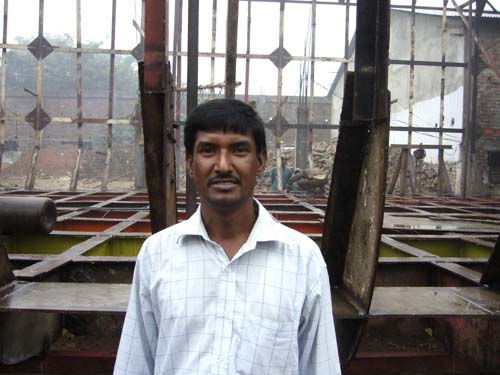
This gentleman is the owner of the operation. He said the metal comes from Chittagong, and is built into the ship which is sent back to Chittagong by river. Then it is used to move materiel between Chittagong and Dhaka. Takes about 8-9 months to make such a large ship. All the work is done on the premises.


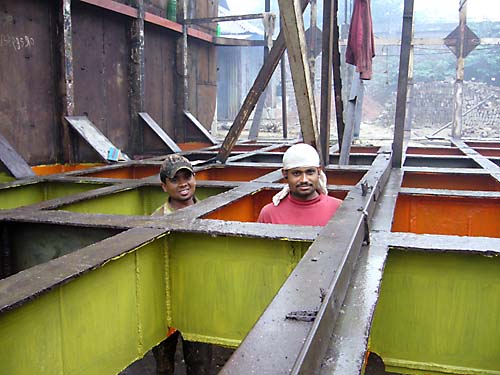
These two workers were painting the hull. They used a rag instead of paintbrushes to reach all the nooks and crannies (to seal them from rusting?)


I asked them about Keraniganj, where I had seen large boat building facilities. They said it had shifted here due to people moving into Keraniganj area (gentrification.)

I hope to be back when they lower the boat onto the river. That should be quite a sight.

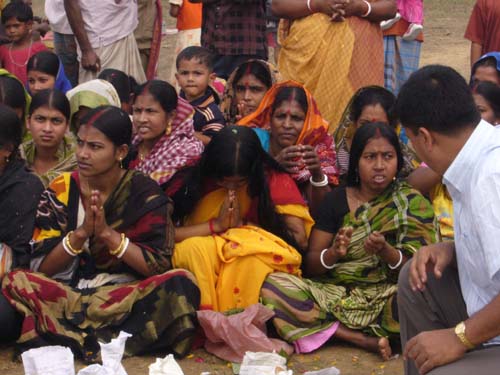
On our way back, Peter spotted some color at a distance from the road and we stopped to investigate. We walked to a field behind a village. It turned out a Hindu Puja - and an accompanying Mela - was in progress. It was called Purnima Puja or Dhamai(?) Puja. This priest was leading the prayers.


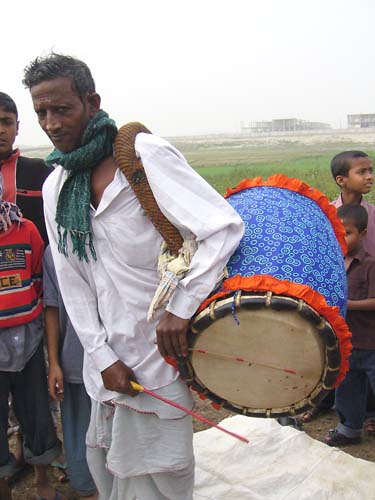
The air was festive, with music and drums.


The people praying were mostly women.


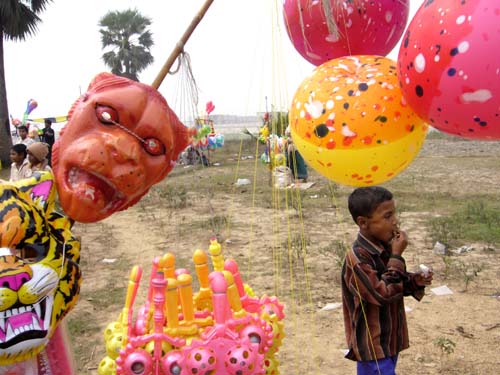
The mela offered toys for the kids.


This gentleman asked me to take his picture with his granddaughter. I said I thought it was her daughter - he looked so young. He gave a hearty laugh.


This girl had got her own balloon and was playing on the side by herself.


At night, it was full-moon, so indeed it was a Purnima. All in all, great day of exploring. Many thanks to my bicycling companions Peter and Mehreen.

Thursday, February 01, 2007

Bank Experience

Some days ago, I had to go to a (govt) bank for some business. This is not my "normal" bank, but my Father maintains his account there. So I go there, say, once every 2-3 months. I was wearing a short sleeve shirt, casual pants and sneakers. I had to open the door myself despite the sentry sitting inside - he could not be bothered. The bank officials did their work for me, but only after my pushing and prodding. They were not exactly cooperative or helpful. And as I was leaving I barely restrained myself from yelling at the sentry because he would not get up and open the door for me.

So I was annoyed and weighed whether to go back and yell at all of them. After all, my Father has banked with them for 20+ years.

Instead, another opportunity presented itself. I had to return in a couple of days for another errand. But instead of preparing for a fight, I tried an experiment. I put on a nice shirt, creased pants, a blazer, and a pair of black leather shoes. And wore a serious scowl on my face.

Voila! At my approach, the sentry stood up, opened the door and saluted me smartly. The bank officials were all very cooperative and I got the errand done in record time!

Lesson: if you are going to a (govt) bank in Bd, dress better than anyone working in there and act mean!