Monday, August 14, 2006

View From the Train (Photos)

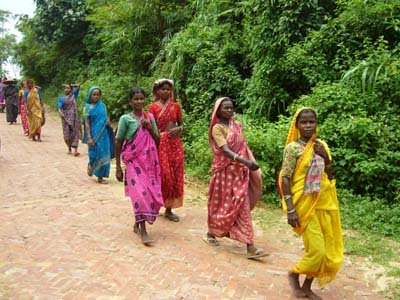
I took the train from Dhaka to Srimongol last Saturday. I saw these from my window:

My train was called "Parabat Express":


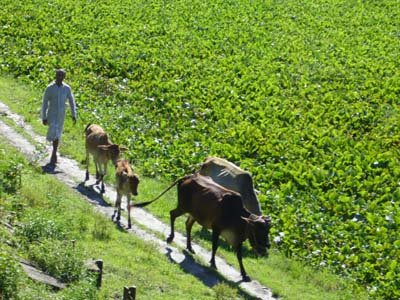
Man walking cows to the field:


Farmers transplanting rice seedlings; harvest in Aghrahayan:


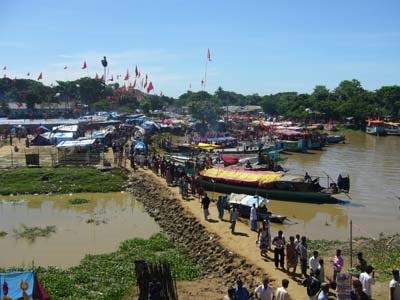
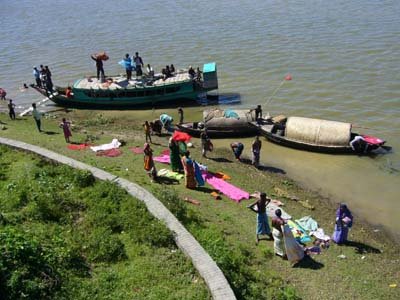
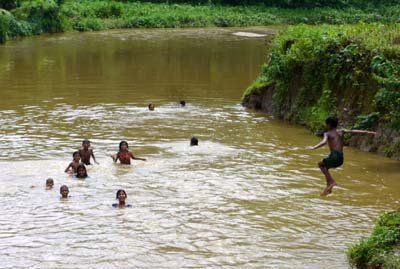
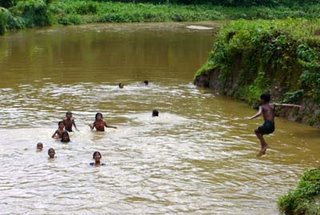
Typical river scene:


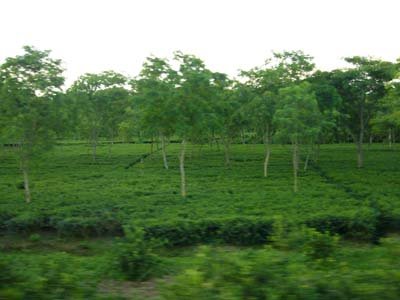
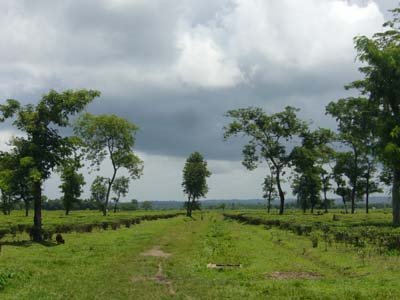
Tea garden:


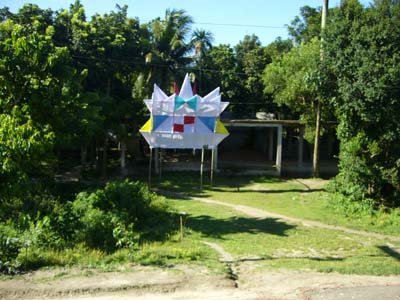
Decorated gate for a village wedding:


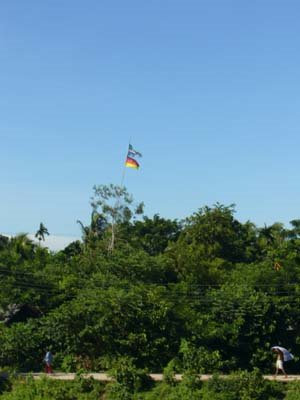
Flags supporting world cup soccer:


An Uros party (celebrating the death anniversary of a local saint):


Boats of Bedey people (who live their lives on boats):


Man building a temporary home:


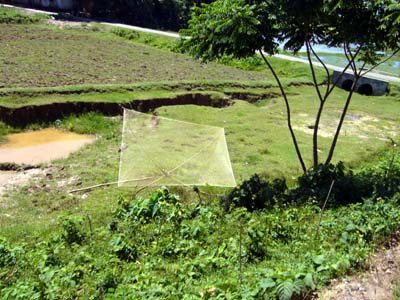
Fishing net being dried in the sun:


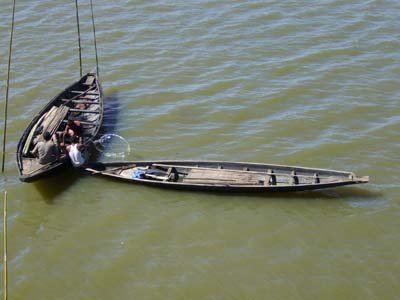
Helping get water out of a boat:


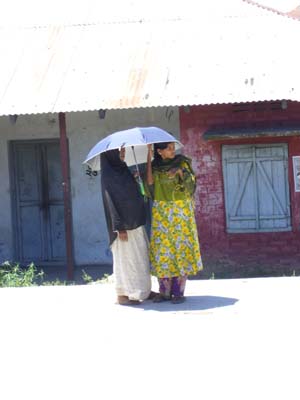
Mother and daughter at a train station in the (hot) noonday sun:


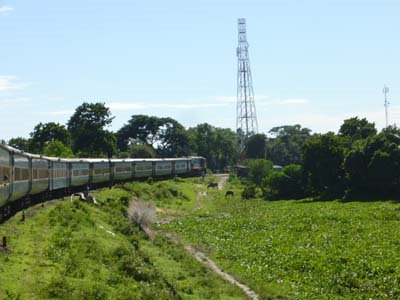
Train going the opposite direction:


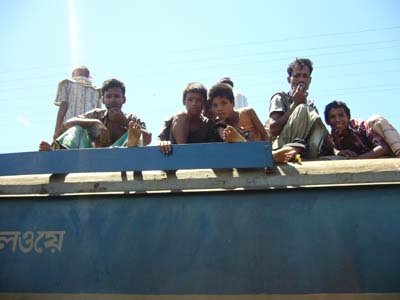
People on the roof:


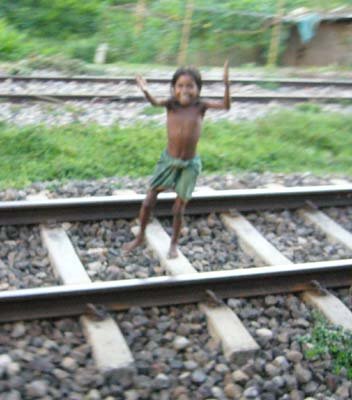
Girl on tracks:


Note: this was a First Class seat. A/C Class windows are fixed shut and will not offer these views. Trip was 4.5 hours.

Friday, August 04, 2006

Srimongol Bike Ride (Photos)

Yesterday I went for a 40-mile bike ride through the tea gardens in Srimongol. With me was Stefan (a biking buddy) who planned this trip and came prepared with an older edition of Lonely Planet Bangladesh with a map of this area (the current edition does not.) We started out in Kamalganj and biked in a loop through many tea estates including Srigobindapur, Dolai, Balicchera, Husseinabad and Phulbari.

The starting point for this loop was the HEED bungalow in Kamalganj. From there we followed the main road towards Shamshernagar until reaching a large intersection, where we turned right. Then we pretty much followed this road all the way, looping through various gardens and emerging on the main road again near Srimongol.

The road varied from paved to brick to sand. We did not encounter significant mud despite the rainy season.

It was a daytrip from Dhaka. Left Dhaka by car: 6:30am; arrived at Kamalganj: 9:30am; done biking: 3:30pm; left for Dhaka by car: 4pm; arrived home: 8:30pm.

It was beautiful in a serene, peaceful kind of way. Here are some pictures. Many thanks to Stefan for taking the initiative for the trip and navigating.

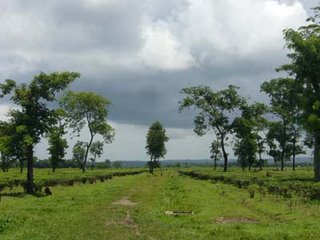
We ran into some spectacular landscapes. In the distance it was raining, but we luckily managed to stay dry:


The path was pretty though the brick portions of it jarred every bone in my body!


Many people used biycles in the villages. The boy in the foreground is too small to sit on the saddle but can ride by threading his leg through the frame's triangle. Later we met two boys who had bicycled from Shamshernagar to Srimongol (19km) for fun.
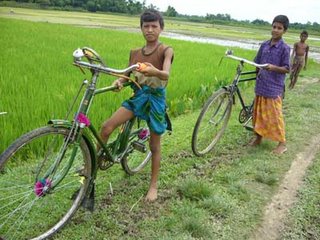


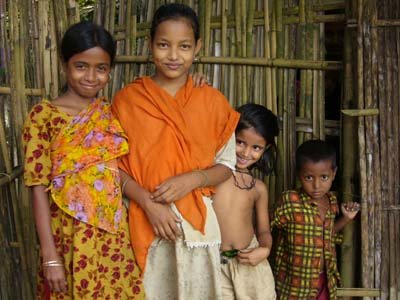
Once we lost our way and ran into these kids in a village...
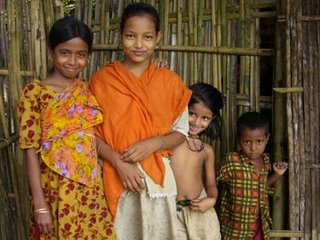


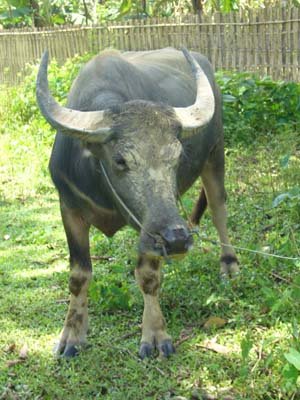
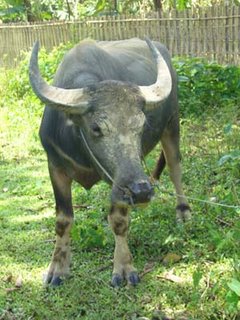
... and then this Mohish (water buffalo) with whom I was very careful not to get into an argument!


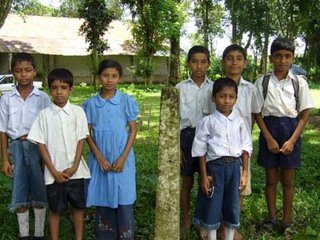
School was over near Srigobindopur:


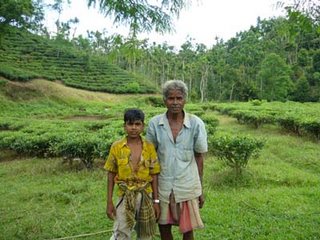
This father and son pair were working in the tea field:


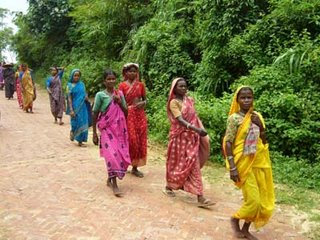
In the garden, women waited to weigh the tea they had collected. Life must be hard when so much of it depends on weight - be it tea-leaves, rubber-latex, fruits, firewood or fish.


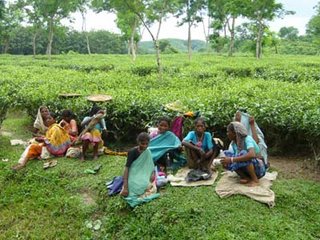
Other workers got a lunch break...


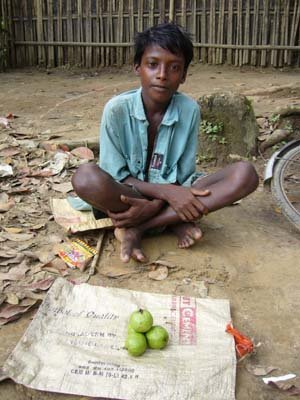
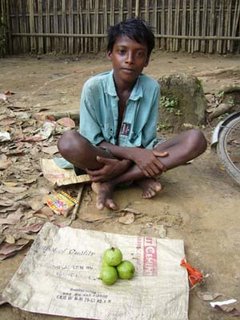
...While a boy offered guavas for sale near a labor village.


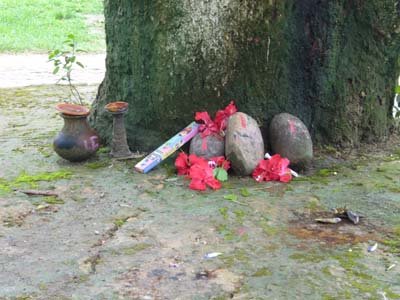
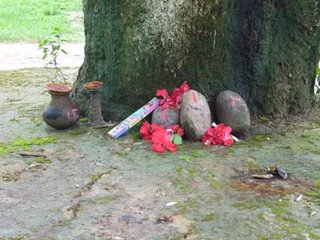
On a mandap at the foot of a large tree were remains of a prayer offering:


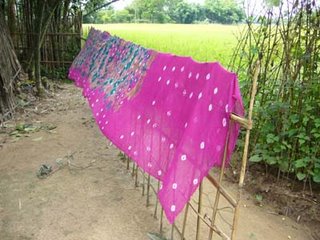
A drying sari lit up the landscape...


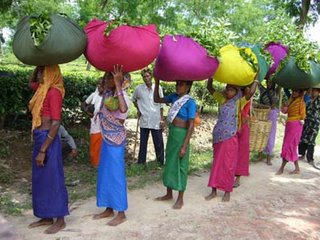
... as did this group who had just finished their weighing:


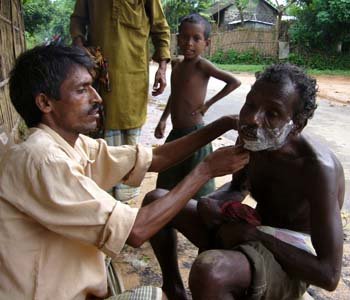
Meanwhile, it was time for the Friday shave for one of the men -
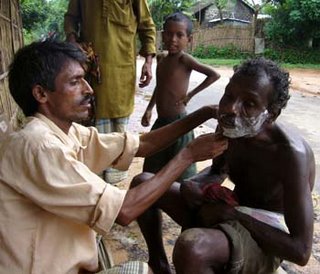


...but - as usual - the children had a better idea!


Postscript: Several years ago, I photographed the tea workers extensively. You can see some of them in my photo exhibit at the Fixing Shadows online Gallery, for example, this girl
Tuesday, August 01, 2006

Local Delights

One of the most delightful things about coming back to Bangladesh is the access to second-tier local fruits. The top-tier ones, such as mangoes and lichis, were available in the US. But the smaller ones (such as "Lotkon" (Bhubi in Sylheti), Orboroi (Leboir in Sylhet), Guavas (specially the small ones with red inside, called "Syedi Shofri" in - guess where? - Sylhet), Kamrangas, Jamruls, Amlokis, Koromcha, Panifol, Makhna, etc etc - parade through here during the year, one after another.

These fruits played a bigger role in my childhood than the top-tier ones because they were more easily accessible.

They are not just eaten fresh, but some in Bharta, others as "Tok", some in Jelly, and yet others in Aachar (eg, Leboir makes an excellent sweet achar.)

I tasted a Bhubi after 30 years. The taste and flavor were as exquisite to me as they had been years ago.

Attracting Large IT Companies

Tony Blair visited Silicon Valley last week, partly to lobby for bringing more companies to the UK, partly to understand what makes the Valley tick.

Sun CEO Jonathan Schwartz was at a lunch with Blair. Here is what he says about attracting their business to your country.

"So if you want to attract companies like Sun to your economy, focus on investing in education, in your students, and in your leaders. Focus on educating your policy makers as to why you're committed to education - not to build presitigious institutions, but to invest in progress, academic as well as economic. Focus on the value of broad based talent as a competitive weapon, don't be distracted by cost reducing labor."

http://blogs.sun.com/roller/page/jonathan

Friday, July 21, 2006

Bara Katra, Chhota Katra (Photos)

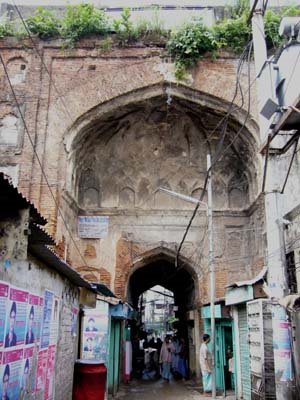
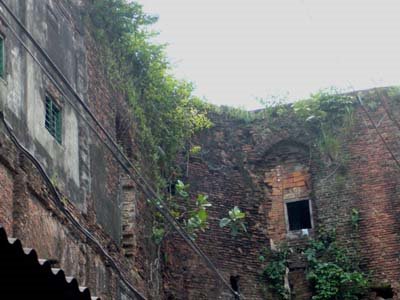
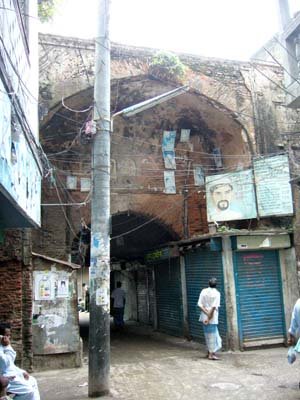
Bara Katra is one of Dhaka's oldest buildings, built in 1644 by Mir Abdul Qasem. It was originally an enclosed quadrangle on the Buri Ganga, with a marvellous entrance/gate with four wings and 22 rooms. The remains include the entrance and the tower. In a sad an delapidated state, one needs to use one's imagination to visualize the grandeur that this place must have held.

Here is the front of the entrance:


and the rear:


The tower:


Back side of the edifice:


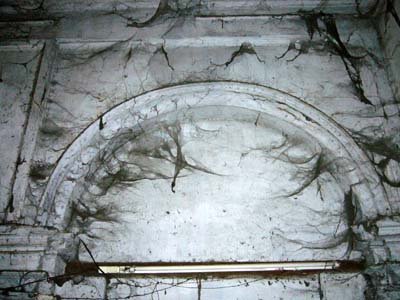
Underside of the archway with decorations:


Living quarters under the archway. The archway also contained a few stores.


Inside Bara Katra is a Madrasa now. A kind man showed me around. Interior views:


Stairs inside Bara Katra:


Chhota Katra was built by Shaista Khan in 1663. D'Oyly mentions it in his "Antiquities of Dhaka." It is similar to Bara Katra, but even less remains.

Entrance of Chhota Katra:


Inside Chhota Katra was an umbrella-making shop with these walls:


View from top of Chhota Katra looking to the river:


Having recently visited Italy and seen the amount of tourist revenue they must get out of old monuments, I am convinced that if we take steps to save/restore these monuments, our investment will be paid back many times. Why is it that we so easily let our irreplaceable buildings slide to destruction?

I got the historical facts from "Discover the Monuments of Bangladesh" by Dr. Nazimuddin Ahmed, published by UPL.

Friday Morning in Old Dhaka (Photos)

Feeling inspired by the adventures of Mr Islam and Ms Mustoe, I took advantage of Friday morning's light traffic to bike to old Dhaka and check out Bara Katra/Chhota Katra.

On the way I ran into this life-size sculpture on Shaheed Tajuddin Rd, made entirely from rickshaw/bicycle chains:


When I reached old Dhaka, the stores were all closed, including the famous Haji's Biriyani House on Alauddin Road. It has no signs, but twice a day people line up to buy the delicious biriyani cooked in mustard oil:


Life, however, went on. Friday luxuries included a visit to the barbershop...


...and getting the ears cleaned.


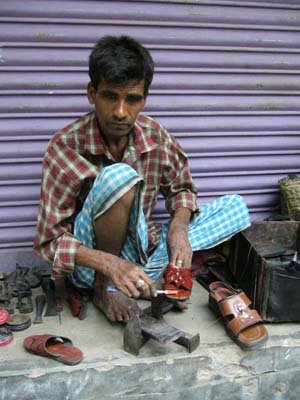
And don't forget shoes need polishing too:


A man in front of a closed store sold colorful children's clothes...


...And a girl was out wearing her "Friday best"


I had to share the road with all manners of vehicles!


The sky grew dark and in minutes there was a torrential downpour. I got shelter, but this rickshawallah did not get a break.


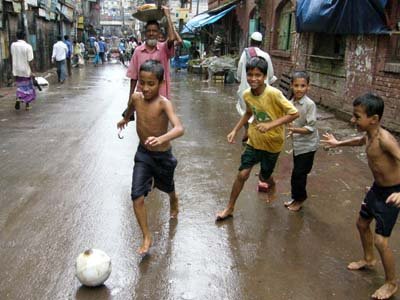
After the rain cleared, kids came out to play soccer on the wet street.


The fresh mud was no deterrant for a good tumble!


I went on to my destination. Details and photos in the next posting.

Wednesday, July 19, 2006

Math Olympiad

Starting in 2001, the nationwide Math Olympiad has increased young Bangladeshis' interest in mathematics and from a national craze we have gone international. Today the 47th International Math Olympiad ended in Slovenia. Bangladesh placed 80 out of 102 countries. So Bangladeshis are competing with the brightest from all over the world - thus learning to be globally competitive.

Team site is http://www.matholympiad.org.bd where you can see the contestants and sign a guest book if you choose.

Congratulations to the competitors for their effort, and to the organizers and sponsors for their dedication.

Bangladeshi and Other Bicyclists

Last weekend's ChhuTir Diney magazine (Prothom Alo) had a cover story on one Shahidul Islam, who bicycled from Tokyo to Dhaka. He started in Tokyo, crossed by sea to Korea, and after biking across, took a ship to China. From there he biked all the way to Vietnam, then Laos and Thailand. The Burmese stopped him from entering Myanmar, so he had to go back to Bangkok and fly to Dhaka. Quite an adventure! He covered 4000km from 26 March to 7 June. That averages to ~50km/day, but I'd bet his average on "biking days" was much higher, because it appears he took quite a few off days. Kudos to Mr. Islam on his accomplishment. He is quite an inspiration for us.

On a related note, I just finished reading "A Bike Ride" by Anne Mustoe, a 54-year-old British woman who bicycled around the world in 1988. The understatement of the title is reminiscent of another British traveller Eric Newby who called his hair raising adventure in Afghanistan "A Short Walk in the Hindu Kush." Ms. Mustoe's book is engaging and inspiring - the charm lies in her plain and straightforward storytelling. She started Eastward from the UK, through France, Switzerland, Italy, Greece, Turkey, Pakistan, India, Thailand, Malaysia and Singapore. Then she took a plane to California and biked across the US.

Her bicycle enabled Ms. Mustoe to mix with the locals - and indigenous ones at that - at a level that we in today's world of Hiltons and Sheratons are completely shut out of. There are stories of kindness and generosity from every country she visited. However, whenever there was a side-by-side comparison (eg, Turkey/Greece, Pakistan/India, Thailand/Malaysia), it appeared that people from Muslim countries charmed her more.

Too bad she jumped from Kolkata to Bangkok without bothering in Bangladesh, but back in 1988 she would have found it extremely difficult to find hotel-lodging in remote places in the country.

She has a great sense of humor, describing a harmonium as a "small keyboard with bellows" and baseball as "grown men in Victorian underwear playing rounders."

Oh, here is the amazing thing: even after 20000+km of cycling she still did not know how to fix a puncture. Go figure.

Wednesday, July 12, 2006

Gopal Bhaar and the Mobile Toilets

This article caught my attention today. It should be a big help for long-suffering denizens of Dhaka, although the number of toilets, 50, seems miniscule for 10 million people. Kudos to those who will make it happen.

http://www.thedailystar.net/2006/07/12/d607122503137.htm

But Tk.5 for defecating and Tk 2 for urinating? Reminds me of the old Gopal Bhaar story. Is someone going to be standing with a big stick to beat them up if they try to cheat?

Given our penchant for creating distinctions between people based on class, is there going to be a VVIP model, a VIP model and a Business and Economy model? The mind boggles at the possibilities.

And you know those signs on the back of cars here, things like, "Engaged in Important Export Duty", "Under Land Ministry", "Belongs to the Legal Counsel for the XX Minister", and the ubiquitous "Press"? Are we going to have similar signs for the potties? What will they say?

What would one advertise? Let's see... perfumes? lungis? Pepto-bismol? Or Ishobguler Bhushi?

Is there an exhaust-free CNG model in the works?

(Gopal Bhaar - the court jester for King Krishnachandra - story goes like this: one day a sentry arrived at Gopal's house and sat down to defecate on his lawn. Gopal ran out of the house and asked him to stop. The sentry said, "The King has ordered that I s**t on your lawn - so what can I do? Neither you nor I can disobey a king's direct order." Gopal asked him to wait a second, went inside the house and returned with a big stick. Then he positioned it like a baseball bat over the sentry. The sentry said "What are you doing?" Gopal said "The Kind only ordered you to s**t and said nothing about urinating. So if you urinate on my lawn while carrying out your assignment, I will kill you. Mutechho ki morechho." And so the sentry gave up and left. )

Saturday, July 08, 2006

Bangladeshis in Italy

Last month, a 20-year dream came true: we visited Italy. While it was an amazing lesson in history, I was also taken by surprise at the Bangladeshis in Italy.

I heard estimates of between 200,000 and 600,000 Bangladeshis in Italy.

I saw them in Rome, Florence and Venice (but not in Siena.) The ones I saw all had small to medium-size businesses. In Rome, they were selling handbags, sunglasses and tourist material on the streets. In Florence, we walked into a store selling "Indian-looking" things - "monohori dokan" - only to find the owner was a Bangladeshi who had a chain of these stores in the city.

In Venice, they were selling trinkets - like little puppets made from balloons - on the Accademia bridge and in San Marco Square. The seller told me these would not sell in Rome, but in Venice the tourists buy them.

They were incredibly kind and polite to us. The person in Florence - much to our protestations - fed us Cokes and ice cream, and sold things to us at large discounts. When it came to prices, they said "Pay us what you want - we are so happy to see a Bangladeshi tourist here." It was a kind of haggling in reverse. One street vendor in Rome, after selling a sunglass at 18 Euro to an European person, turned around and sold me a similar sunglass at 4.5 Euro. I wanted to pay him more, but, incredible as it seems, he would not take it. I think this covered his cost, barely.

At a mini-flea-market of Bangladeshi stalls at the Tiburtina station in Rome, I fell into a discussion of the business. It costs them 1000-2000 Euros a month to rent each stall. The work is very hard, and they live frugally. So they are able to save some money which they send home. One seller in Venice said he can save up to Euro 1000 a month, but only if a lot of conditions are met (eg, he has to sell an average of 50 euros' worth daily; his food expenses cannot exceed Euro 80/month, etc etc.)

I was inspired by their entrepreneurship and touched by their generosity and hope their dreams come true soon.

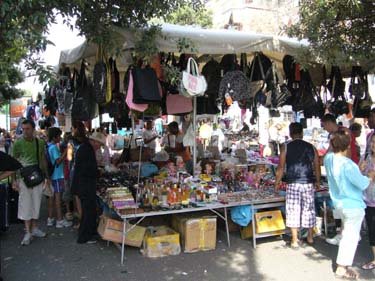
Here is a stall at the mini-flea-market outside Tiburtina:

Tuesday, July 04, 2006

Happy Birthday America

It's 4th of July, hope you are enjoying a sunny day outside, perhaps a picnic or a barbecue, finishing up with sweet watermelon and fireworks!

Monday, July 03, 2006

Anwar Choudhury on Mirror Talk Show Tomorrow

Just a quick note, my better half Sonia will interview the British High Commissioner Anwar Choudhury on the Mirror Talk Show on Bangladeshi TV Channel I. At 6:20pm BDT, 1:20PM UK, and 5:20 am California.

Wednesday, June 21, 2006

Web 2.0 article

On the emergence of Web 2.0 and how Bd can play in this:

http://www.thedailystar.net/2006/06/19/d606190901122.htm

Tuesday, June 20, 2006

Queue Manners

I am out of the country at the moment, so please accept my apologies for the infrequent blog postings.

At ZIA, as I was standing in (a long) line at the gate for the final security check, for a split second there was a 2-feet gap between me and my family, and mysteriously this man had sneaked into the gap. When I asked him how he had gotten into the line between me and my family, without saying a word he looked down, turned around and quickly walked to the back of the line. I was thinking this is Bangladesh.

Well guess what, I was at the MacDonald's in Dubai airport, in line to buy breakfast, when - again, my attention had travelled for a couple of seconds - these two Arabic looking guys popped into the line ahead of me. When I asked them how did you guys get here they started saying loudly their flight leaves soon, what was the problem, where was I from, etc, in Arabic accents. I calmly but firmly told them there was a line here, they need to go to the back of the line and it was none of their business where I was from. They backed off. Shokter Bhokto Noromer Jom.

Final incident: near Mont Blanc, France, waiting at a train station to visit Glacier caves, we thought we were in line when a huge mass of europeans enter the same area, and get in front of us, bypassing us on the right. They were East Europeans, I think. Well, I was thinking, I am from Bangladesh and I know how to play this game! So I led my companions to bypass them on the left and were some of the first to get on the train!

It was a good lesson. I will still get irritated whenever I see Bangladeshis jump queue, but at least I will remember they are not the only ones.

oh, btw, the guys in Dubai? When we left McD's after eating a leisurely breakfast, they were still chomping away. So much for the late for the flight excuse.

Friday, June 09, 2006

Unusual Agro Products

Agriculture is a thriving sector in Bangladesh. I have heard of some unusual agricultural products, including jackfruit seeds exported to Japan, and a syrup made from "Khejurer Rosh" - the sweet fluid extracted from Date trees.

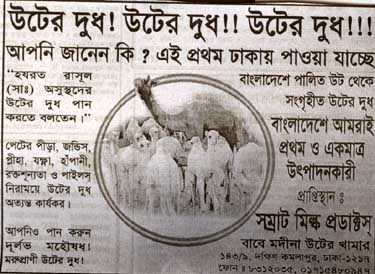
Here is another one that was advertised in the paper yesterday - locally produced camel milk! (or is it !!!)

Wednesday, June 07, 2006

Personal Space

Because of a sudden downpour at the usual time - 7am - I was late going for my morning run today. When I reached the park at 8:10, I found it empty. Instead of sharing this park with dozens of others - mostly walkers - I had the whole place to myself.

I found myself wondering why this was so. Had the numerous people who walked here every morning, as early as 6am, been scared off by the rain? Were they all busily getting ready for another day at the battlefields of work? Did they decide to forego the Park authority's stern advice, spelled out in bold letters at vantage points throughout the park: the crisp "Health is Wealth", the common-sensical "Of all exercises, Walking is best" and the logic-defying "All the wealth you accumulate has to be shared with others, but your health is for your own enjoyment only."

But here is the weird part. Instead of being pleased that I had this small but open place to myself, I was actually missing those people! I realized that I was learning to become a Bangladeshi again, and that my notion of personal space - once so important to me when I was in the US - was slowly eroding.

Whether or not you agree with Sartre that existence precedes essence, you have to agree that an important essence of being Bangladeshi is making do with tiny amounts of space: an inevitable side-effect of 130 million people sharing a land smaller than Wisconsin. From the moment a person is born, to their deathbed, they must cope and thrive while surrounded by people.

You can call it "making do" with small space - or you can say that they are violating my personal space. It really does not matter. The point is that Bangladeshis deal with this issue heroically every day. But this same heroics can drive foreigners to distraction. Some days I marvel at the heroics, other days I want to pull my hair out.

I marvel at the way a romantic couple makes the long walk up to one of the large flyovers in the city, because there are no pedestrians on top, and they think they are alone on top of the world. I marvel at gaggles of schoolchildren, or the streams of garment workers who flutter out like so many butterflies from their institutions. I marvel at the way shopkeepers at the Bazaar who manage to keep track of the orders of all the customers who are never in line and always crowding them. I marvel at the way that drivers, rickshaw pullers and bicyclists all share the road, sometimes getting in each others' way, always navigating through whatever tiny space they can find, but never losing their cool. And I marvel at the traffic policemen who, despite all the crazy traffic, keep on directing traffic to reduce jams and get people to where they are going. (Well, most of the time. Sometimes the traffic cops seem asleep or just stand there without doing anything.)

I pull my hair out when the Bangladeshi passenger contingent on a flight to Middle East, upon hearing the announcement, rushes to the gate as one monolithic mass, almost trampling each other and small children in their hurry to board the plane. Is the plane going to take off without them? Once inside the plane, when I am standing on the aisle placing the bags on the overhead, why must they push and shove past me instead of giving me 5 seconds to sit down and get out of their way? When I am at a crowded place, such as a Bazaar, I pull my hair out when I am pushed, shoved, stepped upon and sometimes even poked by umbrellas. But no one else seems to mind this kind of behavior - whether on sending or receiving end - it seems they grew up with it and know no better.

Encroachment on personal space goes beyond the physical. What about the intense stares one receives on the road or public space, specially if one is foreign or female (or both?) And at the workspace, instead of delegating work and letting employees complete it in their own intellectual space, we Bangladeshis love to butt in and micromanage. When someone falls sick, every well-wisher has a recommendation for this medicine and that doctor.

So there you have it. For better or worse, to be a Bangladeshi means learning to make do with very little personal space. And it looks like I am getting used to it, even as I enjoy a morning run.

Another Dream Project

I was brainstorming with some brilliant ex-BUET engineers in Dallas and this idea came to us:

1. Pick 10 enterprising and resourceful kids from final year CSE (the self-starter types rather than good-in-the-exam types). This is the critical step. They must be willing and able to read reams of code and figure out how a software is working.

2. Give each a cubicle and a Internet-connected computer.

3. Point them to sourceforge and other open source repositories.

4. Tell them they have 12 months, during which they will get paid, to build whatever they want using open source code. Of course they must show up every day and work on their project.

Who knows, something interesting may come out of this. Cost? Maybe 25-35 lac?

Submarine Cable

Apparently 23 ISPs are now connected to the submarine cable. My ISP, Grameen Cybernet, claims to be connected. However, I am seeing virtually no difference in my browser and download performance. I measured 27kbps download and 55 kbps upload speeds today. According to my service level I should be getting (pre-submarine) 32 down and 16 up (which, to be fair, I almost never got in reality, so things have gotten ever so slightly better.)

Grameen Cybernet also told me about issues related to how BTTB is allocating bandwidth to ISPs.

Be still my beating heart.

:-(

Sunday, June 04, 2006

Bangladesh: The Sleeping Beauty

Nice article in The Independent of UK:

http://travel.independent.co.uk/asia/article355274.ece

"... We reflected on why so little had been done to preserve the country's heritage."

Yes indeed.

Thursday, June 01, 2006

The Sweet Month

It is the middle of the Bengali month JoisTha, also known as the "modhu" month. "Modhu" means honey in Bengali.

So why is JoisTha the sweet month? Because our favorite fruits have ripened.

Sweet, fragrant lychees are in full swing. Of the many varieties floating around, I have tried three. The "deshi" ones have slightly fatter seeds and thinner layer of flesh around it. The "bombay" ones have thinner seeds but just as juicy - the preferred way to get these is to "book" a tree in Rajshahi and then share it amongst a group. Someone from work had done this and so I got a few hundred. The third variety I tried was much bigger than the other two with larger grains on them. This one was also delicious.

Another fruit that I did not taste in many years has also ripened - Jaam. These black ovals have an intense sweet-tangy taste and are extremely refreshing. The best way to eat them is to smash them up with some salt which softens the tang. Black outside and purple inside, Jaams tasted just as good as they had years ago.

KaThaals - Jackfruits - have also started arriving in the markets. Two main kinds - the soft, chewy kernels and the crunchy kernels (Khaja KaThaal) - have their own fanatical followings.

And the king of them all, mangoes - the early varieties from Rajshahi are available, including Gopalbhog, but the sublime Lengra is not here yet. Maybe in a couple of weeks...

(I do miss the California summer fruits, specially the incredibly sweet white nectarines and babcock peaches bought from farmer's markets - the grocery store ones were no good.)